



Image courtesy of ADI
Clear vision matters. But what follows is just as critical.
Not long ago, simply getting a robot to travel from one location to another was considered a success. Those days are gone. Modern robots must move at higher speeds, function in ever-changing surroundings, and handle a growing number of obstacles in their path. With these rising expectations, vision systems have become essential for both navigation and spatial understanding.
“The primary hurdle today isn’t just about image clarity,” says Stephen Liu, robotics lead at embedded systems developer Advantech. “It’s about orchestrating the entire system. As the number of sensors increases, robotics teams must juggle bandwidth, latency, synchronization, and processing power simultaneously.”
These platforms process enormous volumes of data on the fly, and when interfaces can’t keep up with data flow, perception becomes unreliable. Sensor fusion also hinges on exact timing—even slight misalignment between cameras, lidar units, and inertial measurement units can reduce navigational precision.
“Robots don’t simply observe their surroundings—they must make decisions and react in an instant,” Liu notes. “Coordinating the GPU, microprocessors, and real-time operating system is essential to achieving that kind of predictable, reliable performance.”
In tough operational settings, these challenges intensify. Robots need to sustain performance despite vibrations, dust exposure, moisture, and temperature extremes, all while fitting cables into increasingly tight form factors.
“Longer cable runs put more strain on connectors, and electrostatic discharge becomes a bigger issue to manage,” Liu explains. “Stable synchronized video feeds and long-range signal transmission are critical, especially in rugged applications.”
One technology gaining widespread traction across the robotics industry to address these vision system demands is GMSL.
“GMSL is transforming multi-camera robot design,” Liu says. “It delivers high-speed video, control commands, and timing synchronization through a single lightweight cable—reliably and with minimal delay. This significantly cuts down wiring complexity, boosts electromagnetic interference resilience, and enables precise hardware-level synchronization. From a design standpoint, the whole system becomes much simpler to implement.”

Image courtesy of ADI
These same architectures have been a staple in automotive systems for years. As the GMSL technology ecosystem has evolved, those design principles have naturally carried over into robotics.
“The crossover is quite seamless,” Liu explains. “Automotive platforms like ADAS and autonomous driving already tackled many of the same engineering challenges robotics confronts now—multiple synchronized cameras, extended cable runs, demanding environments. Robots deployed in warehouses, agricultural fields, or urban streets operate much like vehicles. They travel fast, endure long operating hours, and simply can’t afford lapses in perception. By bringing automotive-proven GMSL technology into robotics, teams benefit from field-tested durability, consistent low-latency performance, and seamless scalability.”
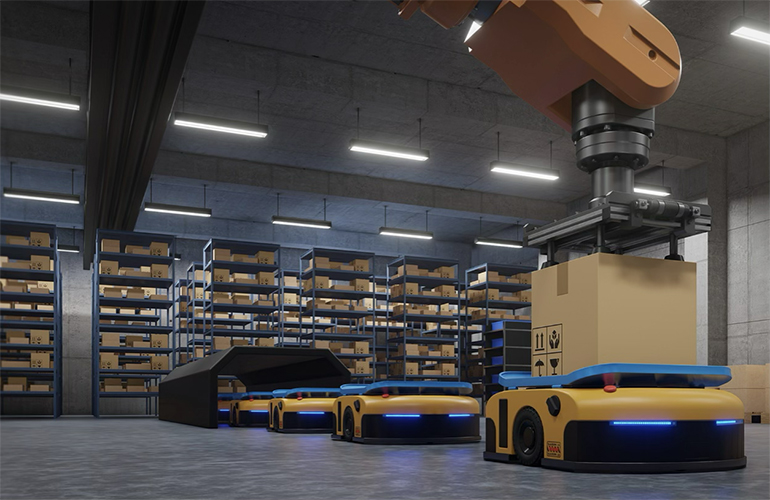
These deployments have moved well beyond the prototype stage—many robots already depend on GMSL in live production environments. Roughly one-third of the robotics projects Liu oversees are either actively using or evaluating GMSL cameras. After gaining a strong foothold in warehouse autonomous mobile robots (AMRs), the technology is rapidly expanding into humanoid robots and automated picking stations, with growing uptake in agriculture and select healthcare use cases. On construction sites, robotic systems are being deployed to enhance safety and productivity around heavy machinery.
ADI has built a mature GMSL ecosystem that accelerates the journey from concept to deployment. Rather than spending months wrestling with low-level camera integration and driver setup, teams can begin with pre-validated camera modules, adapters, board support packages, and ROS-compatible platforms. This means faster prototyping, reduced integration risk, and a smoother transition from proof-of-concept to large-scale production.
“Robotics teams can direct their energy toward what truly sets them apart—AI models, autonomy capabilities, application-specific logic, and deployment strategies—rather than rebuilding the sensing foundation from scratch,” Liu says.
For startups, incubators, and innovators, speed and flexibility are often decisive factors. In a robotics market where getting to market quickly can feel like a sprint, strategic partnerships and ready-made solutions offer a major advantage. Without them, many developers would struggle to deliver products on schedule.
“Our goal is to bring GMSL camera technology within reach of small and medium-sized robotics developers who operate with low volumes and high product variety,” Liu says.
Computing power is another key factor. Typically, extensive low-level configuration and custom coding are involved, along with various AI software development kits and tools to fine-tune system performance. This work demands deep expertise in both camera hardware and computing platforms. Advantech supports customers in implementing GMSL cameras across platforms from Intel and Qualcomm to NVIDIA, where each system presents its own unique considerations.
“We see a clear opportunity for ADI and Advantech to play an even greater role in streamlining and speeding up these computing and camera integrations,” Liu says. “Ultimately, customers expect a fully functional, plug-and-play solution that includes both the computing hardware and the camera system.”
To learn more about ADI’s GMSL ecosystem, visit
To learn more about Advantech’s solutions, visit
Sponsored content by Analog Devices
