



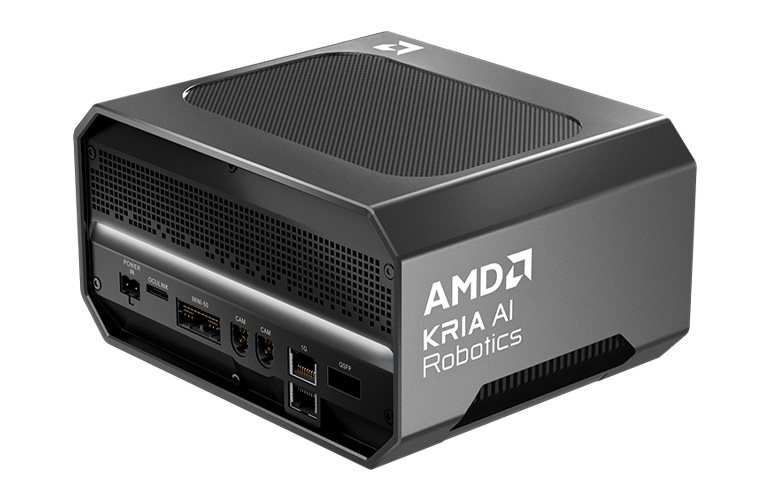
**AMD’s Kria AI Robotics Platform: A New Contender in the Robot Hardware Race**
Advanced Micro Devices Inc. is making a full-stack push into the robotics market with its new Ryzen AI Embedded X100 series processors and the accompanying Kria AI Robotics platform. Designed to deliver deterministic real-time control and unified CPU–GPU–NPU memory, AMD is positioning its new stack as a high-performance alternative to existing solutions. The company claims the platform can outperform competitors like NVIDIA’s Orin and Thor on key system-level robotics workloads.
At the core of the announcement is a unified memory architecture intended to cut down on data-copy bottlenecks. AMD says this is critical for demanding tasks such as perception, sensor fusion, and motion planning. The X100 family targets both “firm” and “hard” real-time control scenarios, supported by Linux and BIOS optimizations, advanced quality-of-service (QoS) features, and Zen-based virtualization.
The Kira AI Robotics platform builds on this silicon with a system-on-module, a development kit, and an open software stack. According to AMD, the hardware and software combination supports a wide range of applications, from industrial manipulators and autonomous mobile robots to humanoid platforms.
—
### A Direct Challenge to NVIDIA
NVIDIA currently dominates the physical AI chip market, and AMD’s latest offering is explicitly designed to compete. Rob Bauer, senior director of product management at AMD, described the X100 architecture as a “shot across the bow” of NVIDIA’s dominance in signal-processing and AI workloads for robotics.
Performance claims are ambitious. AMD states that the Kria AI System-on-Module delivers 3.4× better real-time performance compared to the NVIDIA Thor T5000, along with 1.6× spare compute capacity and 2.3× more agentic AI capacity. These figures are aimed at high-end segments such as aerospace, defense, and industrial automation.
—
### Open Standards and a Partner-Driven Approach
One of the distinguishing features of the Kria platform is its adherence to open standards. Instead of using a proprietary module format, AMD has adopted COM-HPC, an industry-standard form factor. The company says this approach prevents vendor lock-in and allows other manufacturers to design compatible systems.
Developers will also find support for ROS 2 and Nav2 acceleration, with a focus on deterministic control and seamless integration into existing robotics workflows. The ROCm software stack provides a unified AI development environment that extends from the cloud to the edge.
AMD is further bolstering its ecosystem through a curated Robotics Partner Network that includes software providers like Open Robotics and OpenCV, as well as sensor and manufacturing partners. Early deployments include systems from Castec International and Foundation Robotics.
—
### FAQ
**What is the AMD Ryzen AI Embedded X100 series?**
It is a family of system-on-a-chip (SoC) processors designed specifically for embedded AI and robotics applications. It features a unified CPU–GPU–NPU architecture and is optimized for real-time performance and dense AI workloads.
**What does “unified memory” mean in the X100 architecture?**
Unified memory allows the CPU, GPU, and NPU to access the same memory pool without copying data between separate address spaces. This reduces latency and improves efficiency for tasks such as sensor fusion and AI inference.
**How does the Kria AI SoM differ from consumer Ryzen products?**
The Kria module and X100 processors are engineered for industrial and robotics use. They offer extended reliability, burn-in testing, higher-quality control, and fit rates required in commercial and industrial deployments.
**What real-time performance claims does AMD make?**
AMD reports that the Kria AI SOM achieves control-loop closure in 1.5 microseconds and delivers significantly better latency and determinism compared to conventional CPU-plus-GPU setups.
**Which software frameworks does the platform support?**
The platform supports ROS 2, Nav2, and AMD’s ROCm stack, enabling compatibility with common robotics toolchains and AI frameworks.
**Who are some early customers of the Kria platform?**
Early adopters include Castec International for semiconductor-fab autonomous mobile robots and Foundation Robotics for humanoid robot development.
—
### Conclusion
AMD’s entry into the robotics hardware space represents a significant shift from its traditional PC and data center focus. By combining a unified memory architecture, real-time optimizations, and an open-standard module design, the company is offering robot builders a credible alternative to established players. With a strong software stack and a growing partner ecosystem, the Kria platform could reshape the economics and capabilities of robotic systems across industrial, commercial, and research applications.
