



# Autonomous Delivery Robots: How Robot.com Scaled Sidewalk Operations with Sodexo
**A landmark multi-year partnership is pushing autonomous delivery robots from niche pilots into large-scale commercial reality.**
An autonomous robotics company has entered into a landmark seven-year commercial agreement with Sodexo Group, one of the world’s largest facility management and services companies. The partnership builds on a relationship that began over four years ago and has steadily expanded across college campuses in North America.
The deal represents what the robotics company calls its single largest enterprise deployment to date. It also highlights a growing trend among major service organizations: the willingness to commit long-term to robotic solutions as a response to persistent workforce challenges.
## Overcoming Labor Shortages Through Automation
Labor shortages remain one of the most pressing obstacles for service-oriented businesses worldwide. Sodexo, which employs hundreds of thousands of people across the globe, has been no exception to this challenge. The company’s difficulty in filling open positions created an opening for robotic solutions that could supplement its workforce without sacrificing service quality.
“Large enterprises like Sodexo are facing real constraints when it comes to filling roles,” said the co-founder and CEO of the robotics company. “The partnership grew naturally as both sides learned what it takes to deploy robotics effectively in live environments.”
The CEO emphasized that long-term contracts of this nature are rare in the robotics industry. They require both parties to develop trust, refine operational procedures, and demonstrate consistent value over time. The fact that Sodexo committed to a seven-year term signals a strong vote of confidence in the technology.
## The Role of Remi: A Platform That Drives Economics
At the heart of the company’s ability to operate at scale is a proprietary platform called Remi, short for “robot implementation intelligence.” The platform has been in development for nearly a decade and combines classical robotics hardware with third-party software and advanced advertising technology.
Remi allows the company to optimize the cost of deploying and maintaining fleets of delivery robots while simultaneously creating additional revenue streams through integrated advertising. Rather than relying solely on delivery fees, the platform enables robot operators to monetize the screens and sensors embedded in their machines.
By using Remi, the company has been able to improve the financial model for campus-based delivery beyond what was previously thought possible. The platform also simplifies the process of rolling out robots across diverse locations, ensuring consistency regardless of the environment.
## The R-Dog: A Versatile Addition to the Fleet
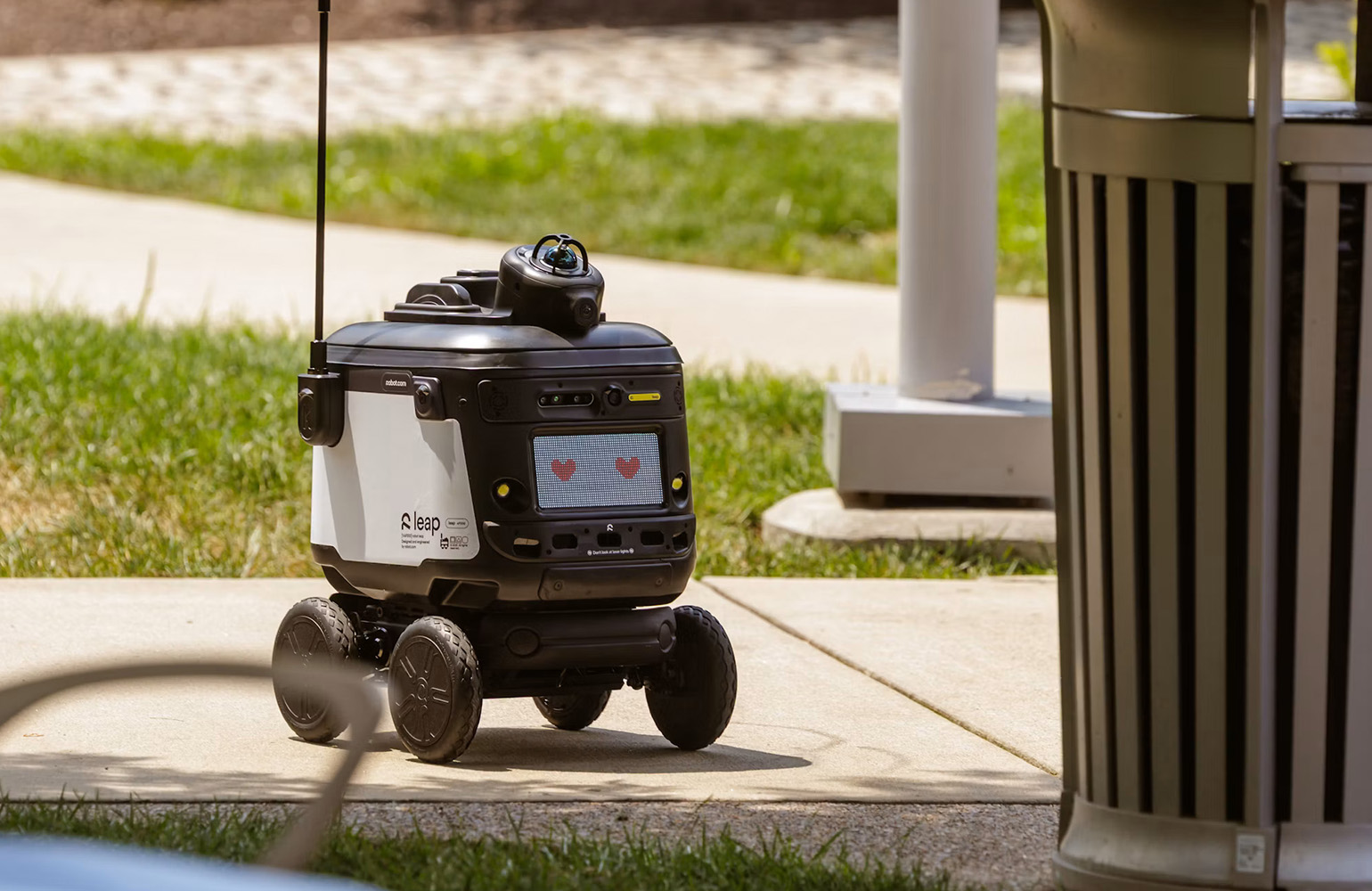
While the company’s signature wheeled delivery robot has become a familiar sight on sidewalks and campuses, it recently announced plans to expand its portfolio with a new quadruped robot called the R-Dog. Unlike most delivery robots on the market, which require recipients to physically open the unit and retrieve their items, the R-Dog is capable of placing packages directly at a customer’s location.
This capability opens the door to a wider variety of deliveries, including items that are fragile or require careful handling. The R-Dog also holds a key advantage when it comes to accessibility: it can navigate stairs and enter autonomous vehicles without any modifications to those vehicles.
The quadruped design gives the R-Dog a level of mobility that wheeled systems simply cannot match, making it well-suited for urban environments where sidewalks, curbs, and other obstacles are common.
## Safety and Support at Scale
Operating more than 500 delivery robots across multiple locations presents significant logistical challenges, particularly when it comes to safety. The company takes a layered approach to robot management, incorporating on-site attention, teleoperation, and AI-driven monitoring systems.
To address the safety requirements of increasingly complex deployments, the company has established partnerships with two leading artificial intelligence firms known for their work on robotic perception and autonomous decision-making. These collaborations ensure that new robot embodiments can meet the highest safety standards before being placed in public-facing environments.
## From Sidewalks to Industrial Settings
What started as an experiment in college campus food delivery is now serving as a foundation for broader industrial applications. Because the company has already solved many of the core challenges associated with outdoor autonomous navigation, transitioning to industrial use cases is expected to be considerably smoother.
Industrial environments typically offer more reliable connectivity and more controlled conditions than city sidewalks. The company believes its fleet operations experience and the Remi platform will translate directly into these new settings.
In addition to industrial robots, the company has introduced a humanoid platform called R-noid, which features a wheeled base and two functional arms. Rather than selling it as a standalone product, the company plans to sell it to the same customer base it already serves with its delivery robots, using the existing relationship to build familiarity and trust.
For now, wheeled platforms remain the preferred choice due to their cost-effectiveness, reliability, and the superior economics they offer to customers. The company carefully tracks the operational hours of every robot it deploys and uses that data to make informed decisions about where legs might eventually make sense.
## Growing Operational Ambitions
The company says it has already generated a significant volume of operational hours in the first half of the current year, and it has set an ambitious target of reaching one million operational hours annually in the near future. That goal would represent a dramatic scaling of the business and underscore the commercial viability of autonomous sidewalk delivery at scale.
—
### Frequently Asked Questions
**What is Robot.com, and what does the company do?**
Robot.com is a robotics company that designs and operates autonomous delivery robots for sidewalk and campus environments. Founded in 2017, the company has developed both wheeled and quadruped robots for commercial use and has deployed hundreds of units across North America and beyond.
**What is Remi?**
Remi is the company’s proprietary robot implementation intelligence platform. It combines robotics hardware with third-party software and advertising technology to optimize the economics of large-scale robot deployments. Remi is designed to lower operational costs and create additional revenue streams through integrated advertising.
**Why are college campuses a good testing ground for delivery robots?**
College campuses offer a controlled outdoor environment with enough pedestrian activity to test delivery operations without the complexity and unpredictability of dense urban streets. This makes them an ideal staging ground for refining robotic systems before moving on to more challenging settings.
**What makes the R-Dog different from other delivery robots?**
The R-Dog is a quadruped robot capable of placing packages directly at a customer’s door rather than requiring the recipient to retrieve items from the machine. It can also navigate stairs and board autonomous vehicles without requiring modifications to the vehicles, giving it greater versatility than wheeled alternatives.
**Who are the company’s safety partners?**
The company has partnered with Field AI and Physical Intelligence, two AI firms known for their expertise in robotic perception and autonomy. These partnerships help ensure that new robot platforms meet rigorous safety standards before being deployed in public-facing environments.
**What is the significance of the Sodexo partnership?**
The seven-year agreement with Sodexo is the company’s largest single enterprise deployment to date. It demonstrates that major service companies are willing to commit long-term to robotic solutions, and it validates the scalability of autonomous delivery in real-world commercial settings.
**What are the company’s long-term goals?**
Beyond expanding sidewalk delivery operations, the company aims to move into industrial automation and urban logistics. It has introduced a humanoid platform, R-noid, and plans to eventually deploy additional robot embodiments as the economics of legged and humanoid robotics improve.
—
## Conclusion
The sustained growth of Robot.com’s partnership with Sodexo illustrates how autonomous delivery technology is maturing from an experimental concept into a commercially viable tool for enterprise service operations. By combining a robust implementation platform, a growing fleet of purpose-built robots, and strategic alliances with leading AI companies, the company is positioning itself at the forefront of a rapidly expanding market. As the technology continues to improve and operational costs decline, autonomous sidewalk delivery is poised to become an increasingly common sight in campuses, cities, and industrial settings around the world.
Thank you for reading.
