



# Axis Robotics Unveils Massive Open-Source Simulation Dataset for Franka Arm Manipulation in Physical AI
A new open-source dataset has emerged as one of the most significant contributions to the field of physical AI and robotic manipulation research. Axis Robotics released Axis Sim Dataset V1, a large-scale simulation resource built around the Franka Research 3 robotic arm, designed to accelerate the development of manipulation policies through diverse, crowd-sourced data.
## What Is Axis Sim Dataset V1?
Axis Sim Dataset V1 is a publicly available simulation dataset containing more than 50,000 human-teleoperated trajectories spanning 207 distinct manipulation tasks. These trajectories were generated across over 60,000 scene variants, all simulated on a Franka Research 3 arm. The full dataset, accompanying training code, and benchmark results are freely accessible to the research community.
The dataset was assembled using a distributed crowd of contributors who interacted with Axis’s browser-based teleoperation platform, Axis Hub. Rather than relying on a single expert team, Axis gathered demonstrations from a broad group of individuals, embracing variability and imperfection in the process. Researchers from UC Berkeley, Johns Hopkins University, the University of Michigan, and other institutions collaborated on the project.
## Why This Dataset Matters for Robotics Research
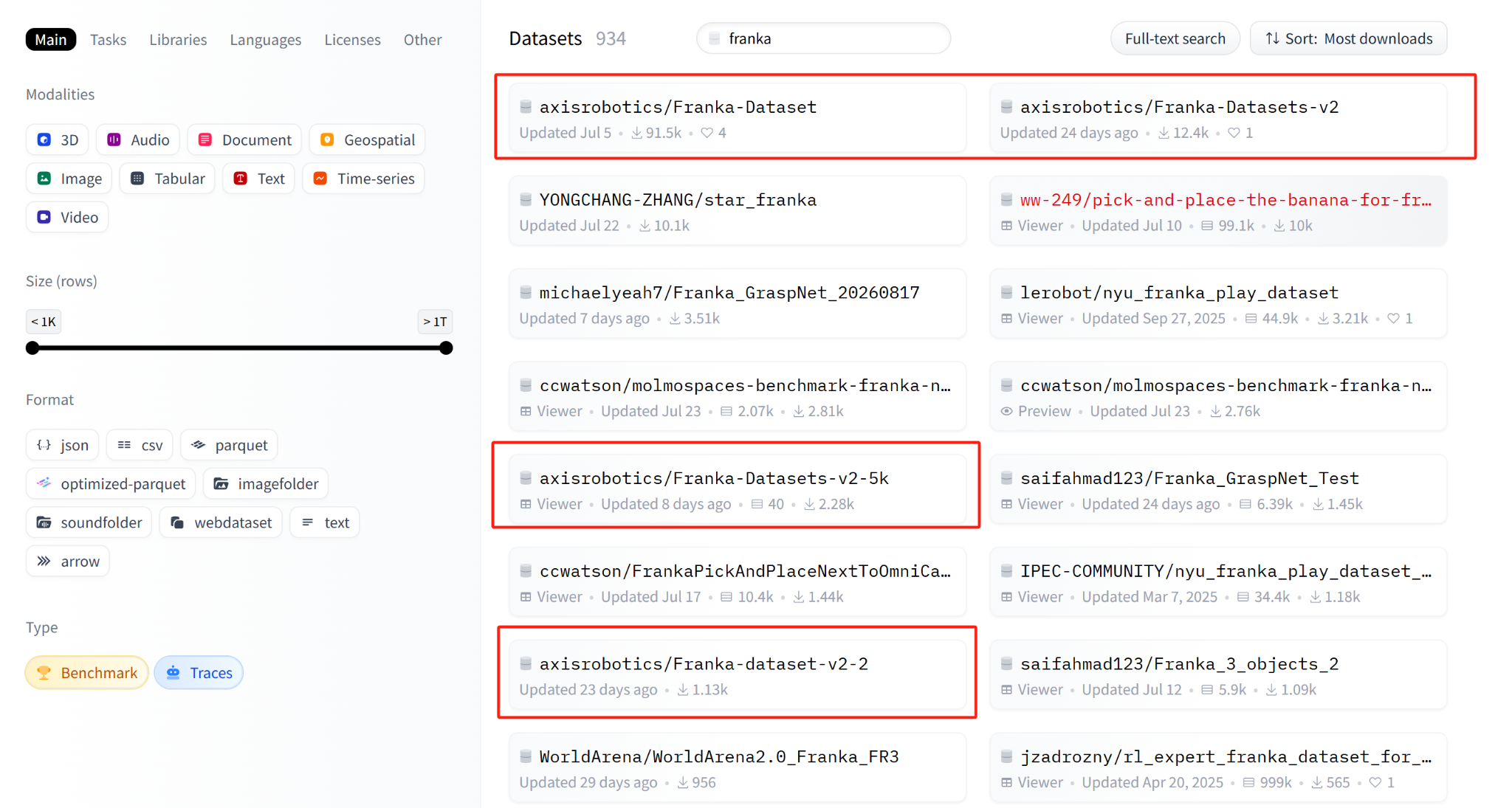
The release quickly gained traction in the research community, drawing over 160,000 downloads on Hugging Face and becoming the most downloaded open-source simulation dataset for Franka manipulation on the platform. Its impact is further validated by benchmark performance.
On the LIBERO-Plus benchmark, continual pretraining using V1 improved π0.5 success rates from 83.9% to 88.8%, outperforming a volume-matched RoboCasa365 baseline by 37.3%. Notably, performance gains increased steadily as the proportion of pretraining data grew from 25% to 100%, with no signs of plateau. The largest improvements were observed under conditions involving camera perturbation, sensor noise, and layout variation — precisely the types of randomized variations introduced during dataset generation.
## A New Philosophy: Embracing Noisy Data at Scale
Axis Robotics challenges a long-standing assumption in robotics: that training data must consist of near-optimal expert demonstrations. Their approach operates on the principle that when a sufficiently large and diverse group of contributors produces suboptimal trajectories, the uncorrelated errors tend to cancel each other out during training, allowing a robust policy to emerge.
This philosophy is reflected in how V1 was built. Tasks range from basic pick-and-place and stacking to more complex pouring, articulated-object manipulation, and tool use. All were captured through Axis Hub, a browser-based teleoperation interface designed for accessibility and broad participation.
## The Compounding Data Engine
Axis Sim Dataset V1 is just one output of a larger infrastructure Axis calls a “compounding data engine.” Unlike traditional data collection pipelines that define a fixed specification and stop, Axis uses model performance and failure cases to continuously guide what data should be collected next. Each training cycle informs the next, creating a self-improving loop.
The engine operates across four parallel data lines, all running at scale:
– **Simulation**: Over 200,000 distributed contributors on Axis Hub have produced more than 4.7 million trajectories across 13 different embodiments, making it a top contributor on the Base network.
– **Egocentric Capture**: A managed network of over 1,000 full-time, quality-controlled collectors is capturing first-person activity in real homes and businesses across 14 industries. The dataset currently exceeds 200,000 hours of footage and grows by over 4,000 hours daily, with Vicon-verified hand pose annotation.
– **Loco-Manipulation**: More than 500 hours of combined mobility and dexterity data have been collected on real humanoid platforms, including the Unitree G1 and Booster T2, using hardware-agnostic teleoperation methods.
– **Human-Gated DAgger Post-Training**: An additional 500+ hours of human-in-the-loop correction data targets deployment edge cases, enabling fine-grained policy refinement.
Every task and trajectory is recorded on-chain on Base for full provenance, and contributors are rewarded based on verified work quality.
## Looking Ahead: V2 and Beyond
Axis has already begun work on V2, which aims to scale to 1.2 million trajectories across 1,200 tasks. The next-generation dataset will emphasize cross-embodiment generalization and will be evaluated across multiple vision-language-action (VLA) models, further demonstrating that suboptimal simulation data can train robust and generalizable policies.
## From Open Data to Commercial Partnerships
While the simulation dataset is open-source, Axis also works directly with robot embodiment companies to build tailored data pipelines and model priors. As the first sim-data partner of Booster Robotics, Axis rebuilt a real workspace as a task-aligned digital twin, collected over 42,000 simulation episodes through distributed contributors, and distilled them into a Booster-specific model prior. With only 30 real-robot demonstrations, that prior achieved 87.5% success — compared to 37.5% for an out-of-the-box π0.5 baseline — while using half the real-world demonstrations.
Axis’s commercial partnerships extend across embodiment companies such as Feagine Robotics, model companies like Manycore Tech and Dexmal, and industrial automation clients including Lotus Cars and Geely Auto. The company also supplies on-chain robotics networks such as BitRobot on Solana and OpenRoboto on Bittensor.
## Funding and Team
Axis Robotics raised $12 million in seed funding led by Hack VC, with participation from Nomad Capital, Pi Network Ventures, 10K Ventures, and a group of angel investors. The company was founded by researchers from UC Berkeley, Carnegie Mellon University, Georgia Tech, and Shanghai Jiao Tong University, alongside serial entrepreneurs with experience scaling consumer platforms to over 30 million users. Their research is advised by Jiachen Li, Assistant Professor at Georgia Tech.
## Frequently Asked Questions (FAQ)
**Q1: What makes Axis Sim Dataset V1 different from other robotics datasets?**
A1: V1 is distinguished by its scale, diversity, and open philosophy. It contains over 50,000 trajectories from a distributed crowd rather than a single expert team, spanning 207 tasks across 60,000+ scene variants. Its data collection embraces variability, operating on the principle that noisy but diverse data averages out to produce robust policies. All code, benchmarks, and results are fully open and verifiable.
**Q2: What is the Franka Research 3 arm, and why is it significant?**
A2: The Franka Research 3 (FR3) is a lightweight, 7-degree-of-freedom robotic arm developed by the University of Tokyo’s JSK Lab. It is widely used in robotics research due to its dexterity, affordability relative to industrial arms, and compatibility with a range of manipulation tasks. Its popularity in the research community makes datasets built around it highly valuable.
**Q3: How does Axis Hub work?**
A3: Axis Hub is a browser-based teleoperation platform that allows distributed contributors to control simulated robotic arms through their web browsers. It provides an accessible interface for collecting human demonstrations at scale, enabling Axis to gather trajectories from over 200,000 contributors across the globe without requiring specialized hardware on the user’s end.
**Q4: What is a compounding data engine, and why is it important?**
A4: A compounding data engine continuously generates and refines data based on model performance and failure cases. Each training cycle identifies weaknesses and directs future data collection toward those areas. This closed-loop approach ensures that data production is always aligned with what the model needs next, leading to compounding improvements over time rather than static, one-time data dumps.
**Q5: Who can benefit from Axis Sim Dataset V1?**
A5: The dataset is freely available to researchers, developers, and organizations working on robotic manipulation, physical AI, and vision-language-action models. It can be used for pretraining manipulation policies, benchmarking new algorithms, studying sim-to-real transfer, and exploring continual learning strategies in robotics.
**Q6: What are vision-language-action (VLA) models?**
A6: VLA models are a class of AI systems that integrate visual perception, natural language understanding, and action execution. They allow robots to interpret high-level instructions — such as “pour the water into the cup” — and translate them into sequences of motor commands. These models are increasingly central to advancing general-purpose robotics.
**Q7: What is on-chain provenance, and why does it matter?**
A7: On-chain provenance refers to recording data lineage and contribution records directly on a blockchain. In Axis’s case, every task and trajectory is logged on the Base network, ensuring transparency, traceability, and accountability for data quality. Contributors are also rewarded based on verified work quality, creating a sustainable incentive structure.
## Conclusion
Axis Sim Dataset V1 represents a bold step forward in how robotics data is collected, shared, and used. By challenging the notion that only pristine, expert-level demonstrations are valuable, Axis has demonstrated that scale, diversity, and a closed-loop data engine can produce robust manipulation policies that outperform volume-matched alternatives. As the company scales toward V1.2 million trajectories and deepens its commercial partnerships, it is positioning itself as a foundational pillar in the evolving landscape of physical AI. For researchers and practitioners alike, this open-source release offers a powerful new resource to accelerate progress in robot learning.
Thank you for reading
