



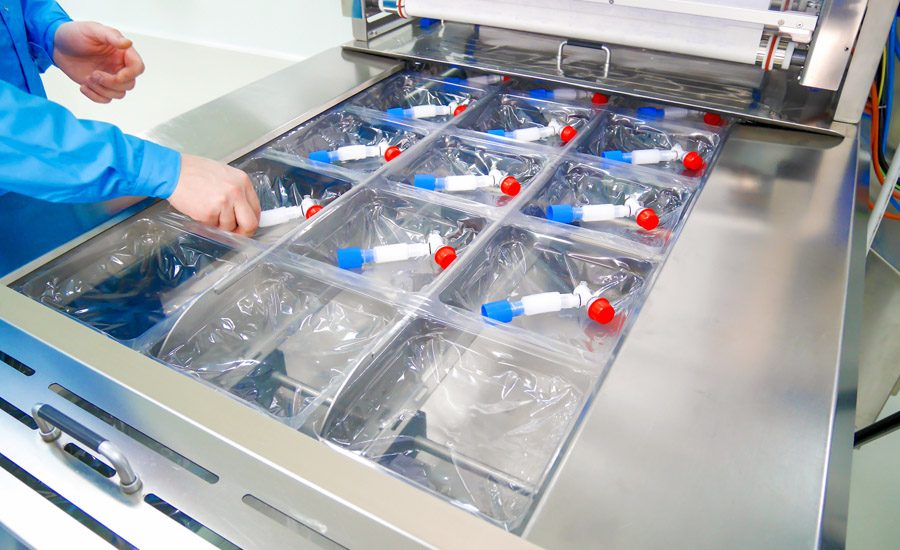
# Rethinking Terminal Sterilization in Medical Device Manufacturing: Beyond the Downstream Handoff
## Why Sterilization Timing Matters More Than Most Teams Realize
Bringing a medical device to market is a complex endeavor. Every detail matters—from the initial product architecture and packaging decisions to supplier selection, manufacturing validation, and production scheduling. But for devices that will penetrate the human body or come into contact with normally sterile tissues, there is one additional non-negotiable requirement: the product must remain sterile from the moment it leaves the manufacturing floor until it reaches the clinical setting. This is known as terminal sterilization.
Terminal sterilization occupies a unique position in the production pipeline. It happens toward the end of the manufacturing sequence, which means any disruption at this stage can reverberate backward through the entire program timeline. Despite its critical role, most device manufacturers have historically treated terminal sterilization as a downstream task—something to hand off to a specialized third party and then wait for completion.
This longstanding convention is convenient, but it carries hidden costs and risks that manufacturers would be wise to examine more closely.
—
## The Two Dominant Sterilization Methods
When it comes to eliminating microbial contamination from finished medical devices, the medical industry relies primarily on two broad categories of sterilization.
The first is ethylene oxide (EO) gas sterilization, a well-established method that works well for heat-sensitive devices and those with complex geometries or embedded electronics. The second encompasses various forms of radiation sterilization, including gamma irradiation, X-ray processing, and electron beam (e-beam) treatment. The selection between these modalities depends heavily on the device’s material composition, packaging design, and electronic content.
Regardless of which method is chosen, the traditional operating framework has remained surprisingly consistent over the decades. Once a batch of finished devices is assembled and packaged, it is shipped to large-scale sterilization facilities operated by specialist providers. These facilities manage sterilization cycles across dozens or even hundreds of different customer programs simultaneously, running at massive scale to serve the global healthcare industry.
—
## The Hidden Cost of the Traditional Model
There is no denying the value these large sterilization providers bring. They operate sophisticated equipment at industrial scale, maintain deep regulatory expertise, and offer global reach. But operating sterilization as a separate, outsourced step introduces significant operational friction that is easy to underestimate.
### Queue Times and Lack of Visibility
At high-volume sterilization facilities, a manufacturer’s finished goods may sit in a queue for weeks before the sterilization cycle even begins. Throughout this period, communication about where a particular lot stands in the process is often limited. Manufacturers are essentially flying blind, unable to predict when their inventory will be released back into the supply chain.
### Inventory and Working Capital Pressure
Uncertainty around release timing forces manufacturers to maintain significantly higher safety stock than they otherwise would need. Finished goods pile up in warehouses, consuming working capital that could be better deployed elsewhere—toward new product development, market expansion, or process improvement. Even small increases in dwell time at a sterilization facility compound across an OEM’s entire product portfolio, tying up resources in ways that are difficult to quantify until the financial impact becomes severe.
### Scheduling Fragility
An OEM is never the only customer at a sterilization facility. Scheduling is typically locked in well in advance, and options for expediting are scarce or nonexistent. When equipment malfunctions, regulatory inspections occur, capacity gets strained, or another customer experiences an urgent need, the ripple effects land directly on every manufacturer sharing that facility—with little warning and few recovery paths.
—
## A New Way of Thinking: Integrated Sterilization
What if terminal sterilization were no longer a separate handoff, but an organized phase within the broader manufacturing ecosystem?
This is the premise behind the integrated sterilization model, and it represents a meaningful shift in how device manufacturers approach the end of their production lines. Rather than treating sterilization as a service provided by an external entity, the integrated approach embeds the sterilization process within the same operational environment as assembly, packaging, and quality management.
### Benefits of Embedding Sterilization into the Production Flow
**Real-Time Visibility.** When sterilization operates under the same quality management system as upstream manufacturing, problems can be identified and addressed immediately. Cross-functional teams have direct access to process data across the entire production sequence, which dramatically reduces the coordination delays that typically surface when multiple entities are involved.
**Streamlined Workflows.** Traditional EO sterilization involves a series of disconnected steps: transportation to the facility, preconditioning, the sterilization cycle itself, aeration toremove residual gas, biological indicator incubation, release documentation, and reverse logistics. Each transfer between steps introduces potential delays and increases the complexity of tracking and validation. Integrated models consolidate these steps, reducing operational complexity and accelerating throughput.
**Faster Release Decisions.** Within an integrated environment, manufacturers may adopt validated parametric release methodologies. Instead of waiting for biological indicator incubation results—which can extend lead times significantly—release decisions are made based on proven process parameters and continuous monitoring controls. This approach shortens the time between completing sterilization and returning product to the supply chain, which in turn helps keep finished goods inventory lean.
### Practical Applications
Several contract manufacturers have already begun implementing integrated sterilization on their premises. Some facilities house EO sterilization chambers directly alongside assembly lines, using modern single-chamber systems that combine preconditioning, sterilization, and aeration into a continuous, unified workflow. These facilities also incorporate advanced emissions monitoring and abatement systems designed to meet evolving regulatory standards.
In the radiation space, gamma sterilization operations have been integrated directly into broader manufacturing campuses, allowing sterilization scheduling, production coordination, and release planning to function as a cohesive unit rather than as separate, isolated programs. Facilities are also investing in next-generation X-ray sterilization capabilities as an alternative modality that offers additional flexibility for certain device types and materials.
A unified program management approach ties all of these elements together. By applying centralized scheduling discipline and continuous workflow visibility across distributed manufacturing environments, organizations can coordinate sterilization with upstream and downstream activities in real time, rather than managing it as an afterthought.
—
## FAQ
**What types of medical devices require terminal sterilization?**
Any device that will contact a patient’s bloodstream, normally sterile tissue, or the interior of the body requires terminal sterilization. This includes surgical instruments, implantable devices, infusión systems, certain diagnostics, and any product classified as sterile by regulatory authorities.
**Why is ethylene oxide so commonly used for sterilization?**
EO sterilization is effective at low temperatures, making it compatible with heat-sensitive materials such as many plastics, electronics, and polymers. It also penetrates complex device geometries and packaged products effectively, which is why it remains the go-to method for many disposable and implantable devices.
**What is a parametric release methodology?**
Parametric release is a validated approach to confirming sterility that relies on established process parameters—such as temperature, pressure, gas concentration, and exposure time—rather than on biological indicators alone. It allows manufacturers to release finished product sooner, reducing the hold times associated with traditional biological incubation methods.
**What is the difference between irradiation and ethylene oxide sterilization?**
Irradiation (gamma, X-ray, or e-beam) uses ionizing radiation to destroy microorganisms and is well-suited for heat-stable and radiation-tolerant materials. EO sterilization uses a gas to achieve microbial kill and is better for heat-sensitive or complex devices. The choice depends on the device’s material properties, design, and packaging.
**Can integration of sterilization into the manufacturing workflow increase compliance risk?**
No—not when managed properly. In fact, integration often improves compliance by enhancing documentation traceability, enabling real-time data access, and ensuring that sterilization parameters are validated within the same quality system that governs the rest of production. The key is working with qualified facilities and maintaining rigorous validation protocols.
—
## Conclusion
The traditional model of outsourcing terminal sterilization has served the medical device industry for decades, and large specialist facilities remain essential to meeting global demand. However, as supply chain pressures mount, regulatory expectations heighten, and device complexity grows, the limitations of that model become increasingly apparent. Extended queue times, fragmented workflows, unpredictable release schedules, and excessive inventory burdens are all consequences of treating sterilization as a downstream afterthought rather than a coordinated phase of manufacturing.
The integrated approach offers a compelling alternative. By bringing sterilization activities into the same operational environment as design, assembly, and quality management, manufacturers gain transparency, reduce complexity, and shorten their path to market. This does not mean abandoning large sterilization networks—it means reconsidering whether each program benefits from keeping sterilization operationally separate in the first place.
Ultimately, the question is not about choosing one modality over another, or about pitting internal capability against external service. It is about ensuring that when and how sterilization happens is integrated into the broader manufacturing strategy—where it can deliver the greatest value for timelines, compliance, and commercial readiness.
Thank you for reading
