



**Ropedia Raises $22M to Scale Data Collection for Training Robots, Launches Wearable HOMIE Device**
Ropedia, a company building data infrastructure for physical AI, has raised $22 million in pre-Series A funding, bringing its total seed and pre-Series A capital to $30 million. The company plans to use the investment to scale its wearable head-mounted device, HOMIE, and expand its data platform, annotation tools, and AI research team.
—
### The Robotics Industry Needs Data Infrastructure
Redia’s full-stack approach to data collection and processing sets it apart from traditional data-labeling providers and teleoperation-based capture methods. Instead of relying on existing client-owned data or hardware-dependent robot systems, Ropedia focuses on high-quality, human-centric data gathered through purpose-built hardware and in-house sensor development.
According to the company, the ability to process massive amounts of data at industry-standard quality is critical to scaling robotics AI. “Delivering 1,000 hours of data is a totally different thing compared with delivering 1 million hours of data,” said Zhaoxi Chen, co-founder and CEO of Ropedia. “You need to make sure that everything is industry-level standards.”
—
### What Is HOMIE?
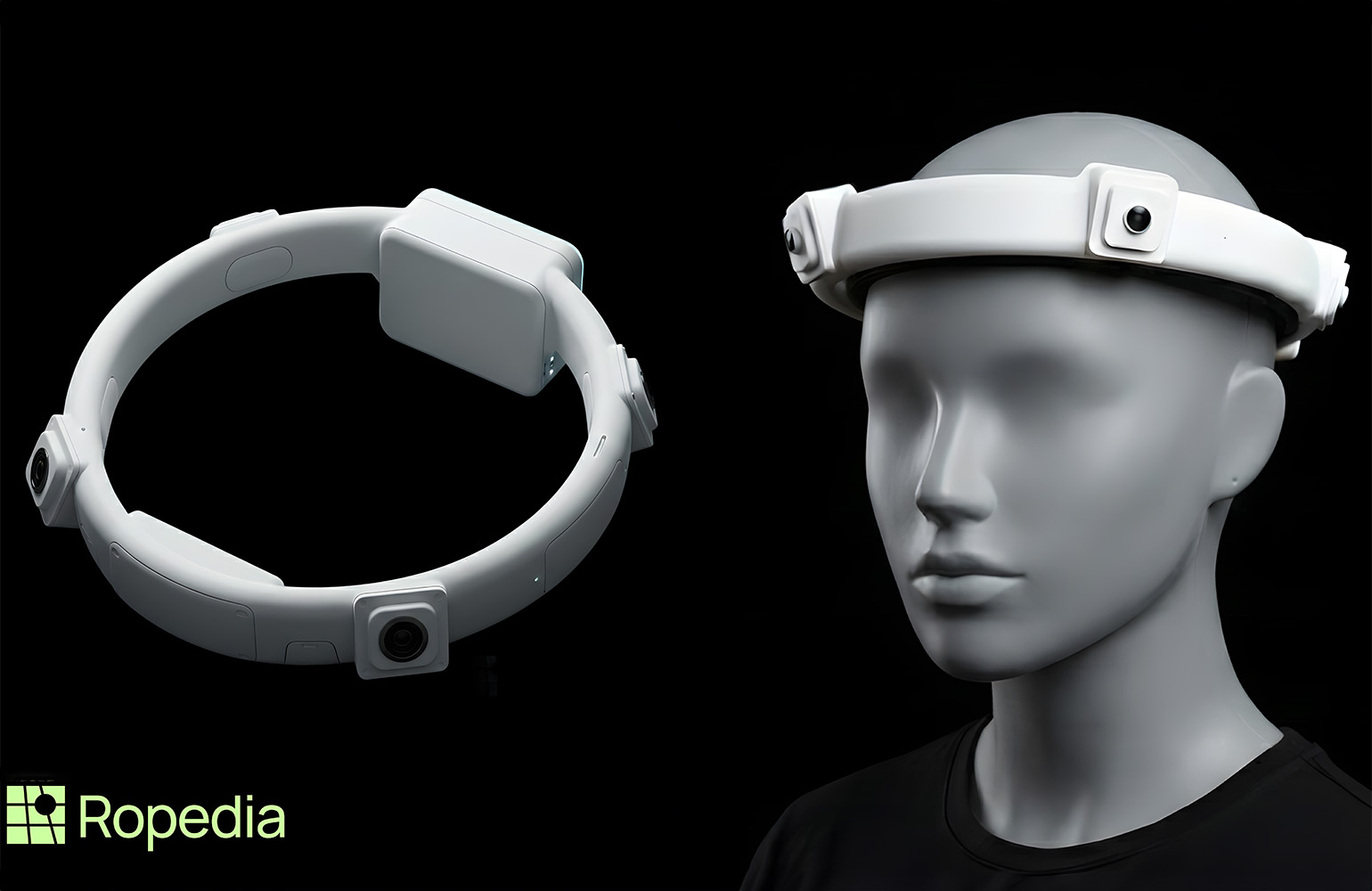
HOMIE is a lightweight, wearable device designed to capture first-person human movement, object interaction, and spatial context. It features four cameras, an audio sensor for sound source localization, and a motion unit that tracks head movement. The data collected is used to train robotics AI models using human-like learning methods—mimicking how humans acquire skills through first-person visual and sensory input.
A key innovation of HOMIE is its custom hardware integration. While Ropedia does not manufacture individual sensors like CMOS chips, it develops the overall structure, PCBAs, and hardware synchronization in-house. This design helps reduce data collection costs by up to 50 times compared to traditional methods.
—
### What Tasks Is Ropedia Targeting?
Ropedia is initially focusing on casual home environments and tasks such as housekeeping, cleaning, and interior design. The company has also partnered with a pickleball club to collect training data during gameplay. These use cases help build diverse datasets for real-world robotic applications.
Currently, Ropedia collects around 1,000 hours of data per week, with a total of 100,000 hours gathered to date. The company already provides both off-the-shelf datasets and custom data acquisition services to early customers.
—
### What Are Ropedia’s Next Steps?
Ropedia plans to expand data collection in Southeast Asia and North America, grow its U.S. team, and increase HOMIE manufacturing. The company is also developing next-generation wearable devices, including a hand-tracked device for tactile interaction and shoes that sense foot-ground interaction—both designed to synchronize with HOMIE for multi-modal data capture.
—
## FAQ
**What is Ropedia’s HOMIE device?**
HOMIE is a lightweight, wearable head-mounted device equipped with four cameras, an audio sensor, and motion tracking. It captures first-person human movement and interaction data for robotics AI training.
**What kind of data does HOMIE collect?**
HOMIE collects visual data through 360-degree cameras, audio signals, and motion tracking. This data reflects human behavior in real-world environments.
**How does Ropedia differ from traditional data-labeling companies?**
Ropedia builds its own data infrastructure, capturing and processing data in-house rather than relying on external clients or teleoperation-based systems. This allows for greater scalability and consistency.
**What tasks is Ropedia focusing on now?**
The company is currently targeting household tasks such as cleaning, housekeeping, and interior design, with plans to expand to more complex applications.
**Where are Ropedia’s offices located?**
Ropedia has offices in Singapore and Mountain View, California.
—
## Conclusion
With its new funding and wearable data-capture device, HOMIE, Ropedia is positioning itself as a key player in robotics data infrastructure. By focusing on human-first data collection and in-house hardware development, the company is addressing one of the biggest challenges facing robotics AI: acquiring high-quality, scalable data. As Ropedia expands its reach and product line, it could play a major role in accelerating the development of practical, real-world robotics applications.
