



**Table Foundation Models Decoded: TabICLv2 and the New Frontier in Tabular AI**
The landscape of tabular machine learning is undergoing a quiet revolution. For years, the default approach for almost any table-based problem has been to reach for a tuned gradient-boosted decision tree (GBDT). These models are reliable, relatively fast to train on CPU, and their performance has become a well-worn benchmark. However, a new class of models—pretrained tabular foundation models operating via in-context learning—has begun to overturn this assumption. A recent independent audit of one of the leading open models, TabICLv2, confirms that these foundation models now sit at the top of the performance frontier, outperforming even heavily optimized tree-based ensembles.
—
### What Is a Tabular Foundation Model?
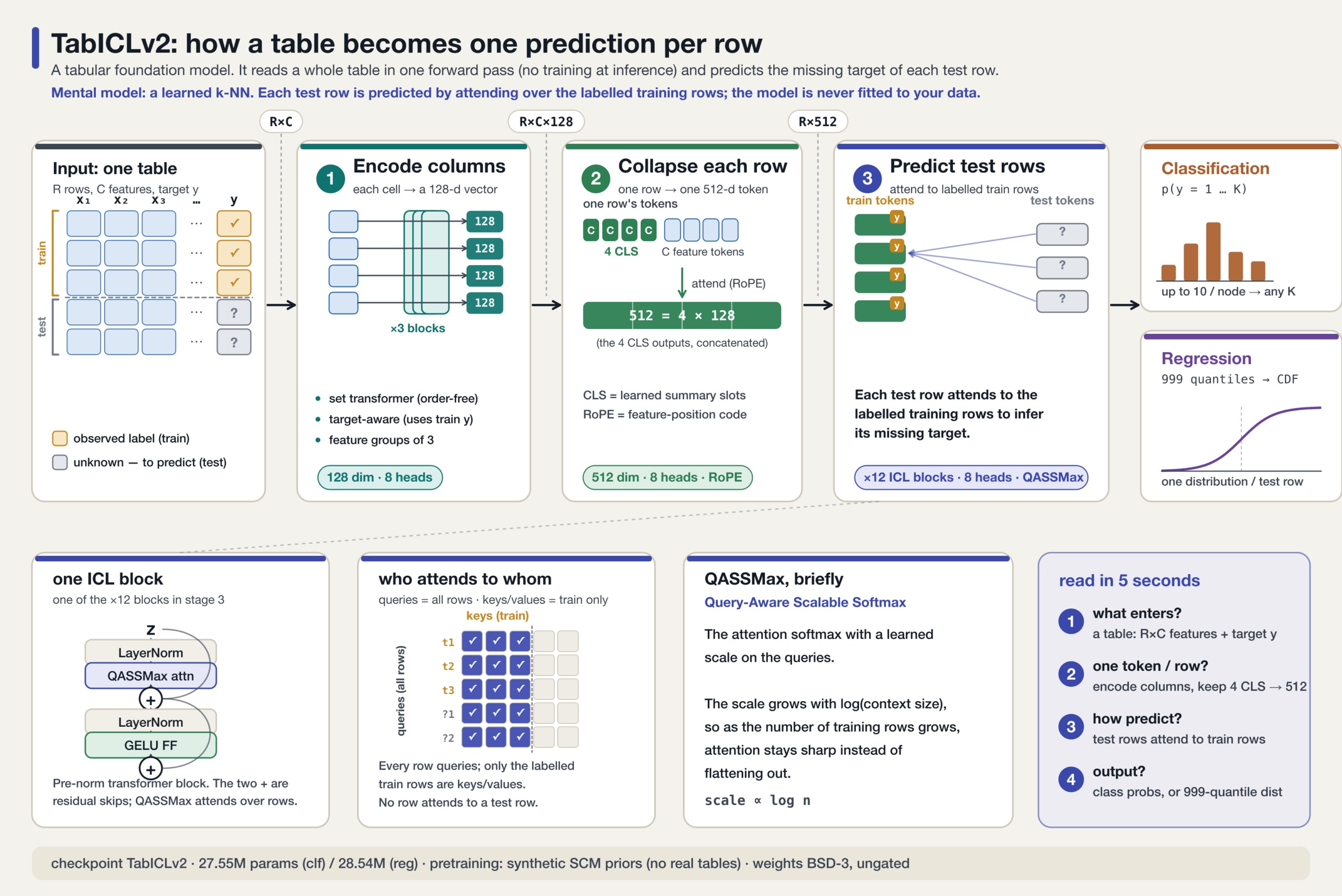
At its core, a tabular foundation model is a single, pretrained transformer that can make predictions on any table without further fine-tuning. Instead of training a model on your specific dataset, you provide the model with labeled rows as context and ask it to predict the labels for unlabeled rows. This process, known as in-context learning, involves no gradient updates or hyperparameter searches. The model attends to the provided examples, identifies structurally similar rows, and makes a prediction based on their labels.
This approach behaves similarly to a learned k-nearest neighbors algorithm, but the notion of “similarity” is learned during pretraining rather than being fixed by design. The key innovation lies in how these models are trained beforehand: they are exposed to millions of synthetic tables generated from random structural causal models. The goal is not to memorize specific data, but to learn a general procedure for understanding how features relate to a target variable.
The family of tabular foundation models has expanded rapidly, with notable contributions from Prior Labs (TabPFN), Inria’s SODA team (TabICL and TabICLv2), Layer 6 (TabDPT), and most recently, Google Research (TabFM). What unites them is a shared architectural philosophy built on transformers, designed to handle the unique properties of tabular data.
—
### What Makes TabICLv2 Special?
Among these models, TabICLv2 stands out for three defining characteristics: it is small, fully open, and highly reproducible.
TabICLv2 weighs in at approximately 28 million parameters, making it compact compared to large text-based language models. This small size is not a limitation but a design choice. Tables are inherently lower-complexity than language, and tens of millions of parameters are sufficient to capture the relevant patterns.
The model is built from three stacked transformer blocks, each serving a distinct purpose. The first transformer processes each column independently, converting raw cell values into embeddings that reflect their internal distribution. This allows the model to understand that the number “450” can represent a price in one context and a postal code in another. The second transformer aggregates row-level information by attending over column embeddings, producing a single vector representation for each row. The final transformer performs prediction in-context. It compares unlabeled test rows to labeled training rows, identifies the most similar examples, and aggregates their labels to produce a final answer. No training occurs at this stage.
For regression tasks, the model outputs 999 quantiles, providing a full predictive distribution rather than a single point estimate. These quantiles are trained using pinball loss, a technique that pushes predictions toward their correct percentile. The result is a model that not only predicts outcomes but also expresses uncertainty about them.
Perhaps the most important aspect of TabICLv2 is its openness. Its weights are publicly available under a permissive BSD-3 license, allowing anyone to download, inspect, and evaluate them. Installing and running the model is as simple as `pip install tabicl`, and it will automatically download the checkpoints on first use. This level of transparency is rare among top-performing models and is critical for independent verification.
—
### Independent Verification Confirms Performance
To ensure that the leaderboard results were not an artifact of methodology, an independent re-evaluation was conducted. Using the same Lite protocol as the TabArena benchmark, TabICLv2 was run from scratch on a single AWS A10G GPU. The results were remarkably consistent with the official scores. Across 51 datasets, median relative differences were just 0.08%, and the worst divergence was 3.5%, a gap attributable to normal GPU nondeterminism rather than methodological differences. The entire sweep, including environment setup, completed in about 2.1 hours at a cost of just over two dollars.
This verification confirmed that TabICLv2’s official Elo rating of 1575 was accurate, placing it at the top of the public board among models with unrestricted open weights.
—
### How Does It Compare to Traditional Methods?
When compared against tuned and ensembled gradient-boosted trees, the performance gap is striking. Even the best-tuned LightGBM and XGBoost configurations sit more than 150 Elo points below TabICLv2. CatBoost, known for its strong default performance, remains a competitive and cost-effective alternative, especially for CPU-based deployment. However, when raw accuracy is the goal, foundation models dominate.
It is important to note that not all problems favor foundation models. TabICLv2 struggles with very wide tables—those with over 100 features—and datasets where high-cardinality categorical variables dominate. In these cases, traditional GBDTs still hold an advantage. The model also exhibits different scaling behaviors depending on dataset size, performing best within the range for which it was pretrained.
—
### The Role of Synthetic Pretraining
All tabular foundation models discussed in this article are pretrained exclusively on synthetic data. This design choice ensures that benchmark contamination is eliminated. Because no real-world tables are used during pretraining, there is no risk of information leakage from the evaluation sets. While some newer models incorporate real data into their pretraining pipelines to squeeze out additional performance, this comes with increased epistemic uncertainty regarding data provenance and potential leakage.
—
### Decision Guidance for Practitioners
Given this landscape, how should practitioners choose a model? The following rule of thumb has emerged:
– For tables with fewer than 100 features and moderate row counts, **TabICLv2 in zero-shot mode** is the strongest option available with fully open weights and rapid deployment.
– For very wide tables or datasets with complex, high-cardinality categorical variables, **carefully tuned GBDTs** remain the safer choice.
– When maximum accuracy is required and interpretability is less critical, **ensembling multiple foundation models** can provide additional gains, though this often involves trade-offs in complexity and licensing.
—
### Conclusion
The era of automatically assuming that gradient-boosted trees are the best tool for tabular data is coming to an end. Pretabular foundation models, exemplified by TabICLv2, have demonstrated that they can surpass traditional methods across a wide range of standard benchmarks. With open weights, strong theoretical grounding, and competitive inference speed, they represent a new default for many tabular problems. While trees are not obsolete, the balance of power has shifted—and the field will never look quite the same again.
