



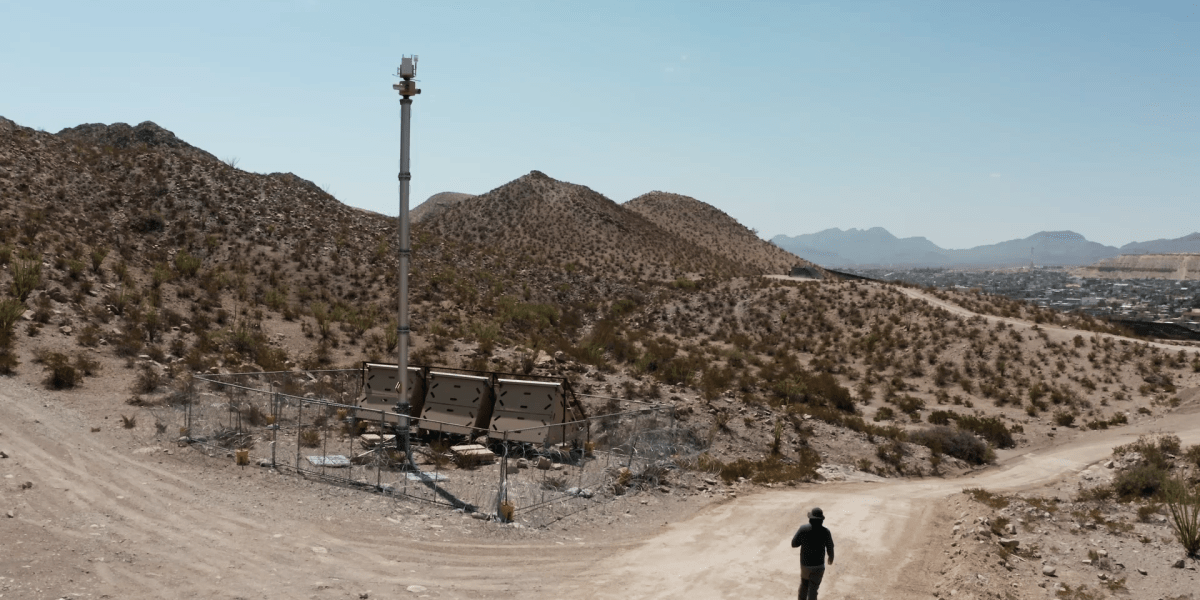
# The Surveillance Towers Along the US-Mexico Border: Technology Promises vs. Lives Lost
## When the Watchful Eye Fails
The United States has invested billions of dollars in a network of surveillance towers stretching along nearly 2,000 miles of its southern border with Mexico. Promoted as a modern, cost-effective alternative to traditional physical barriers, these towers—equipped with cameras, radar, and artificial intelligence—have been heralded by officials as tools that can detect threats, track movement, and even save lives. Yet a growing body of evidence reveals a troubling reality: the system is failing in the two most fundamental ways possible—by not detecting people in distress, and by failing to respond when it does.
The human cost is staggering. Investigative reporting has documented that between 500 and 700 people have died within range of the first-generation camera towers since 2015. Hundreds more have perished within the surveillance zones of newer, AI-powered towers. Many of these deaths occurred under the watchful gaze of equipment that was supposed to prevent them.
## A History of Escalating Investment
The push for technological border security began in earnest during the 1990s, when the government concentrated Border Patrol agents along urban crossing points. This strategy inadvertently pushed migration into remote, dangerous desert terrain, where extreme heat, lack of water, and rugged geography made crossings far more lethal. In response, authorities turned to cameras mounted on tall metal towers—structures resembling cell phone towers, standing 60 to 80 feet high.
By 2006, roughly 200 of these early camera towers had been installed at a cost exceeding $429 million. But the flaws were immediate and obvious. Agents were expected to monitor up to 30 screens simultaneously, each camera covering only three to five miles. The sheer volume of information proved overwhelming. As one former official who managed the contracting program put it, the odds of noticing a critical event on one of those screens after just 20 minutes were “about zero.”
The problem persisted for years. In a 2005 report, the Department of Homeland Security’s inspector general warned that without automated tracking, suspicious activity could “go unnoticed” unless agents were actively watching the cameras. More towers were still installed. By 2024, congressional testimony revealed that over 66% of these first-generation towers were non-functional, despite annual operating budgets of $50 million to $100 million per unit. A quarter of them remained broken as recently as early 2026.
## The Promise of AI: A New Generation of Towers
Frustrated by information overload, border officials sought a technological leap. The question was no longer simply whether cameras could see—it was whether software could do the watching for them. In 2015, the Israeli defense contractor Elbit began installing its Integrated Fixed Towers along the Arizona border. These towers used radar to detect motion and then automatically pointed cameras toward the source, covering more than five miles each.
The next leap came from Anduril, a defense technology startup founded by Palmer Luckey, the creator of Oculus VR. With backing from Silicon Valley investors and defense contractors, Anduril developed 33-foot-tall, solar-powered towers equipped with computer vision capable of classifying objects—distinguishing people from vehicles from wildlife—and generating automated alerts for Border Patrol agents.
The company’s promises were ambitious. In 2021, a Border Patrol press release claimed the technology could “save migrant lives.” A 2024 permitting request stated that “if anyone within the viewshed of the towers appears to be in distress, EMTs or first responders will be sent to help.” The government committed $6.2 billion over the lifespan of its planned 803 towers, and with unprecedented funding awarded in 2025, Customs and Border Protection (CBP) now plans to deploy 1,497 additional towers by 2034 at a cost of $1 billion—all required to be equipped with AI.
## The Fatal Gap Between Detection and Response
Despite the technological advances, deaths near the towers continued. Investigators who conducted extensive interviews with more than 45 people—current and former White House advisors, Border Patrol agents, medical examiners, sheriffs, humanitarian volunteers, and technology company employees—found that both types of system failures were occurring simultaneously. The technology was failing to detect people crossing, and agents were failing to respond even when detections did occur.
Some agents estimated that the newer towers initially missed 10% to 15% of what they should theoretically have caught. False negatives—people the systems failed to detect—were a recurring but rarely discussed problem. Smugglers quickly adapted their tactics, covering groups with tarps, netting, or blankets to fool the algorithms. In one case in Texas, a car carrying migrants crashed into the Rio Grande less than 100 feet from an Anduril tower. The occupants swam to safety on the Mexican side. The camera, which agents later reviewed, had never detected the incident at all.
Algorithm limitations also led to tragic misclassifications. Groups of people were sometimes labeled as cattle, meaning no alert was ever sent to agents. Rafts carrying up to a dozen people across the Rio Grande were detected as mere “unidentified objects”—motion without identity—so no audible alarm sounded. As one agent noted, the system’s greatest vulnerability was the gap between what the camera saw and what the AI chose to interpret as significant.
The failures were not limited to the technology. Agents described being stretched too thin to respond to alerts, particularly during peak migration periods. But even during quieter times, when encounters had plummeted to one-tenth of their peak levels and agents had more capacity, deaths near towers continued unabated.
## The Hotspot Near El Cenizo, Texas
Nowhere illustrates the paradox more starkly than the area near El Cenizo, Texas. This roughly 13-square-mile expanse of mesquite brush—surrounded by seven surveillance systems—became a hot spot for fatalities. Investigators found that 19 people died there, including one man who perished less than 500 feet from a border road and half a mile from two schools. In every case, the narratives obtained through public records requests indicated that authorities learned of the deaths only after bodies were discovered or through 911 calls reporting someone missing—not through the surveillance towers installed across the ranches.
In one heart-wrenching case, a family of three from Brazil attempted to cross the Rio Grande near Del Rio in 2022. The father carried his two-year-old daughter on his shoulder when he fell into the water. The mother, just 100 feet from one camera system and a third of a mile from two others, placed the unresponsive toddler on a rock and went for help. She was spotted only when she waved down an agent on a bridge. The toddler, Eloah, did not survive. The father’s body was found days later. The cameras had a clear view of the entire crossing site, yet the family was not detected in time.
## No Formal Accounting of Failures
Perhaps most alarming is the absence of any systematic effort to understand how many people have died in the towers’ watch and why. Former agents and officials said that when a body is found, CBP does not formally investigate whether surveillance should have detected the individual, or if it did detect them, why agents did not reach them in time. None of the officials interviewed—those who had overseen border security across four presidential administrations—could point to any comparable government analysis of the towers’ effectiveness in preventing deaths.
The lack of documentation represents a missed opportunity. Surveillance footage from these towers is overwritten every 30 days, and recordings are preserved only if they become part of an active investigation—which begins only when someone dies in CBP custody. This means that in most cases, the only evidence of what the cameras saw and when they saw it vanishes permanently.
“This surveillance could be incredibly useful,” said one humanitarian worker. “If I could get that footage, then we would go through that, and hopefully bring some answers to family members.”
## The Political Landscape
The virtual wall continues to enjoy broad political support even as evidence of its shortcomings mounts. Border security hardliners view the towers as an essential tool for stopping the flow of drugs and people. Others promote them as a cheaper alternative to a physical wall. In 2023, the government estimated its tower plans would cost $6.2 billion over their lifespan. The 2025 spending bill awarded $2.7 billion for border security technology alone, and CBP was quick to signal that billions more would flow to industry.
Yet some lawmakers have begun to push back. One congresswoman who sits on the House Homeland Security Committee called the technologies “ineffective” and “negligent,” arguing they are deployed “with no commitment to oversight or transparency.” Others have called for terminating the program entirely.
CBP’s official response has remained consistent: autonomous surveillance towers use artificial intelligence to detect and classify people, vehicles, and animals, and complement physical barriers by improving detection and situational awareness. The agency says it evaluates the technology based on its impact on detection, response coordination, agent safety, and mission outcomes.
## A System That Measures Itself as Successful
A deeper structural problem compounds the lack of oversight. The metrics used to evaluate the virtual wall’s success are malleable and open to interpretation. When apprehensions increase, CBP claims the technology is working. When apprehensions decrease, it argues the border is calmer because people are too frightened to cross. There is no standardized way to determine whether the towers are preventing deaths or simply observing them.
An external study from the RAND Corporation in 2020 found that deploying newer towers resulted in lower apprehension rates nearby, but concluded this did not necessarily prove the towers were deterring crossings. Other research suggested earlier surveillance systems actually pushed people toward more dangerous, remote routes where they were harder to detect and less likely to survive.
No procedure exists—at the local or national level—to examine individual deaths near towers or analyze them collectively for surveillance failures. When asked about this gap, former officials were blunt. “We never thought about plotting deaths to see if the towers were missing things,” one said. Another added that raising the issue “could reveal important gaps in the agency’s approach.”
## The Expanding Footprint
While questions about effectiveness persist, the expansion continues. Anduril’s towers have been sold abroad—to enforce the UK’s borders, defend US Marine Corps bases in Japan, and serve as drone defenses for an Australian Air Force base. General Dynamics, the original contractor behind the older camera systems, has now released its own AI-equipped towers and received a $115 million order from CBP. Newer entrants in the surveillance technology market are also emerging.
In October 2025, the Department of Homeland Security dissolved the office that had oversaw major spending programs—a move that means even less accountability for the billions being spent on these systems. The number of Border Patrol agents has grown to nearly 21,500, the highest in the agency’s history, but agents themselves say the persistent shortage of personnel continues to limit the towers’ practical value.
## Common Questions About Border Surveillance Towers
**What are border surveillance towers?**
Border surveillance towers are tall structures—typically 33 to 80 feet high—equipped with cameras, radar, and sensors, deployed along the US-Mexico border. They come in three main generations: the Remote Video Surveillance System (RVSS) cameras from the late 1990s, Integrated Fixed Towers (IFTs) from Elbit Systems, and the more recent autonomous surveillance towers developed by Anduril that use AI to detect and classify movement.
**How much has the government spent on these towers?**
The government has spent over $3.7 billion on the older RVSS systems alone. For the newer towers, the 2023 estimate for 803 planned units was $6.2 billion over their lifespan, with an additional $1 billion allocated for 1,497 more towers by 2034. The 2025 spending bill awarded $2.7 billion for border security technology.
**How effective are the towers at detecting people?**
Effectiveness varies dramatically based on terrain, weather, vegetation, and the specific model. In flat areas like the El Paso sector, visibility may reach 80-90% of the promised coverage area. In hilly or mountainous regions like the Otay Mountain Wilderness, coverage may drop to 15-25%. Agents estimated that newer towers initially missed 10-15% of what they should have detected. False negatives—failures to detect people entirely—remain a documented but underreported problem.
**Why do people die near towers that are supposed to save lives?**
Deaths occur due to a combination of factors: technology failures (cameras not capturing events, algorithms misclassifying people as animals or unidentified objects), agent failures (being too stretched thin to respond, or choosing not to prioritize certain alerts), and environmental factors (extreme heat, lack of water, remote terrain). In many cases, surveillance footage was never retrieved because it was overwritten before an investigation was opened.
**Does the government track deaths near these towers?**
No systematic tracking exists. There is no formal procedure to examine individual deaths near towers or analyze them collectively. CBP does not investigate whether surveillance should have detected a deceased person or why agents did not respond. The Government Accountability Office has attempted to focus on whether towers increase apprehensions, but the data collection has been inconsistent and widely regarded as unreliable.
**What happens to the surveillance footage?**
Footage and data from these towers are overwritten every 30 days. Information is preserved only if it becomes part of an active investigation, which typically begins only if someone dies in government custody. This means the vast majority of footage showing what happened before a death is permanently erased.
**Are there alternatives being discussed?**
Some lawmakers have called for terminating the autonomous surveillance tower program entirely. Others advocate for more traditional border infrastructure alongside increased personnel. Humanitarian groups argue that resources should be directed toward rescue operations and access to water rather than surveillance systems that have not demonstrated consistent effectiveness at saving lives.
## Conclusion
The story of the virtual wall is ultimately a story about the limits of technology when applied to complex human problems. Billions of dollars, thousands of towers, and cutting-edge artificial intelligence have not solved the fundamental challenge of securing nearly 2,000 miles of remote, rugged terrain. They have not prevented hundreds of deaths, and in some cases, the towers watched as people died within their field of view without anyone responding.
The deaths documented near these towers represent only the failures that left a trace. The number of people who cross undetected, and the number of bodies that remain undiscovered, may be far higher. What we know is already staggering: between 500 and 700 people have died within sight of the older camera towers since 2015, and hundreds more have perished within the zones of newer, more advanced systems.
As CBP accelerates its tower deployment plans—with AI required on every new unit—the absence of rigorous oversight, reliable metrics, or meaningful accountability measures raises profound questions. The technology has advanced significantly since the first cameras were mounted on metal poles in the Arizona desert. But the fundamental gap between what the towers promise and what they deliver has not closed.
The human cost of this gap is measured not in data points or detection rates, but in the lives that ended in open desert while the watchful eye looked on. As one analyst put it, “A system may fail, but humans suffer.” The question that remains is how many more failures the system is allowed to accumulate before the architecture itself is reconsidered.
Thank you for reading
