



# The Watchful Eye: How Border Surveillance Technology Has Failed to Prevent Migrant Deaths in Southern California
## A landscape of glass and steel, and the bodies no one came to save
She was 30 years old, a mother of three, and she had been walking for barely two hours when the desert began to reclaim her. On a September afternoon in 2025, Graciela Gómez Hernández stepped over the border wall in the rugged terrain east of San Diego, California, leaving behind her three children, her parents, and a husband who had already crossed north in search of work. Her oldest boy, just 11, had asked for a bicycle. That was the thing she was trying to give him.
Within hours, her phone went silent. Her voice messages to her mother and sister stopped mid-sentence. Two weeks later, a forensic crew arrived to collect what was left of her, and found that most of her body had already returned to the earth. She was found a little over a mile from the border wall, in one of the most heavily monitored stretches of territory on the planet.
This is the story of how modern surveillance — a sprawling web of AI-powered cameras, military-grade towers, drones, sensors, and satellites — has failed to prevent the deaths of thousands of people in the U.S.-Mexico borderlands, and what the gap between watching and saving tells us about the limits of technology in the service of human life.
—
## The tower that watched but did not save
Gómez Hernández’s final hours unfolded in a landscape that would have been difficult to navigate even for a seasoned hiker. The Otay Mountain Wilderness, just a few miles from the city of San Diego, is a tangle of sagebrush, manzanita, rocky ravines, and hidden trails that stretch for miles into the inland valleys. Temperatures can swing violently between scorching daytime heat and dangerously cold nights. Dehydration can claim a person within hours, and the terrain makes rescue efforts slow and difficult.
Surveillance towers have stood in this area since 2011, with new installations appearing regularly. The one closest to where Gómez Hernández was found — a structure built by General Dynamics and standing over 100 feet tall — was installed in 2019. It carries two sets of electro-optical and infrared cameras with lenses powerful enough to track a target from five to seven miles away. At just one mile from the point where she died, the camera should have had an unobstructed view.
Between them, more than a dozen surveillance towers now overlook different parts of the Otay Mountain Wilderness, some perched on ridgelines, others hidden in canyons and on hilltops. In total, more than 120 towers stand along the California border alone, according to documentation gathered by the Electronic Frontier Foundation. The border is additionally crisscrossed by trail cameras, underground movement detectors, radar systems, infrared sensors, drones, and even aerostats — blimp-like surveillance platforms. In March 2025, the federal government directed the Department of Defense to extend surveillance coverage to the border using military satellites.
Yet people continue to die.
—
## A pattern written in remains
A detailed analysis of border death records in California found at least 138 cases in the past four years where the remains of migrants were discovered within the nominal detection range of a surveillance camera. A separate topographical investigation determined that more than half of those individuals were in a location where a camera would have had a clear, unobstructed line of sight — with no hill, ridge, or thick vegetation blocking the view.
The people who died in these circumstances came from across the globe. Some were from Central America, others from Mexico, and some had traveled from as far away as Africa. Their ages ranged from five to seventy. They died from heat exposure, hypothermia, dehydration, and falls. They died at the foot of cameras that cost tens of millions of dollars to install and operate.
Consider a few of the cases that emerged from the records.
In July 2023, the remains of Marcia Dutra, a 36-year-old woman from Brazil, were found near a border fence. A medical examiner concluded she likely died of heat exposure. An AI-equipped surveillance tower sat approximately 2,000 feet to the northeast of where her body was found, on a plateau out of sight from the slope where she had been discovered.
In February 2024, Elvi Vasquez Bortolon, a 28-year-old Mexican man, was found dead on a ridge near the border wall after suffering from suspected hypothermia. He had been dead for more than five days before a Border Patrol agent in a helicopter noticed his body from above. A remote video tower stood roughly 1,400 feet away, concealed from view by the ridge that bordered the canyon.
In August 2024, Ramón Montenegro, a 51-year-old Mexican man, was discovered in the mountains near Dulzura, having possibly died of heatstroke. An AI surveillance tower, invisible on the other side of a hill, was located just 1,300 feet away — roughly the length of a large parking lot.
These are not cases of vast, trackless wilderness where no technology could possibly reach. These are deaths that occurred in the sightlines of machines designed to see everything.
—
## The promise of AI, the reality of the field
Surveillance tower manufacturers have positioned their products as transformative tools. Anduril, the defense contractor that produces roughly half of the towers currently installed along the southwestern border, claims that its AI-equipped systems can autonomously distinguish between border-crossers, animals, and other moving objects, and can identify hundreds of thousands of border crossings without human intervention. The company has stated that its towers “directly contributed to saving lives and stopping illicit drugs from entering the United States.”
John Morris, a Border Patrol sector chief in Arizona, told reporters at a law enforcement convention in May 2026 that surveillance capabilities were approaching total awareness: “We’re dang close to pretty much knowing everything that comes across.”
But the gap between the claims made by manufacturers and the reality on the ground appears to be substantial.
An internal memo obtained by a news outlet in October 2024 revealed that roughly 30 percent of the older-style surveillance towers — the models that require human agents to review camera footage in control rooms — were completely nonfunctional. Most were missing critical components, and the rest were running outdated equipment that could no longer operate reliably. These approximately 150 broken towers continued to stand at the border, inert and expensive monuments to a failed deployment.
Even newer, AI-equipped towers face serious challenges in the rugged terrain of the borderlands. A report from the U.S. military, published in March 2026, documented the difficulties encountered when installing G-BOSS(E) combat-grade surveillance towers in the Otay Mountain Wilderness. The towers proved vulnerable to tipping over, damage from rodents, exhaust failures, and battery depletion. On one occasion, a truck carrying a tower on a dirt road bounced so severely that the cameras became permanently stuck in a zoomed-in position, rendering them useless for wide-area monitoring.
Osvaldo Ruiz, a volunteer coordinator for the Border Angels, an organization that leaves water and supplies along migrant trails, has spent years observing the towers from the ground. He describes the Otay Mountain Wilderness as crisscrossed with “beacons throughout the mountains” that can see over wide stretches of terrain, but notes that the reality is more complicated.
“With all that surveillance that’s out in the mountains, there’s still a lot of brush and high covered areas that would make it easy to stay undercover,” Ruiz said. Hidden cameras are sometimes placed inside rocks or bushes along trails, and license plate readers are mounted on safety cones along roads. The surveillance network is dense, but not impenetrable.
—
## The deterrent that pushed people deeper into danger
Perhaps the most troubling finding from the analysis of surveillance and death is what it suggests about the behavioral effect of the technology itself.
RAND Corporation analysts, in a 2020 report, concluded that the most observable effect of surveillance towers was not the detection of migrants in real time, but rather the deterrence they created. The towers’ presence pushed people away from monitored areas and into more remote, more dangerous routes. The analysts wrote that “the likely deterrent effect on migrant crossings through surveilled areas overwhelms any boost to situational awareness” that the technology provided.
This phenomenon has only intensified in recent years. As hundreds of new towers have been installed — the federal government plans to have 2,300 towers in operation along the southwestern border by 2034, at a total cost exceeding $1.4 billion — the spaces where migrants can cross without being detected have steadily shrunk. Faced with fewer undetected routes, some migrants have begun attempting to pass directly through surveilled territory rather than circumventing it, according to advocates who work in the borderlands.
“People are doing things that to me seem terrifying or crazy,” said Bryce Peterson, a researcher with the advocacy organization No More Deaths who maps migrant deaths. “They’re trying to get from one sensor to the next really quickly, before Border Patrol shows up. It seems like people aren’t stopping to drink water. People are going really fast, often running, not being able to take the time to take care of themselves.”
Larraenza, who leads Desert Angels, a search and rescue group, has observed a related pattern. Migrants increasingly choose to cross during the hottest weeks of the year, reasoning that fewer agents will be on patrol in extreme heat — a calculation that dramatically increases the risk of fatal dehydration and heatstroke. In a September 2025 interview, he said at least two people had gone missing in the Otay Mountain Wilderness in the preceding weeks, and he had been unable to locate their remains.
“People who die in Southern California came from just across the border, or from as far away as Africa. They were as old as 70 and as young as 5. They died in the heat or the cold. But they all died within range of a surveillance camera.”
—
## The question no one is answering
When a person is found dead near a surveillance tower, there are essentially two possibilities. Either the system failed to detect that person in distress, or it detected them and no response was initiated.
In the case of Graciela Gómez Hernández, both answers are plausible — and neither has been confirmed. The Border Patrol declined to answer whether the tower visible from the site where her body was found was operational on the day she died. Anduril did not respond to questions about how its AI-equipped towers perform in the mountainous terrain of the Otay Mountain Wilderness. General Dynamics, the manufacturer of the closer tower, referred all inquiries to the Border Patrol, which also declined to comment.
Rafael Hernández Larraenza, who leads Desert Angels, has come to a blunt conclusion about some of the towers in the region: “They’re just adornment.” He says that in conversations with Border Patrol agents, the search and rescue team is regularly told that agents do not have the time or resources to conduct searches in the wilderness. “People in need of rescue are not a priority,” Peterson said.
On one occasion in September 2024, Larraenza was leading a rescue of a family of five in the Otay Mountain Wilderness when he encountered a man wearing a vest labeled “SHERIFF” on the trail. When asked whether Border Patrol would arrive to take the family into custody, the deputy responded, “Oh, they don’t come out here.”
The irony is stark. On the same hillside where Gómez Hernández died, multiple Border Patrol trucks were visible just hundreds of yards away on a recent visit, slowly patrolling the road beneath the surveillance tower. “If we hadn’t sent the Border Patrol the coordinates, they never would have bothered to go find her body,” Ortigoza said.
It is also possible that the towers did capture images of Gómez Hernández, but agents chose not to intervene. Hours before she died, she told her sister through WhatsApp that there were “police” nearby — possibly Border Patrol trucks she could see making their regular rounds below the wall. Peterson noted that Border Patrol agents frequently ignore individual migrants, even those in obvious distress, because apprehending a single person is not worth the time and resources. “They want to be able to catch a whole group of people,” he said.
—
## Why they cross
Graciela Gómez Hernández paid roughly $1,150 to smugglers to help her cross the border — far below the current average of around $10,000. But the arrangement came with a cost: she would have to navigate the terrain alone, without a guide, relying only on the smugglers’ instructions about when to start and which direction to walk. Her phone would send location pings back to the smugglers’ hideout in Tijuana as part of the deal.
She told no one in her family about her plan until the day before she left. Her husband, who had crossed north earlier to find work, had stopped sending money. “There were moments when they didn’t have enough money even for a bag of detergent, or to eat,” her sister, Irma, recalled. “She would call me crying.”
When Gómez Hernández finally reached the U.S. side on September 14, 2025, she sent voice messages to her mother and sister to let them know she had made it. She was walking through the Otay Mountain Wilderness, and by early afternoon she was already struggling. The hillside was exposed on all sides, and she could see the border wall just a few hundred yards away — and the mountains on the other side, stretching endlessly into the distance.
At around 2 p.m., she told her sister she could not continue. “I can’t do it anymore,” she whispered. By 4 p.m., her phone had stopped transmitting. Her last known position, a point barely a mile from the border, would not be discovered for weeks.
Irma believes it is possible that the other migrant Gómez Hernández was traveling with abandoned or harmed her during those final hours, because she was not moving fast enough. At one point, a man they encountered on the trail told her, “There isn’t time.” After that, Graciela’s phone continued to receive messages but she never responded.
It took Irma nearly two weeks to contact the smugglers and extract the last known GPS coordinates of her sister’s phone. “They didn’t move a single finger,” she said, until she threatened to share the smuggler’s phone number with the police.
—
## The search for the missing
Cesar Ortigoza, who leads the Armadillos search group and has been locating migrant remains in the region since 2010, receives as many as five calls a day from people looking for their missing family members at the border. The numbers of border crossings and reported deaths have decreased since the change in administration in early 2025, but the need has not disappeared. “There are still a lot of people on the other side trying to get here,” Ortigoza said. “Because the problems in their countries persist.”
After Gómez Hernández’s remains were identified through DNA testing, her family in Mexico paid over $4,000 to have her bones returned home, and a funeral was held nine months after her death. Her oldest son, who is now 12, often sits quietly and says he misses his mother.
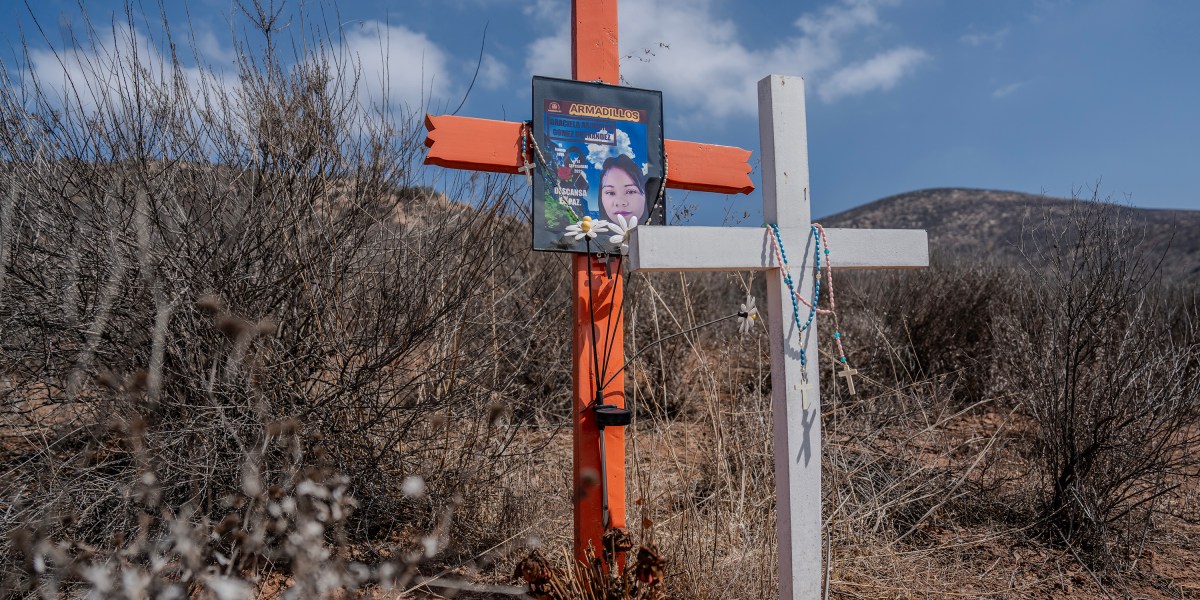
The Border Patrol gave Ortigoza and a group of volunteers permission to place a cross at the site where Gómez Hernández was found. In July, Ortigoza visited the memorial to leave flowers and played one of the voice messages Irma had sent to her sister. The voice, crackling with the quality of a WhatsApp audio file, filled the dirt hillsides where the faint outline of where her body had lain was still visible nearly a year after it was removed.
“I know that in the place you’re in, there isn’t suffering, like how you suffered here on this earth,” Irma said. “I know you left thinking about your children. I know you wanted to give them a better life. I feel you here, and I feel you alive.”
—
## What the numbers tell us
Government figures on border deaths are widely considered incomplete. Medical examiner offices in San Diego County and Imperial County have kept records for years, but the methodology for identifying border-crossing deaths has varied, and many cases of missing migrants are never matched to remains. The list of confirmed deaths is almost certainly an undercount.
Meanwhile, funding for border surveillance continues to grow. The Government Accountability Office reported in June 2026 that the Border Patrol had 803 towers already deployed across the southwestern border and planned to install 175 more. The agency expects to receive a billion dollars in funding from a major legislative package passed in 2025. By 2034, the number of towers could reach 2,300.
“This makes every single agent and officer more effective,” said the border czar at a press conference in San Diego in December 2025, describing the surveillance infrastructure.
But for the people who cross the desert with nothing but a phone battery and a desperate hope, the technology offers little more than the illusion of safety. The towers watch, the cameras record, the algorithms classify. And people continue to die in plain sight — in the line of fire of systems that were supposed to help them.
—
## Frequently Asked Questions
**What is the Otay Mountain Wilderness, and why is it significant?**
The Otay Mountain Wilderness is a rugged, mountainous area in eastern San Diego County, California, located just a few miles from the U.S.-Mexico border. It has become one of the most heavily used — and most deadly — crossing corridors for migrants entering the United States. The terrain is characterized by steep hillsides, rocky ravines, low scrub vegetation, and limited water sources. The area is blanketed with surveillance infrastructure, making it one of the most monitored landscapes in the country, yet deaths in the wilderness continue to occur at a high rate.
**How does the surveillance tower system work?**
The system consists of a network of towers equipped with electro-optical and infrared cameras, some of which are powered by artificial intelligence capable of distinguishing between humans, animals, and vehicles. Older tower models require human agents in control rooms to monitor live footage. Newer AI-equipped towers can autonomously detect and classify moving objects, alerting agents to potential border crossings. These towers are networked with other surveillance technologies including trail cameras, ground sensors, radar, drones, and aerial platforms.
**Why do migrants still die within range of surveillance cameras?**
There are several contributing factors. The terrain often blocks camera sightlines, even in areas with dense tower coverage. Many towers have been found to be nonfunctional or operating with outdated equipment. When the system does detect a person in distress, agents are frequently unable or unwilling to respond — prioritizing larger groups over individuals in need of help. Additionally, the deterrent effect of surveillance has pushed migrants onto more dangerous, more remote routes, and has led some to attempt crossings through monitored areas more quickly and with less preparation, increasing the risk of fatal dehydration and exposure.
**Who installs and operates the surveillance towers?**
The towers are manufactured by defense contracting companies including Anduril and General Dynamics, and are deployed and operated by U.S. Customs and Border Protection (CBP), the federal agency responsible for border security. The Department of Defense has also been directed to expand surveillance coverage using military satellites.
**What is being done to address the gap between surveillance and rescue?**
Advocacy organizations like No More Deaths and Border Angels continue to document deaths and provide humanitarian aid — water, food, and supplies — along known crossing routes. Search and rescue groups like Desert Angels and the Armadillos work to locate missing migrants and recover remains. However, there is currently no federally mandated system that links surveillance detection to emergency medical response for migrants in distress. The fundamental tension between enforcement and rescue has not been addressed in the current infrastructure buildout.
**How reliable are the statistics on border deaths?**
Experts widely agree that official death counts are an undercount. Many migrants who disappear in remote areas are never found, and the remains of others are never identified. Medical examiner records rely on families or acquaintances coming forward to report deaths, and cross-border communication is often severed when the person crossing lacks documentation or contacts in the United States. Additionally, different counties have used different methodologies for identifying and recording border-crossing deaths, making comprehensive national statistics difficult to compile.
**What is the stated purpose of the surveillance towers?**
According to federal officials and manufacturers, the towers are designed to enhance border security by detecting unauthorized crossings, tracking the movement of people and vehicles, and enabling faster response times from Border Patrol agents. Companies that produce the technology claim that the systems save lives by enabling quicker interventions. However, advocates and researchers argue that the evidence does not support the life-saving claims, and that the net effect has been to redirect migrants into more dangerous situations without a corresponding increase in the detection and rescue of people in distress.
—
## Conclusion
The story of Graciela Gómez Hernández is not unique. It is one of hundreds — perhaps thousands — of cases that reveal a profound disconnect between the surveillance infrastructure deployed along the U.S.-Mexico border and the human reality of the people it was ostensibly designed to protect. In a landscape where cameras can track a license plate from miles away and AI algorithms can distinguish a human figure from a coyote, the question that haunts the borderlands is not whether the technology works, but what it is actually for.
If the towers can see everything, why do people still die in their sightlines? The answer, as the evidence from the Otay Mountain Wilderness and elsewhere suggests, is that surveillance has been built to monitor and control — not to save. The machines watch, the data flows, and the people on the ground are left to navigate a gauntlet of technology that was never designed with their survival in mind.
Until the gap between watching and helping is closed, the borderlands will continue to claim lives in the shadow of unblinking lenses and spinning cameras. The technology has grown more sophisticated, more numerous, and more expensive. But for the people who cross it, the desert remains as indifferent as ever.
—
Thank you for reading
