



# Understanding TypeSafe AI’s Jev: A Closer Look at Structured Decision Models
The AI landscape is crowded with buzzwords, and new models seem to emerge every week promising to change everything. One model that has recently attracted significant attention is **Jev**, developed by TypeSafe AI. Before diving in, it helps to approach the conversation with some healthy skepticism — and a willingness to separate what is genuinely novel from what is simply repackaged.
—
## What Exactly Does Jev Do?
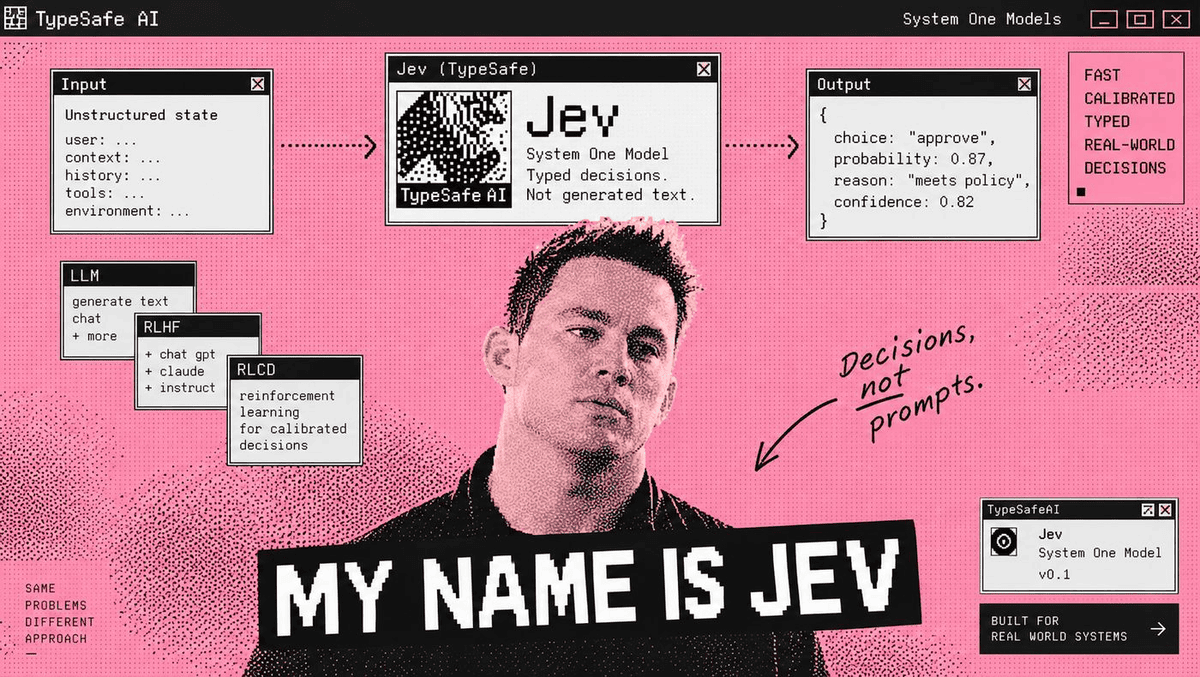
At its core, Jev is designed to take a piece of text and return a set of structured decisions with associated probabilities. Think of a customer support message like:
> *”I upgraded yesterday but now I can’t access the features I paid for.”*
Rather than generating a lengthy written response, Jev evaluates the input against a predefined list of categories and produces a probability breakdown:
“`
Technical 64%
Sales 23%
Billing 13%
Cancellation 0%
“`
It selects the most likely category — in this case, **Technical** — and also communicates how uncertain it is. This is powerful because downstream applications can use both the decision and the confidence score to make smarter choices, like automatically resolving high-confidence tickets while flagging uncertain ones for human review.
The underlying tasks — classification, scoring, routing, and intent detection — are well-established in machine learning. What appears to set Jev apart is how TypeSafe AI has built an entire model around these structured, probabilistic decisions from the ground up, instead of retrofitting a general-purpose language model to behave like a classifier.
—
## The “System One” Concept Explained
TypeSafe AI frames Jev as what they call a **System One Model**, drawing inspiration from dual-process theories of human cognition.
**System One thinking** is fast, intuitive, and automatic. It’s what you use when you instantly recognize a familiar face or react to a sudden sound. Jev mirrors this by producing structured decisions and probability distributions without generating a lengthy chain of text.
**System Two thinking** is slower, more deliberate, and analytical. This is the kind of reasoning associated with advanced language models that work through complex problems step by step.
A practical example illustrates the distinction clearly:
– **System One approach:** “Which team should handle this ticket?” → **Technical: 64%**
– **System Two approach:** “Investigate the root cause, determine what went wrong, and explain the fix to the customer.”
The key takeaway is that neither mode replaces the other. System One excels at speed and routine decisions, while System Two is essential for deep reasoning. Jev is explicitly optimized for the first category.
—
## How Is Jev Different From a Zero-Shot Classifier?
On the surface, Jev operates in a very similar fashion to zero-shot text classification, a technique that has been available to NLP practitioners for years. With zero-shot classification, you provide a text and a list of candidate labels, and the model returns a probability for each label — no task-specific training required.
For instance, you could feed an existing zero-shot model:
“`
Text: “My subscription was charged twice.”
Labels:
Billing
Technical
Cancellation
Sales
“`
And receive a probability distribution across those labels.
Modern natural language inference-based zero-shot classification gained popularity around 2019–2020, and the broader concept of zero-shot learning goes back even further.
However, reducing Jev to just another zero-shot classifier overlooks meaningful differences. TypeSafe AI has engineered Jev around parallel inference, multiple structured decisions, and a training regimen focused specifically on probability calibration. The problem space is familiar, but the architecture and tooling surrounding it represent a distinct engineering effort.
A fair summary might be: **the task is well-known, but the execution and system design may be different enough to matter.**
—
## Is Jev a Large Language Model?
No, and this is an important distinction. Models like GPT, Claude, and Gemini are general-purpose systems capable of coding, reasoning, tool use, conversation, and open-ended creative text generation. Jev occupies a much narrower lane.
Its primary function is to accept text input and produce structured categorical decisions. While it is technically possible to coax a frontier LLM into performing classification using structured outputs, function calling, or constrained decoding, doing so means deploying a large, computationally expensive model for a task that fundamentally requires far less capacity.
Jev is purpose-built for this narrower job description, and that focus is a significant part of why it can operate faster and at a fraction of the cost.
—
## Why Is Jev So Fast and Inexpensive?
The answer lies in its specialization. General-purpose LLMs generate text token by token, which is computationally intensive and inherently slow. Jev, by contrast, is engineered to make structured decisions directly and in parallel.
TypeSafe AI credits three main factors for Jev’s efficiency: its specialized architecture, a parallel sampler, and a calibration-focused training methodology.
Lightweight models for classification tasks are not a new concept — Meta’s BART-based models, for example, have been used for years in exactly this space. What is noteworthy is not simply that Jev is cheaper than a frontier model, but how deeply its architecture has been optimized for the specific workflow of fast, structured decision-making.
—
## How Reliable Are Jev’s Results?
Honest answer: the evidence so far is encouraging but incomplete.
TypeSafe AI reports that Jev achieves approximately **68%** on their own internal workflow evaluation. However, this figure deserves scrutiny — the reference answers used for evaluation were generated by frontier models, not independently verified ground truth. That means the benchmark is essentially asking one AI system to judge another, which introduces its own biases and limitations.
There have been some small independent evaluations worth noting. One fact-checking experiment showed **96.3% accuracy**, and another test across **275 documents** found strong agreement on certain classification tasks. But these are limited in scope and scale.
Until larger, independent benchmarks become available, it is reasonable to view Jev’s performance as promising rather than proven.
—
## Can Jev Really Eliminate Hallucinations?
This claim requires careful parsing. If Jev is given three options — **Billing**, **Technical**, and **Sales** — it cannot suddenly output **Legal**. That category does not exist in the defined schema, so it is structurally impossible.
But Jev can absolutely still make the wrong choice. It might assign **Billing** when the correct answer is **Technical**.
So when TypeSafe AI talks about “zero hallucinations,” what they really mean is **zero out-of-schema outputs** — the model stays within the boundaries you define. It does not mean the model is infallible. It simply means it cannot invent categories that were never part of the setup.
This is a useful property, but it is not the same as perfect accuracy.
—
## How Does Jev Stack Up Against Frontier Language Models?
On **cost and speed**, Jev holds a clear and probably decisive advantage. A specialized model doing a focused job naturally requires less computation and returns far less output than a general-purpose LLM designed for coding, reasoning, long-form conversation, tool use, and creative generation.
The more interesting question is whether Jev maintains **comparable quality** on narrow tasks, making it a viable replacement for expensive frontier model calls in production applications. Early results suggest it can, which is what makes the model genuinely compelling — not because it is faster than a general-purpose model (that would be expected), but because it may deliver sufficient accuracy for specific use cases at a dramatically lower cost and latency.
—
## Understanding RLCD: Reinforcement Learning for Calibrated Decisions
TypeSafe AI developed a training approach called **RLCD**, which stands for **Reinforcement Learning for Calibrated Decisions**.
The critical concept here is **calibration**. A model can make correct predictions while still being terrible at communicating how confident it actually is. Calibration ensures that when the model says it is 80% confident, those predictions are right roughly 80% of the time.
Consider a Jev output like this:
“`
Technical: 64%
Sales: 23%
Billing: 13%
Cancellation: 0%
—————–
Confidence: 53%
“`
The top numbers show how probability is distributed across the available choices, while the confidence score provides an overall measure of certainty around the decision. When calibration is good, higher-confidence predictions are also more likely to be correct.
This transforms uncertainty into a usable signal. Software workflows can act automatically on high-confidence decisions and automatically escalate low-confidence ones for human review — a capability that is enormously valuable in production environments.
Unlike RLHF (Reinforcement Learning from Human Feedback), which trains models to produce responses that humans prefer, RLCD is designed to produce **decisions with probabilities that accurately reflect real-world uncertainty**.
—
## Practical Use Cases for Jev
Jev appears most valuable as a **fast decision-making layer embedded within a larger application**, rather than as the model responsible for generating final outputs. Some real-world examples being explored include:
– **Agent routing:** One developer used Jev to direct requests between recipe, scraper, and meal-planning agents, with decisions completing in **145–271 milliseconds**.
– **Model routing:** Another experiment compared Jev against a standard LLM with structured output. Jev responded in roughly **1 second**, while the LLM took between **4 and 14 seconds**.
– **Browser automation:** The Browser Use project built **jev-ultrafast**, where Jev determines which browser action and element to target. In one Google Flights demo, the task was completed in approximately **7.1 seconds**.
– **Ad analysis:** One analyst processed **724 advertisements from 37 brands in about 40 seconds**, at a reported cost of roughly **$0.09**.
These examples point to a consistent pattern: Jev shines when an application needs to make many small, fast decisions in sequence or in parallel.
—
## Is Jev a Breakthrough?
Calling Jev revolutionary at this stage would be premature. Classification is a decades-old problem. Intent detection has been a core NLP task for years. Zero-shot classification is well-established. Calibrated probabilities are a standard concept in machine learning. And the idea that specialized models can outperform large general-purpose ones on narrow tasks is a long-standing principle of efficient AI design.
What TypeSafe AI has arguably done is reimagine the architecture, training process, inference strategy, calibration approach, and developer experience around these well-known problems. That combination could result in a genuinely excellent product.
But building a better mousetrap is not the same as inventing a new form of intelligence. It is worth celebrating the engineering, while keeping expectations proportionate to what is actually new.
—
## Frequently Asked Questions
### Is Jev open source?
There is no indication in the available information that Jev is open source. TypeSafe AI appears to be offering it as a commercial product, and its internal architecture has not been publicly released for independent inspection.
### What types of businesses benefit most from Jev?
Organizations that process high volumes of text-based decisions — such as customer support routing, content classification, intent detection, and workflow automation — are the most likely to benefit. Any application that needs fast, structured categorization at scale could be a strong fit.
### Does Jev support custom categories?
Yes. Jev can be configured with custom label sets, allowing developers to define categories specific to their domain or use case, similar to how zero-shot classifiers accept arbitrary labels.
### Can Jev handle tasks beyond classification?
Jev is primarily optimized for classification, scoring, routing, and intent detection. It is not designed for open-ended text generation, coding, or complex reasoning tasks, which remain the domain of general-purpose LLMs.
### How does calibration help in practice?
Good calibration means that a confidence score of, say, 90% actually corresponds to roughly 90% accuracy. This allows applications to set thresholds automatically — for example, processing all decisions above 85% confidence directly while sending lower-confidence cases to human reviewers.
### Is Jev meant to replace LLMs entirely?
No. Jev is positioned as a complementary tool — a fast, cheap decision layer that can be used alongside larger models. In many architectures, Jev might handle routing and classification while a more capable LLM handles the actual response generation or reasoning.
### How much does Jev cost compared to using GPT-4 for classification?
Exact pricing details were not specified in the available material, but the reported use cases suggest significant cost savings. One ad analysis task reportedly cost around $0.09 for 724 ads, a price point that would be difficult to match using a frontier API model for similar classification workloads.
—
## Conclusion
Jev represents an interesting engineering approach to a problem that has existed in machine learning for a long time. By building a specialized model optimized for structured, probabilistic decision-making, TypeSafe AI has created a tool that is fast, affordable, and well-suited for integration into production workflows where speed and cost matter.
That said, the claims surrounding Jev deserve a balanced reading. Classification is not new. Zero-shot approaches are mature. And the model’s accuracy claims, while promising, need independent validation at scale. The “zero hallucination” framing is technically accurate but easily misread as meaning zero errors, when it really means zero out-of-schema outputs.
For developers and teams looking for a lightweight, fast decision layer to complement larger AI systems, Jev is worth serious evaluation. For those expecting a revolutionary leap in AI capability, the reality is more incremental — but that does not make it less valuable.
The most exciting development will be watching how Jev performs across independent benchmarks and in diverse real-world applications over time.
Thank you for reading
