



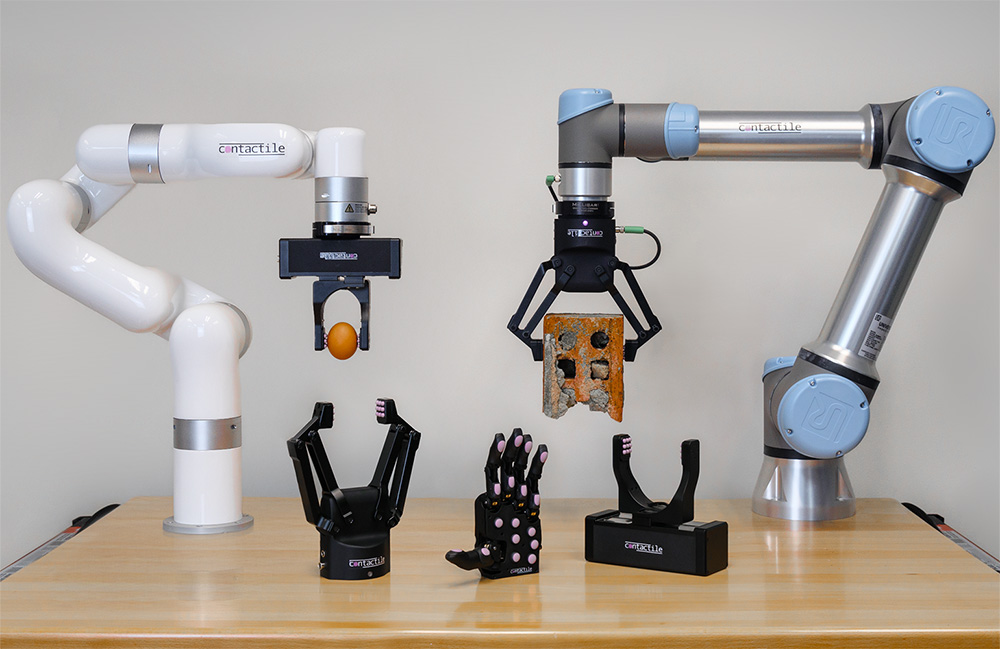
**Friction is Key to Making Better Robot World Models**
The most ambitious direction in robot learning today is the world model: a generalist model of physical reality that a robot can use to predict the consequences of its actions, plan across long horizons, and generalize to situations it has never encountered in training. If a robot’s internal model of the world is accurate enough, it does not need to memorize every task. Instead, it can reason its way through novel ones.
However, the most critical challenge in deploying world models in real robotic systems is **conditioning**—the process of grounding the model in the robot’s current physical state before it can make useful predictions. The quality of this conditioning determines whether the model’s predictions reflect reality or merely an approximation.
Currently, conditioning relies heavily on visual observations from cameras and end-effector position from joint encoders. For free-space motion tasks, this may suffice. But for **contact-rich manipulation**, the most vital information occurs at the interface between fingertip and object—a detail invisible to cameras and unresolvable from joint positions alone.
Even when tactile sensors are added, many systems only encode contact as deformation images, pressure maps, or three-axis force distributions. These indicate *that* contact is happening and *how hard*, but they do not reveal the **coefficient of static friction (μ)**—the key physical quantity that determines whether a grasp will succeed or fail.
—
### The Missing Variable: μ
The missing quantity is **μ**, the coefficient of static friction. It governs whether a grasped object stays grasped and determines the required grip force based on surface properties, contact geometry, and environmental conditions such as moisture or contamination.
Unlike visual or positional data, μ cannot be seen by a camera, inferred from joint currents, or reconstructed from pressure maps. Without μ in the conditioning signal, a world model is operating from an incomplete description of physical reality. It may learn statistical patterns from data, but it cannot reliably generalize to novel surfaces, unfamiliar objects, or changing conditions.
A model conditioned on μ, by contrast, moves from statistical pattern-matching toward **causal physical understanding**. Friction is not a learned proxy—it is the direct determinant of slip and the necessary constraint for computing the target grip force.
—
### Contactile’s Solution: Computing μ at the Edge
Contactile’s **PapillArray Tactile Compute Module** addresses this gap by computing the full set of physical quantities required for complete contact conditioning **at the sensor edge**, with no upstream processing latency. These include:
– 3D force vector at every taxel
– Global 3D force and global 3D torque
– **Coefficient of static friction (μ)** derived from live force distribution
– Per-taxel contact state (non-contact, static, or kinetic/slip)
– A physics-based target grip force—the minimum needed to prevent slip given current μ
These outputs are grounded in contact mechanics and reproducible across objects, surfaces, and environments. They enrich training data and provide live feedback during deployment, forming a complete conditioning stack.
—
### VμA: Vision–μ–Action
Building on prior model frameworks, Contactile introduces **VμA**—vision–μ–action—as the formal designation for world models that incorporate friction as a first-class input.
– **VLA (Vision–Language–Action)** introduced language as a conditioning signal
– **VFA (Vision–Force–Action)** did the same for force
– **VμA** completes the set by integrating real-time μ alongside vision and motor action
A VμA model ingests per-taxel 3D force, global torque, real-time μ, and slip state, along with visual observations, and outputs actions conditioned on the full physical state of every contact point. While VLA gave robots language and VFA gave them force, **VμA gives robots the physics of contact**.
—
### Closing the Loop: Execution Beyond Training
Training data quality is one half of the VμA value proposition; the other is real-time execution. The sim-to-real gap is especially severe in contact-rich tasks because simulation typically lacks accurate friction physics.
VμA execution **eliminates the need for domain randomization**. Since the PapillArray measures μ in real time, the robot knows the actual friction properties of the surface it is touching. The policy can condition on live μ, adapting grip force and manipulation strategy to reality rather than a simulated distribution.
Practical outcomes include:
– Handling dry parts in the morning and wet parts after cleaning without retraining
– Tracking and compensating for μ drift across production batches
– Closing the feedback loop at the contact interface at the speed of contact
—
### Implications for the Field
The manipulation ceiling the field faces is not a model size problem—it is a **conditioning problem**. The next step forward in manipulation reliability is not larger models but more complete models.
For research, VμA establishes a clear benchmark: a model that does not condition on real-time μ is not a complete contact model.
For industry, VμA defines the sensor specification needed to close the reliability gap in contact-rich applications.
The future of robot learning depends not only on what robots can see and remember, but on what they can **feel and understand**—right from the moment of contact.
—
## FAQ
**Q: What is world model conditioning in robotics?**
World model conditioning refers to the process of grounding a predictive model in the robot’s current physical state so it can generate realistic and useful predictions about future states. Conditioning inputs typically include visual observations and joint positions, but may also incorporate tactile, force, and friction data for contact-rich tasks.
**Q: Why is friction important for robot world models?**
Friction, quantified by the coefficient of static friction (μ), determines whether objects slip during manipulation. Vision and joint encoders cannot measure friction directly. Without friction in the conditioning signal, robots struggle to generalize to new surfaces or changing contact conditions.
**Q: How does Contactile’s PapillArray differ from traditional tactile sensors?**
Unlike sensors that output pressure maps or deformation images, the PapillArray computes physical quantities such as 3D force, torque, real-time μ, and slip state at the sensor edge. These outputs are based on contact mechanics rather than learned inference, enabling reliable generalization.
**Q: What is VμA?**
VμA stands for vision–μ–action. It is a framework for robot world models that incorporates visual input, real-time friction (μ), and motor action. VμA represents the next evolution beyond VLA (vision–language–action) and VFA (vision–force–action) by making friction a first-class conditioning signal.
**Q: What is the sim-to-real gap, and how does VμA address it?**
The sim-to-real gap refers to performance differences between simulation and real-world execution, especially in contact-rich tasks. VμA addresses this by measuring μ in real time during execution, allowing the robot to adapt to actual surface properties instead of relying on simulated approximations.
**Q: Can VμA be used with non-Contactile sensors?**
In principle, VμA is hardware-agnostic, but Contactile’s PapillArray is currently the only sensor that computes all required physical quantities at the edge in real time.
—
## Conclusion
The next frontier in robot learning is not larger models—it is more complete models. By conditioning world models on real-time friction, VμA enables robots to generalize reliably in contact-rich, real-world environments. Friction is the missing variable, and with solutions like Contactile’s tactile compute modules, robots can finally interact with the physical world with the same fluency humans take for granted.
