



**U.S. Manufacturing Momentum: Reshoring, Investment, and the Skills Revolution**
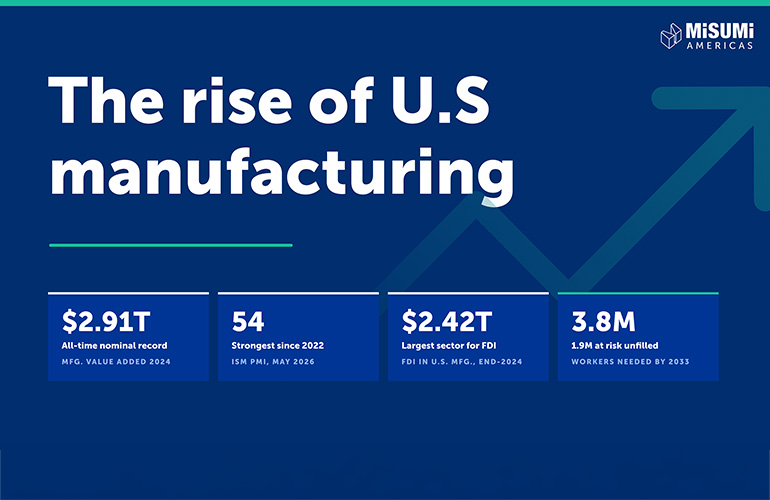
The U.S. manufacturing sector is experiencing a powerful resurgence, reaching a record $2.91 trillion in value added in 2024. If it were its own economy, it would be the eighth largest in the world. This growth is fueled by a combination of national security priorities, supply chain resilience efforts, and significant bipartisan policy support via acts like the CHIPS Act, the Inflation Reduction Act, and the Infrastructure Investment and Jobs Act.
However, this “Made in America” comeback is not without its challenges. A critical labor shortage looms large, driven by an aging workforce, accelerated retirements, and changing generational expectations. With the industry needing 3.8 million new workers by 2033—1.9 million of which are at risk of going unfilled—manufacturers are confronting a stark reality: the most important constraint on growth is no longer capital, but skilled talent.
### The Reshoring and Investment Landscape
The data paints a vivid picture of capital flowing back to the U.S. Foreign direct investment (FDI) in manufacturing has become the single largest sector for foreign investment, representing over 42% of all FDI in the country. In 2025, new FDI jumped 49.5% to $232.2 billion, with manufacturing leading at $121.8 billion. While a portion of this reflects acquisitions of existing businesses, the sheer volume of capital underscores the confidence in the U.S. as a manufacturing hub.
Domestic investment is also surging. Factory construction spending, which peaked at $235.6 billion in 2024, is nearly triple the 2021 level, with semiconductor fabs and electric vehicle (EV) battery plants leading the charge. The momentum is so strong that the ISM Purchasing Managers’ Index (PMI) reached 54 in May 2026, its strongest reading since 2022, signaling robust growth in orders, production, and backlogs.
### The Workforce Gap and the Skills Pipeline
The labor challenge is multifaceted. A significant portion of the 3.8 million needed workers comes from the “silver tsunami”—the retirement of Baby Boomers. But the gap also includes new roles created by reshoring and automation. Compounding this is the fact that total enrollment in undergraduate certificate programs at vocational community colleges remains under 1 million, a small fraction of the millions needed.
To bridge this gap, partnerships between industry and education are critical. Enrollment in high-vocational community colleges has grown 20% since 2020, and states like North Carolina are making significant budget commitments to steer funds toward high-demand advanced manufacturing fields. Programs that offer paid apprenticeships and stackable credentials are proving essential in making these careers attractive.
### A New Policy Frontier: The American Manufacturing Revitalization Exchange Program
Recognizing the need for structured knowledge transfer, a new legislative proposal aims to formalize the movement of talent. H.R. 9097, the American Manufacturing Revitalization Exchange Program Act, introduced by Rep. Bill Huizenga, would provide stipends for American workers to travel to allied nations—such as Japan, Germany, and South Korea—for 6–12 months of hands-on training in advanced production skills. The goal is not to import labor, but to bring world-class best practices back to the U.S. to upskill the domestic workforce.
This “train-the-trainer” model is seen as a vital proof of concept. With support from a broad coalition including the National Association of Manufacturers, the Manufacturing Institute, and BMW Group, the bill represents a bipartisan acknowledgment that winning the talent war requires learning from global leaders.
### Making Manufacturing Attractive to the Next Generation
The image of the modern factory could not be more different from the rust-belt past. Today’s manufacturing careers are in high-tech sectors like robotics, semiconductors, and EVs. To attract young talent, the industry must:
1. **Correct the Image Gap:** Showcase technology-driven careers, not dusty assembly lines.
2. **Create Paid Pathways:** Offer apprenticeships and employer-backed credentials that provide immediate income and long-term growth.
3. **Provide a Visible Ladder:** Demonstrate clear opportunities for advancement, purpose, and professional well-being that resonate with Gen Z and Millennial workers.
At the ground level, companies and organizations are already leading the charge. From sponsoring middle-school robotics teams to teaching graduate-level engineering courses with industrial-grade equipment, the focus is on letting students experience the craft before they choose a career.
### Conclusion
The rise of U.S. manufacturing is a powerful economic story, defined by unprecedented investment, reshoring momentum, and technological innovation. However, its long-term sustainability hinges on solving the human equation. By combining public policy, industry-education partnerships, and a concerted effort to modernize the perception of skilled work, the U.S. can build not just factories, but a world-class, future-ready workforce. The goal is not merely to fill jobs, but to build a durable ecosystem where capital and talent work in concert to secure American manufacturing leadership for decades to come.
—
## FAQ
**Q: What is driving the “reshoring” of manufacturing to the U.S.?**
A: Two primary forces are at play: **labor shortages** in traditional manufacturing hubs and a growing **desire for national self-reliance**. Companies are looking to mitigate risks associated with global supply chains and workforce instability by bringing production closer to home.
**Q: How much are we actually seeing reshoring happen?**
A: Since 2010, reshoring and foreign direct investment have supported the creation of over **2 million U.S. manufacturing jobs**. In 2024, 88% of these new jobs were in high-tech sectors like semiconductors, electronics, and electric vehicles.
**Q: What is the biggest challenge facing manufacturers right now?**
A: Attracting and retaining talent. **More than 65% of manufacturers** cite this as their single biggest business challenge. The industry needs **3.8 million more workers by 2033**, with nearly half of those jobs at risk of going unfilled without intervention.
**Q: Where is the money for this resurgence coming from?**
A: The capital is flowing from multiple channels:
* **U.S. Investment:** Factory construction spending hit $235.6 billion in 2024.
* **Foreign Investment:** Foreign companies have committed **$2.42 trillion** to U.S. manufacturing, with Japan being the single largest source at over $819 billion.
* **Government Policy:** The CHIPS Act and IRA are specifically designed to incentivize domestic production, particularly in semiconductors and EVs.
**Q: Are community colleges equipped to handle the training demand?**
A: Enrollment is growing—up **20% since 2020**—but it is not keeping pace with demand. Total enrollment in vocational programs remains under **1 million students**, which is a fraction of the millions of workers manufacturers will need.
**Q: What role does the new H.R. 9097 bill play?**
A: The American Manufacturing Revitalization Exchange Program Act is a **knowledge-transfer initiative**. It would send American workers abroad for 6–12 months of hands-on training in countries with decades of expertise in advanced manufacturing (like Japan and Germany) and bring that expertise back to the U.S. It is designed to be a pilot program to prove the concept of cross-border skills development.
**Q: Is the goal to import skilled labor from other countries?**
A: No. The stated goal of initiatives like H.R. 9097 is **not to import a workforce**, but to import **knowledge and best practices**. The ultimate aim is to build a sustainable, homegrown skilled workforce that can run the facilities of the future.
**Q: What can be done to make manufacturing careers more attractive to younger people?**
A: Three things are key:
1. **Fix the Image:** Shift the narrative from old, dirty factories to modern tech careers.
2. **Create Paid Pathways:** Offer apprenticeships and credentials that allow people to earn while they learn.
3. **Provide Growth:** Offer purpose, well-being, and a clear ladder for advancement that aligns with what Gen Z and Millennials value.
