



## Understanding and Detecting Hallucinations in LLMs with GraphEval
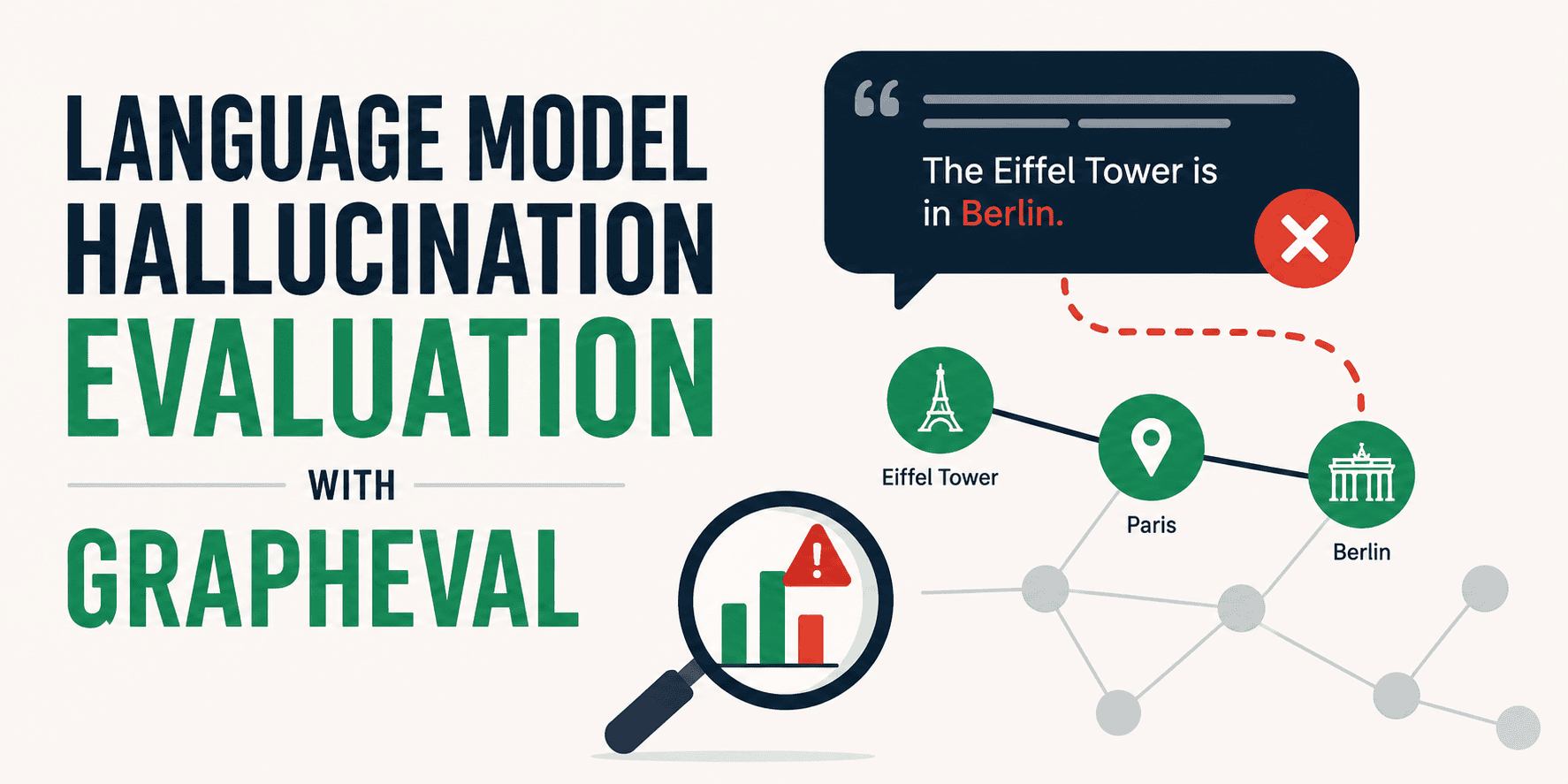
Large language models (LLMs) have revolutionized the field of artificial intelligence, but they are not without their flaws. One of the most significant challenges is “hallucinations”—instances where the model generates responses that are factually incorrect, nonsensical, or entirely made up. This issue often arises due to gaps in the model’s internal knowledge. While various solutions have been proposed to mitigate hallucinations, evaluating and diagnosing them systematically remains a complex task. This is where **GraphEval** comes in.
GraphEval is a framework designed to analyze and detect hallucinations in LLM-generated outputs using knowledge graphs. Unlike traditional evaluation methods that provide a single accuracy score, GraphEval focuses on explainability, pinpointing exactly where hallucinations occur in the model’s response. In this article, we’ll explore how GraphEval works and demonstrate its application through a practical, lightweight example.
—
### What is GraphEval?
GraphEval employs a two-stage process to evaluate LLM outputs:
1. **Knowledge Graph Construction**: The framework converts the LLM’s response into a knowledge graph composed of semantic triples in the form of *(Subject, Relationship, Object)*. These triples represent the relationships between different entities in the response.
2. **Evaluation Against Ground Truth**: Each triple is then evaluated against a trusted ground-truth context using a Natural Language Inference (NLI) model. If a triple cannot be supported by the context—either because it contradicts the information or is neutral—it is flagged as a hallucination.
This methodology not only identifies hallucinations but also provides insights into their origin, making it a powerful tool for diagnosing issues in LLM outputs.
—
### Illustrating GraphEval Through Code
To demonstrate how GraphEval works, let’s walk through a simplified code example. This simulation avoids the computational demands of a full implementation while capturing the essence of the framework.
#### Step 1: Setting Up the Environment
First, install the necessary libraries:
“`python
!pip install -q transformers networkx matplotlib torch
“`
#### Step 2: Define the Ground-Truth Context
The ground-truth context serves as the benchmark for evaluating the LLM’s response. Here’s an example:
“`python
source_context = (
“GraphEval is a hallucination evaluation framework based on representing information ”
“in Knowledge Graph (KG) structures. It acts as a pre-processing step and utilizes ”
“out-of-the-box NLI models to detect factual inconsistencies.”
)
“`
#### Step 3: Simulate an LLM Response
Let’s assume the following response from an LLM:
“`python
llm_output = (
“GraphEval is an evaluation framework that uses Knowledge Graphs. ”
“It requires a highly expensive, enterprise-level server farm to operate.”
)
“`
#### Step 4: Extract Triples from the Response
Using an auxiliary LLM or a simulated process, we extract the semantic triples:
“`python
extracted_triples = [
(“GraphEval”, “is”, “evaluation framework”),
(“GraphEval”, “uses”, “Knowledge Graphs”),
(“GraphEval”, “requires”, “expensive enterprise server farm”)
]
“`
#### Step 5: Evaluate Triples with an NLI Model
Using a pre-trained NLI model from Hugging Face, we evaluate each triple:
“`python
from transformers import pipeline
nli_evaluator = pipeline(“text-classification”, model=”cross-encoder/nli-deberta-v3-small”)
def evaluate_triple(context, triple):
subject, relation, obj = triple
hypothesis = f”{subject} {relation} {obj}”
result = nli_evaluator({“text”: context, “text_pair”: hypothesis})
label = result[‘label’].lower()
is_hallucinated = label != ‘entailment’
return is_hallucinated, label, hypothesis
for triple in extracted_triples:
is_hallucinated, nli_label, hypothesis = evaluate_triple(source_context, triple)
status = “🚨 HALLUCINATION” if is_hallucinated else “✅ GROUNDED”
print(f”{status} | Triple: {triple} | NLI Output: {nli_label}”)
“`
#### Results:
“`
✅ GROUNDED | Triple: (‘GraphEval’, ‘is’, ‘evaluation framework’) | NLI Output: entailment
✅ GROUNDED | Triple: (‘GraphEval’, ‘uses’, ‘Knowledge Graphs’) | NLI Output: entailment
🚨 HALLUCINATION | Triple: (‘GraphEval’, ‘requires’, ‘expensive enterprise server farm’) | NLI Output: neutral
“`
The third triple is correctly identified as a hallucination.
—
### FAQ Section
#### 1. What are hallucinations in LLMs?
Hallucinations occur when an LLM generates responses that are factually incorrect, nonsensical, or invented. These errors often stem from gaps in the model’s training data or its inability to retrieve accurate information.
#### 2. How does GraphEval detect hallucinations?
GraphEval uses knowledge graphs to represent the LLM’s response as semantic triples. These triples are then evaluated against a trusted context using an NLI model. Triples that are not supported by the context are flagged as hallucinations.
#### 3. What is the role of the NLI model in GraphEval?
The NLI model determines whether a given triple is entailed by the ground-truth context. If the relationship in the triple cannot be supported by the context, it is labeled as a hallucination.
#### 4. Can GraphEval be used in production systems?
Yes, GraphEval is designed to be a practical framework for diagnosing hallucinations in LLM outputs. While the example provided is simplified, it can be scaled and integrated into real-world systems with appropriate resources.
#### 5. What are the advantages of using GraphEval?
GraphEval provides two key advantages:
– **Explainability**: It identifies exactly which parts of the response are hallucinated.
– **Actionability**: By pinpointing errors, it helps developers refine and improve LLM performance.
—
### Conclusion
GraphEval represents a significant step forward in addressing the challenge of hallucinations in LLMs. By leveraging knowledge graphs and NLI models, it not only detects hallucinations but also provides insights into their origins. This article has demonstrated the framework’s principles through a simplified code example, showcasing its potential for real-world applications.
As LLMs continue to evolve, frameworks like GraphEval will play a crucial role in ensuring their reliability and accuracy. Whether you’re a researcher, developer, or AI enthusiast, understanding and implementing such evaluation methodologies is key to harnessing the full potential of language models.
**Iván Palomares Carrascosa**, a leader and expert in AI and LLMs, provides valuable insights into applying these techniques effectively in the real world.
