



# How Modern Genetics and Artificial Intelligence Are Transforming Our Understanding of Brain Health
## The New Frontier of Understanding Disease
For decades, scientists have searched for answers about why some people develop brain-related disorders while others do not. The traditional approach was like trying to find a single needle in a haystack — looking at one gene or one mutation at a time. Today, the landscape has changed dramatically. Researchers now combine massive datasets, advanced laboratory technologies, and powerful artificial intelligence tools to uncover the complex web of genetic factors that influence brain development, function, and disease.
This shift has opened doors to what many call precision health — the idea that medical care and scientific understanding can be tailored to the individual rather than relying on one-size-fits-all approaches. By studying how genes behave in different types of brain cells and at different stages of life, scientists are building detailed maps of the human brain at a resolution never before possible.
## From Genetic Associations to Biological Understanding
One of the biggest challenges in modern genetics has been moving beyond simply identifying which parts of the genome are linked to a disease — and actually understanding *why*. Large-scale studies have identified thousands of genetic variations associated with conditions like autism, schizophrenia, Alzheimer’s disease, and depression. But knowing a variation exists is only the first step.
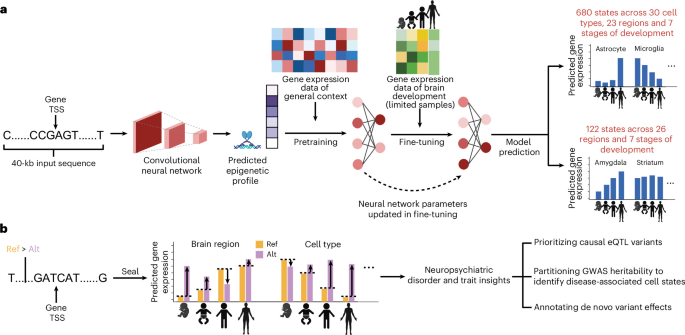
Researchers have developed sophisticated computational models that can predict how these genetic variations affect gene activity. These models analyze DNA sequences and estimate whether a particular change is likely to turn a gene up, turn it down, or alter when and where a gene is active. This work has been critical because most disease-linked variations do not occur in protein-coding regions of the genome. Instead, they live in regulatory regions — the parts of DNA that control gene expression.
By integrating data from hundreds of human tissue types, scientists can now see how the same genetic variation might have different effects in different organs. The brain, for example, has its own unique regulatory landscape that distinguishes it from the liver, the heart, or the skin. Understanding these tissue-specific patterns is essential for interpreting genetic risk.
## Mapping the Brain Cell by Cell
Perhaps the most exciting advances have come from single-cell technologies, which allow researchers to measure gene activity in individual cells. Rather than studying a mixture of millions of cells and averaging the results, scientists can now examine each brain cell on its own.
This approach has revealed an astonishing diversity of cell types in the brain. The cerebral cortex, the outer layer responsible for higher-order thinking, contains dozens of distinct subtypes of neurons and supporting cells called glia. Each cell type has a unique molecular fingerprint, and disruptions in specific cell types have been linked to different disorders.
For example, studies of autism have highlighted specific populations of neurons that form during mid-fetal development as key players in the condition. Similarly, research on Alzheimer’s disease has uncovered unexpected roles for support cells like oligodendrocytes and microglia, not just the neurons traditionally associated with the disease. In depression, specific cell types in the prefrontal cortex have been implicated, offering new targets for potential therapies.
These cell-type-specific insights would have been impossible without the combination of single-cell sequencing and computational analysis. The sheer volume of data generated by these experiments requires machine learning tools to find meaningful patterns.
## Artificial Intelligence as a Research Partner
Artificial intelligence, particularly deep learning, has become an indispensable tool in genomics. Deep learning models can learn complex patterns in DNA sequences and predict their functional effects with remarkable accuracy. These models are trained on massive datasets of genomic and gene expression information, allowing them to capture relationships that would be invisible to traditional statistical methods.
Some of these AI models can now predict how a genetic variant will affect gene expression across different brain cell types. Others can simulate how the three-dimensional folding of DNA — which brings distant regulatory elements into contact with their target genes — influences gene activity. Still other models can transfer knowledge learned from one biological context to another, making predictions even when direct data is limited.
These tools are accelerating the pace of discovery because they can screen millions of possible genetic variants in a fraction of the time it would take in a laboratory experiment. While experimental validation remains essential, AI models help researchers prioritize which variants are most likely to be biologically meaningful, focusing precious resources where they matter most.
## Developmental Timing and Brain Health
One crucial insight emerging from this research is that timing matters enormously. Many brain disorders appear to have their roots in early development — even before symptoms emerge years or decades later. The brain undergoes rapid and complex changes during fetal development and early childhood, and genetic disruptions during these critical windows can set the stage for later problems.
Studies have shown that genes associated with autism are often active during specific periods of fetal brain development. Similarly, genes linked to schizophrenia appear to play roles in the maturation of certain inhibitory neurons during adolescence. Understanding these developmental trajectories gives researchers clues about when interventions might be most effective — potentially long before symptoms appear.
This concept of “critical windows” is also relevant to treatment. If a particular cell type or developmental process is vulnerable during a specific time period, therapies could potentially be timed to protect or support that process at just the right moment.
## The Path Toward Precision Medicine
The ultimate goal of all this research is to improve human health through precision medicine — approaches that are customized to an individual’s unique genetic makeup, cell biology, and developmental history. While we are not yet at the point where a person’s full genomic profile can guide every clinical decision, the building blocks are falling into place.
Integrating genetic data with cell-type-specific information, developmental timelines, and AI-driven predictions creates a powerful framework for understanding disease risk and mechanisms. As these technologies mature, they promise to deliver more accurate diagnoses, better drug targets, and personalized treatment strategies for conditions that have long been poorly understood.
The journey from a genetic association to a biological insight to a clinical application is long and complex. But each new study adds another piece to the puzzle, and the combination of advanced genomics, single-cell technologies, and artificial intelligence is making that puzzle clearer with every passing year.
—
## Frequently Asked Questions
**What is precision health, and how is it different from precision medicine?**
Precision health is a broader concept that encompasses not only treating disease but also predicting and preventing it. While precision medicine focuses on tailoring treatments to individuals who are already sick, precision health aims to use genetic and biological information to maintain wellness and intervene before disease develops.
**Why are regulatory regions of DNA so important for brain diseases?**
Most genetic variations linked to brain disorders are found outside of protein-coding genes, in regulatory regions that control when, where, and how much a gene is expressed. Because brain cells have highly specialized functions, even small changes in gene regulation can have outsized effects on how neurons develop, communicate, and survive.
**How do single-cell technologies work?**
Single-cell technologies measure the activity of genes in individual cells rather than averaging across millions of cells. This allows researchers to identify distinct cell types based on their unique molecular profiles and to detect subtle changes that would be hidden in bulk measurements.
**Can artificial intelligence replace laboratory experiments in genetics?**
No. AI models are powerful tools for making predictions and prioritizing targets, but experimental validation in the laboratory remains essential. AI and experiments work best together — AI narrows down the most promising leads, and experiments confirm whether those leads are biologically real.
**What role does brain development play in adult mental health disorders?**
Many adult brain disorders, including schizophrenia and autism, appear to originate during early developmental periods when the brain is forming its basic circuitry. Genetic risk factors may disrupt specific developmental processes, and the consequences may only become apparent years later when brain circuits are put under stress or fail to function properly.
**How close are we to using genomics in everyday clinical care?**
We are making steady progress. Genomic information is already used in some clinical settings, particularly for rare genetic disorders and certain types of cancer. For common brain disorders, the integration of genomics into routine care will likely happen gradually as our understanding deepens and the cost of genomic analysis continues to decrease.
—
## Conclusion
The convergence of genomics, single-cell biology, and artificial intelligence is reshaping our understanding of the brain and the disorders that affect it. By moving beyond simple associations and toward a deep mechanistic understanding of how genes, cells, and development interact, researchers are laying the groundwork for a new era of brain health. The path ahead is complex, but each discovery brings us closer to a future where personalized insights lead to better outcomes for patients. The progress made so far is a testament to the power of curiosity, collaboration, and cutting-edge technology working together to solve some of medicine’s most challenging puzzles.
Thank you for reading
