



**Unlocking Easy Text Classification with Modern AI Frameworks**
**Introduction**
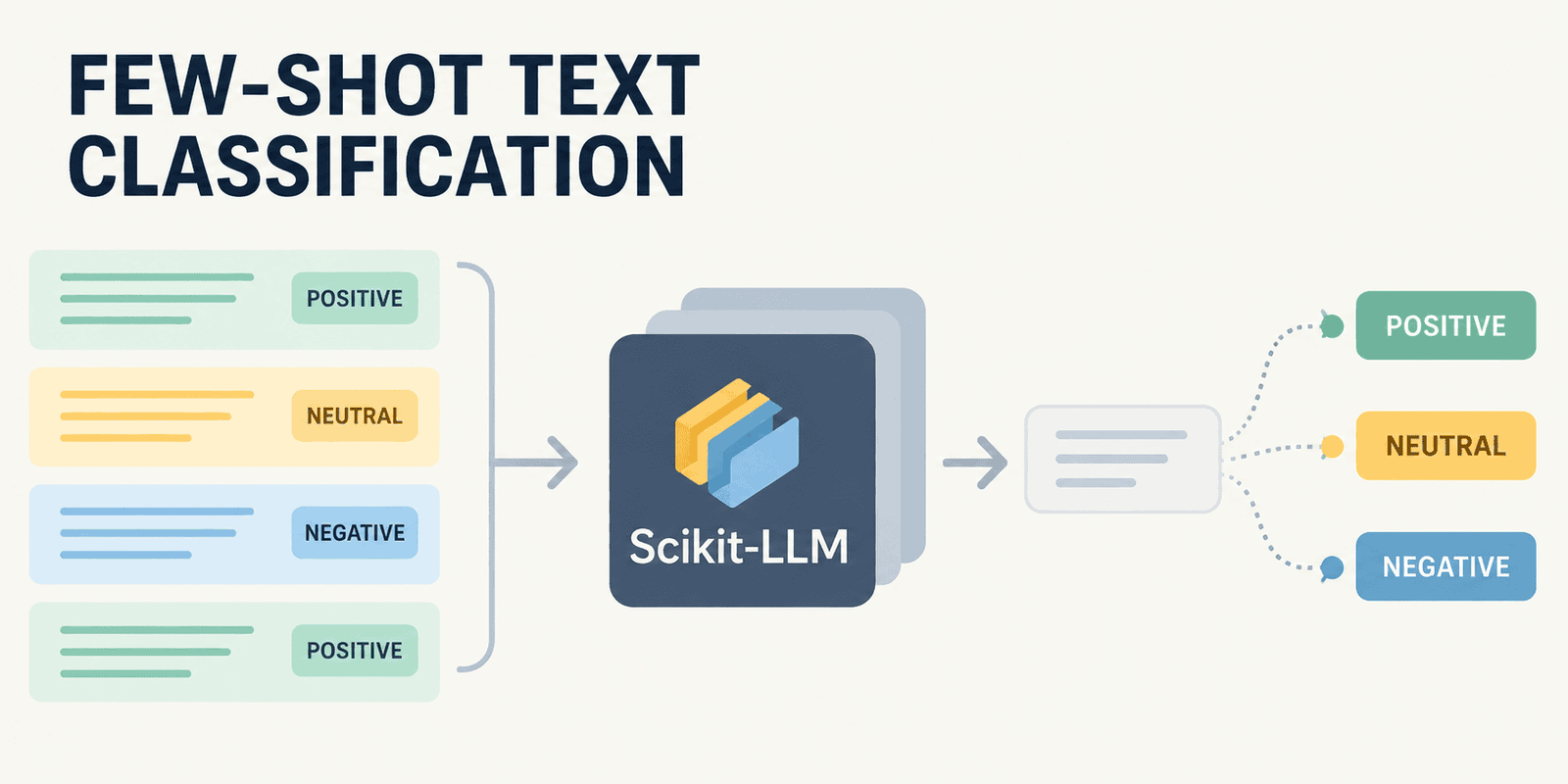
For years, building effective text classification models meant following a grueling routine: gathering hundreds or thousands of labeled examples, scrubbing raw text, converting it into numerical formats like embeddings or TF-IDF, and finally training a model such as a logistic regression or random forest. However, the arrival of large language models (LLMs) has fundamentally changed the game. Today, it is entirely possible to classify text simply by asking an LLM to do so. The challenge is that shifting from traditional machine learning workflows to prompt engineering can be difficult. Modern Python frameworks have emerged to bridge this gap, wrapping the powerful capabilities of pre-trained LLMs behind the familiar `fit()` and `predict()` methods of classical machine learning. This article explores how to use one of these frameworks for few-shot classification—classifying text based on a small number of labeled examples that guide the model on what to do.
**Zero-Shot vs. Few-Shot Classification**
Before diving into the code, it is helpful to clarify the difference between the two most popular LLM classification paradigms.
* **Zero-shot classification:** The model is given a text and a list of possible labels, then asked to categorize the text under the most suitable one—without seeing a single input-output example. This relies entirely on the LLM’s internal knowledge gained during its initial training.
* **Few-shot classification:** A small set of labeled examples, often called “shots,” is provided to the model before it attempts to classify new, unlabeled text. These domain-specific examples supplement the model’s internal knowledge and better steer its reasoning.
Few-shot classification is typically the better choice for highly specialized text classification tasks where the text contains specific jargon, edge cases, or nuanced sentiments. In most cases, providing just 3 to 5 labeled examples is enough to “teach” the pre-trained LLM the extra rules it needs to perform accurate classifications—all without retraining the entire model.
**Running Few-Shot Classification, Step by Step**
To see how this works in practice, imagine we want to categorize IT support tickets into three categories: Hardware, Software, and Access. We don’t need a massive labeled dataset; we just need a small, representative set of labeled examples and a separate set of unlabeled texts we want to predict.
First, we set up access to a compatible language model API and configure the necessary environment variables to connect securely. After the setup, we define our training data and our test data:
Our labeled examples (the “few shots”):
* “My laptop screen is flickering heavily.” -> Hardware
* “I need a new mouse, the scroll wheel is broken.” -> Hardware
* “Excel keeps crashing every time I open a macro.” -> Software
* “How do I update to the latest version of Photoshop?” -> Software
* “I forgot my VPN password.” -> Access
* “Can you grant me admin rights to the shared drive?” -> Access
The texts we want to predict:
* “The keyboard types double letters randomly.”
* “I am locked out of my email account.”
* “Zoom freezes when I share my screen.”
Next, we import the specialized wrapper class for our task and initialize it, pointing it toward a lightweight, open-source model that we can access via a standard API. We then call the `fit()` method, passing in our labeled examples. It is important to note that this `fit()` method does not perform actual training or update the model’s weights. Instead, it simply constructs a prompt in the model’s memory containing the labeled examples it will rely on for reasoning.
Finally, we call `predict()` to obtain our results on the unlabeled texts. The framework returns the classification labels, and they are exactly what we would expect: “Hardware,” “Access,” and “Software.” No heavy model retraining was required, and no large paid models were needed—just a handful of clear examples were enough for the model to classify the new texts accurately.
**Frequently Asked Questions (FAQ)**
* **Q: Do I need a massive dataset to use this approach?**
A: Not at all. Unlike traditional machine learning, few-shot classification requires only a small number of labeled examples—typically between three and five—to effectively guide the model.
* **Q: Does the model actually learn and update its internal weights during the training phase?**
A: No. The framework constructs a prompt containing your provided examples, but it does not retrain or fine-tune the underlying model. The model uses its existing knowledge combined with your provided examples to generate its responses.
* **Q: Can I use paid, large-scale models for this process?**
A: Yes, you can use any compatible API endpoint. However, this approach works exceptionally well with smaller, free-tier, or open models, making it highly cost-effective for everyday tasks.
* **Q: What is the advantage of using a wrapper that provides `fit()` and `predict()` methods?**
A: The wrapper integrates the LLM seamlessly into your existing Python machine learning workflows. It allows you to use familiar commands instead of writing complex, custom prompt engineering code from scratch.
**Conclusion**
By leveraging pre-trained language models and a few targeted examples, developers can build highly accurate, domain-specific text classifiers without the massive overhead of traditional model training. You do not need enormous datasets, expensive infrastructure, or months of development time to get started. With the right tools, a simple setup of a few examples is all it takes to turn a general-purpose language model into a specialized classification engine. This makes advanced AI practical, accessible, and incredibly efficient for a wide variety of real-world applications.
Thank you for reading
