



# When Art Meets Money: How European Artists Are Making the Invisible Visible
## Introduction
For centuries, people have questioned where money gets its value and who controls it. Long before digital currencies existed, artists were among the first to challenge the systems behind financial power. In 1720, satirical prints in Amsterdam mocked the frenzy of speculative bubbles, using humor and imagery to expose how quickly fortunes could vanish. That tradition of questioning money through creative expression has never gone away — it has only evolved.
Today, a new generation of European artists is picking up where their predecessors left off, but this time they’re working with bitcoin, digital currencies, and the hidden mechanics of modern finance. Through screenprints, shredded banknotes, digital art, and large-scale drawings, these creators are building a visual record of how money works, what it means, and how it shapes our lives.
## A City with a Rich History
Amsterdam has always been a place where finance and culture intersect. The city was home to the world’s first stock exchange and early experiments with modern banking. But it was also a hotbed for political art and satire. When speculative mania swept through Europe in the early 1700s, Dutch printers and artists responded with collections of engravings and plays that mocked the excesses of the wealthy and the fragility of financial systems.
This spirit of questioning authority and making hidden truths visible lives on today. In the late 20th century, Amsterdam also became a hub for early experiments in digital money. A cryptographer named David Chaum developed private electronic cash systems at a Dutch research institute in the 1980s and 1990s, planting seeds for ideas that would later inspire decentralized digital currencies. Nearly three decades later, the city hosted exhibitions that directly connected these historical threads to the emerging world of bitcoin and blockchain art.
## Three Artists, Three Approaches
Three artists from Europe have become central figures in this intersection of art and money. Each brings a unique perspective and a different creative medium to the table.
### Martin Fischer (Cypherpunk Now)
Martin Fischer is part of a Prague-based art collective that gained international attention for a daring stunt: inserting a fictional nuclear explosion into a live Czech television broadcast in 2003. The collective, called Ztohoven, used art to question how easily institutions could be manipulated and how much we trust what we see on screen.
Fischer later founded a hackerspace in Prague that became one of the first venues to accept bitcoin as payment. The experience shaped his artistic career. In 2014, he began working under the name Cypherpunk Now, creating screenprints that document the evolution of bitcoin culture. His work draws on themes of freedom, decentralization, and the myths that have grown up around digital money.
Fischer’s most celebrated pieces reimagine classic imagery through a bitcoin lens. One of his favorites reworks the meme of ancient dinosaurs watching their own extinction, incorporating text from the original bitcoin white paper. Another piece, inspired by the legend of Saint George, reimagines the dragon as a symbol of centralized financial power. His style blends political printmaking traditions with the visual language of early internet culture and cypherpunk movements.
### RYR
RYR emerged from Germany’s graffiti scene and takes a uniquely physical approach to the subject of money. He shreds real banknotes, turns the shredded paper into new sheets of art paper, burns the remnants to create pigment, and even casts shredded cash into concrete to create what he calls “artifacts from the future.”
His work asks a fundamental question: if money is essentially a story we all agree on, what happens when we physically destroy the objects that carry that story? RYR explains that he is not simply destroying money — he is cutting an existing narrative into pieces and using those fragments to tell a new one. His concrete weapons, shaped like military ordnance, represent a imagined future where the old financial system has already been replaced, turning today’s monetary conflicts into archaeological relics.
RYR also creates portraits of key figures in bitcoin history, including Satoshi Nakamoto, the pseudonymous creator of bitcoin. His work emphasizes the human stories and cultural shifts behind the technical jargon of digital finance.
### ZETRA
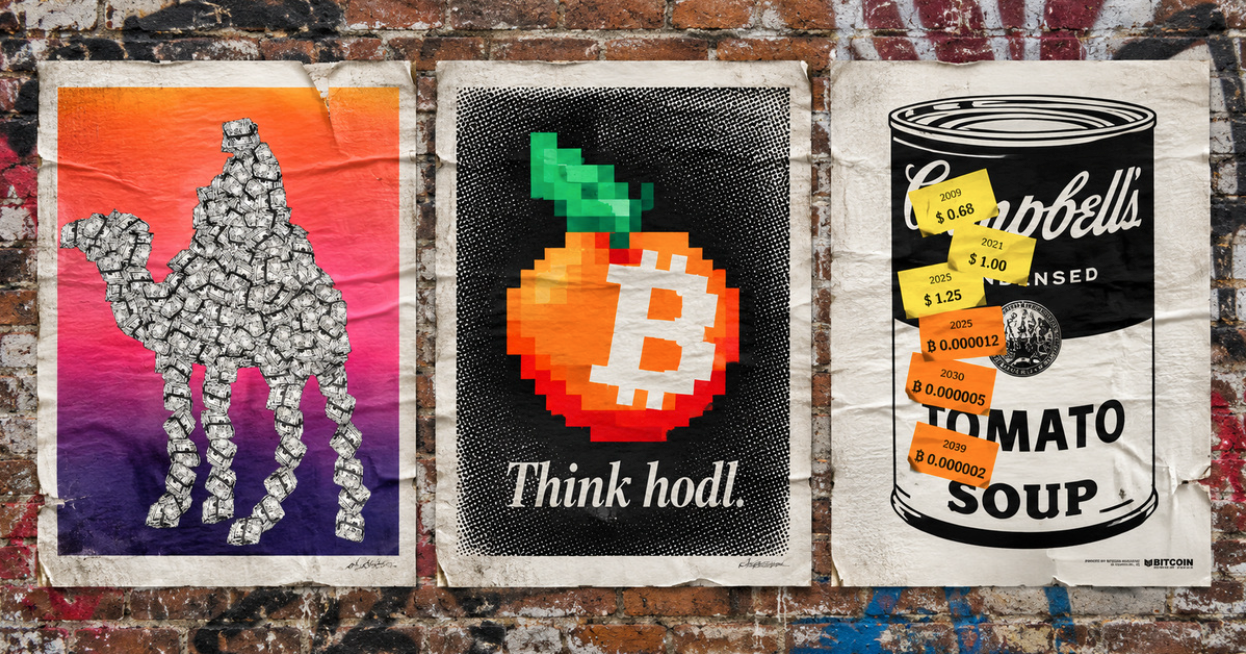
ZETRA began painting in the early 1990s and discovered bitcoin in 2017. His work examines what money can actually buy and how the value of currency changes over time. His most striking series takes Andy Warhol’s famous Campbell’s Soup Cans and reimagines them with real price stickers showing how the cost of soup has risen in U.S. dollars over the decades. When viewed through the lens of bitcoin, the same soup costs significantly less, highlighting the eroding purchasing power of traditional currencies.
Another of his major projects is a series based on the 2,048 words used in bitcoin wallet recovery phrases — the strings of words that allow people to access their digital assets. Each piece in the series reinterprets one of these words as a visual artwork, exploring how language, security, and ownership intersect in the world of digital money. One of the most notable pieces in this series, created in collaboration with another artist, references the specific word that serves as the 1,206th entry in the recovery phrase list.
## Art as a Lens for Understanding Finance
What unites these three artists is their shared goal of making something invisible visible. Money flows through economies, governments, and digital networks, yet most people rarely see the mechanisms behind it. These artists use their creativity to expose those mechanisms — whether through satire, physical transformation of currency, or visual metaphors.
Their work has gained recognition at major international exhibitions, including shows dedicated to bitcoin and digital culture. The artists argue that art has an important role to play in helping people understand financial systems, especially as money becomes increasingly digital and abstract.
## The Tension Between Idealism and Institutional Acceptance
Bitcoin began as a grassroots movement built on ideals of decentralization and financial freedom. Over the past decade, however, it has attracted attention from banks, investment funds, and corporations. This shift raises difficult questions for artists and thinkers who were part of the early community.
Martin Fischer reflects on this tension honestly. He notes that the early days of the bitcoin community were marked by a shared sense of purpose and mutual support. Today, he says, there are more internal conflicts — debates over technical details, artistic choices, and who gets to participate in the ecosystem. He believes this is a natural consequence of success, but he is not sure it is a positive development.
RYR shares a similar view. His concrete weapons and shredded currency artworks capture a sense of nostalgia for the early days of the movement, when the idea of replacing traditional finance felt radical and achievable. He acknowledges that bitcoin may eventually become just another part of the financial system it was designed to challenge, but he hopes its creative and cultural identity endures.
## FAQ
**What is the connection between historical financial satire and modern bitcoin art?**
Both traditions use creative expression to question and critique financial systems. In the 18th century, Dutch artists mocked speculative bubbles through prints and plays. Today’s artists use screenprints, digital art, and physical transformations of currency to examine how money works in a digital age.
**Why do artists use shredded banknotes as a medium?**
Destroying and rebuilding currency into art highlights the idea that money’s value is based on collective belief rather than the physical material itself. By transforming banknotes into pigment, paper, or concrete sculptures, artists force viewers to reconsider what gives money its power.
**How does Martin Fischer’s background in hacktivism influence his art?**
Fischer’s work with collectives that challenged institutional authority shaped his belief that art can question power structures without needing to provoke confrontation. His screenprints document bitcoin culture while exploring themes of decentralization, freedom, and the myths surrounding digital money.
**What is the BIP39 word list, and why do artists find it interesting?**
The BIP39 word list is a standardized set of 2,048 words used to generate bitcoin wallet recovery phrases. These words are essential for self-custody of digital assets, and artists find them rich with symbolic potential — each word can be reimagined as a visual artwork that explores themes of security, language, and ownership.
**Can traditional art audiences appreciate this work?**
Yes. While some pieces are immediately understood by those familiar with bitcoin, many viewers need a bit of explanation. The artists welcome this dialogue, seeing it as an opportunity to help more people understand the changing nature of money and finance.
## Conclusion
Art has always served as a mirror for society’s most important debates. When it comes to money, that role is more relevant than ever. As financial systems grow more complex and increasingly digital, artists like Martin Fischer, RYR, and ZETRA offer a vital service — they make the invisible visible, they challenge assumptions, and they invite us to look critically at the systems that shape our daily lives.
Whether through satire, physical transformation, or visual storytelling, these creators remind us that money is not just a technical invention. It is a human story, built on trust, belief, and collective agreement. And like all good stories, it is always evolving.
Thank you for reading
