



# Retrieval-Augmented Generation vs. Agentic RAG: A Practical Guide
## Introduction
Large language models (LLMs) are powerful but have a notable flaw — they sometimes make up information with total confidence. This phenomenon, known as hallucination, can be a serious problem in business environments where accuracy matters. To fix this, developers turned to a technique called Retrieval-Augmented Generation (RAG), which anchors a model’s responses in real, verified data.
However, as companies started using RAG for more demanding tasks, they discovered its limitations. Standard RAG works well for straightforward questions but struggles when the answer requires thinking through multiple pieces of information from different sources.
Agentic RAG is the next evolution — a smarter, more flexible approach that gives the system the ability to think, plan, and refine its search process before delivering a final answer.
In this guide, we’ll explore how both approaches work, where each one shines, and how to decide which is right for your needs.
—
## What Is Standard RAG?
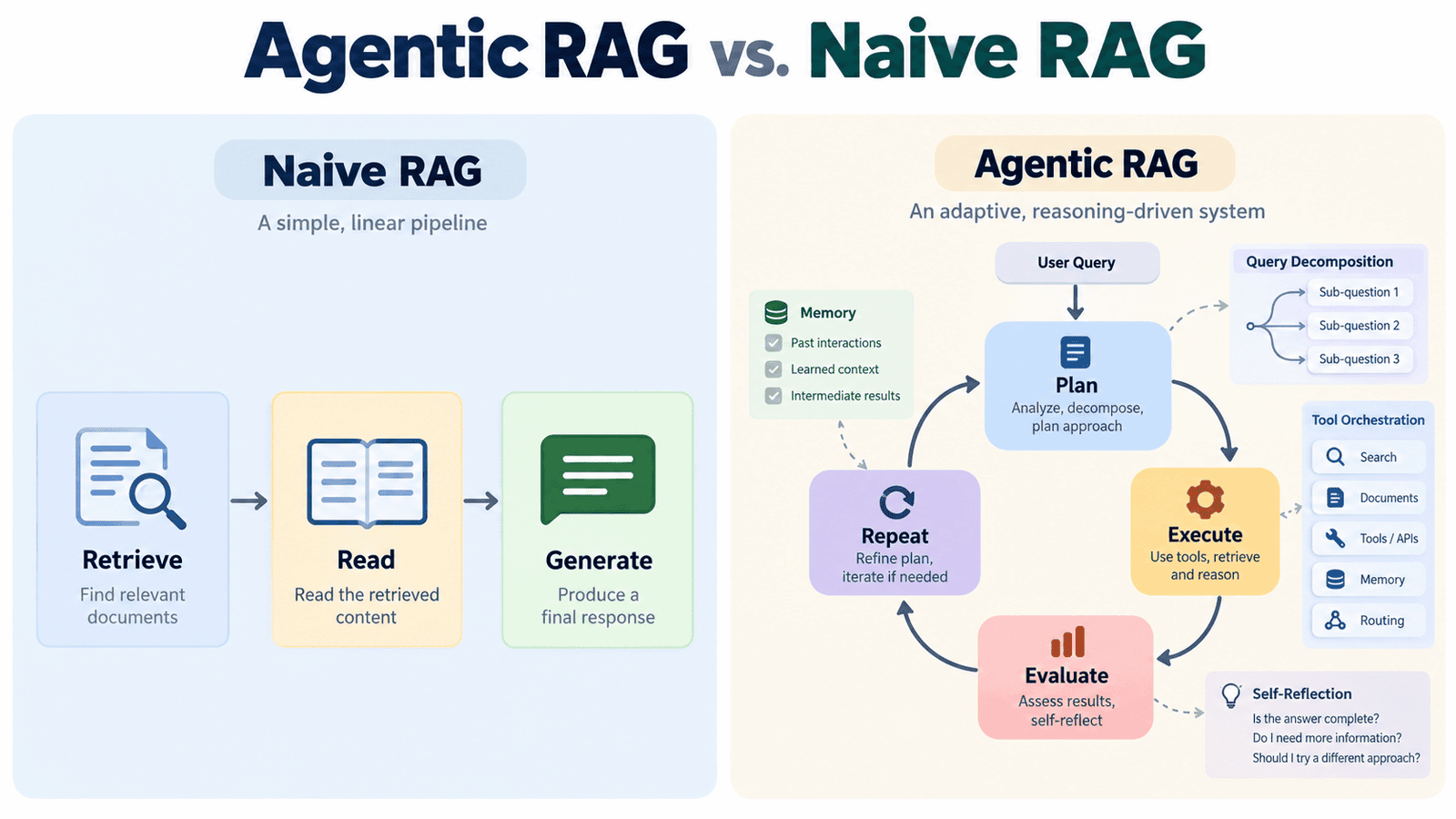
Standard RAG — often called naive RAG — follows a simple three-step process: **Find, Read, Answer**.
Here’s how it works in practice:
1. **Find** — A user asks a question, and the system converts that question into a numerical representation (called an embedding). It then searches a database of documents to find the most relevant passages.
2. **Read** — The top matching passages are selected and provided to the language model as background context.
3. **Answer** — The model reads those passages and generates a response based on what it found.
Think of it like someone browsing a reference book. They look up one topic, read the relevant section, and write down what they learned. It’s fast, simple, and effective for basic questions.
For years, this approach powered countless internal knowledge bases, customer support chatbots, and document search tools. It dramatically reduced hallucinations compared to asking a model to answer from memory alone.
—
## Where Standard RAG Runs Into Trouble
The fundamental weakness of standard RAG is that it only searches once. If that single search doesn’t find the right information, the model has no way to fix the problem.
Here are three common scenarios where standard RAG breaks down:
### One-and-Done Retrieval
Standard RAG gets a single chance to pull relevant information. If the user’s question is ambiguous or poorly phrased, the search might return the wrong documents. The model then builds its answer from those documents — whether they’re useful or not.
### Questions That Need Multiple Steps
Some questions require connecting dots across different pieces of information. For example:
> *”What privacy rules apply to the messaging app owned by Meta?”*
Answering this requires two pieces of knowledge: knowing that Meta owns WhatsApp, and then finding Meta’s privacy policies in the European Union. A single search won’t connect those dots because the information lives in separate documents and requires intermediate reasoning.
### Irrelevant Search Results
When the search returns documents that don’t match the question, the model is stuck. It either ignores the bad results and hallucinates an answer, or it admits it can’t respond. Neither outcome works well in professional settings.
—
## What Is Agentic RAG?
Agentic RAG transforms retrieval from a one-time step into an ongoing, intelligent process. Instead of the model passively receiving pre-selected documents, it actively manages its own research process.
The key difference is the loop structure: **Plan → Search → Evaluate → Repeat**.
Rather than grabbing the first set of results and moving on, the system thinks about what it needs, searches for it, checks whether the results are good enough, and if not, tries again with a different approach.
To stick with our library analogy: where standard RAG is someone who pulls three books off the shelf and calls it a day, agentic RAG is a seasoned researcher who cross-references multiple sources, notices gaps in the evidence, digs deeper, and only writes a conclusion when they’re satisfied with the quality of their findings.
—
## Four Capabilities That Power Agentic RAG
The shift from standard to agentic isn’t one big change — it’s the combination of four distinct capabilities working together.
### 1. Smart Routing
Not every question is best answered by the same data source. A question about quarterly revenue might require querying a structured database, while a question about company policy might need semantic search through internal documents. A question about today’s news might require a live web search.
Agentic systems can examine a question and route it to the most appropriate tool or database automatically. This prevents the common mistake of searching the wrong place for the wrong type of information.
### 2. Breaking Down Complex Questions
When a question is complicated, agentic systems decompose it into smaller, manageable sub-questions. Each sub-question is answered independently, and the answers build on each other to form a complete response.
For the Meta/WhatsApp example, the system would first identify the parent company, then use that answer to search for the relevant regulatory information — chaining together multiple targeted searches rather than hoping one broad search captures everything.
### 3. Self-Checking and Refinement
After retrieving results, the system pauses to evaluate them. Are these documents actually relevant? Do they contradict each other? Is there enough information to answer the question confidently?
If the answer is no, the system rewrites its search query and tries again. This self-reflection loop continues until the system reaches a satisfactory level of confidence or hits a safety limit to prevent infinite searching. This capability alone is what most distinguishes agentic RAG from standard approaches.
### 4. Tool Integration
Agentic systems aren’t limited to searching text documents. Through function calling, the model can use a variety of tools during its reasoning process — running calculations, querying structured databases, performing live web searches, or calling internal company APIs. This means the same system can handle factual questions, mathematical problems, and real-time data lookups all in one workflow.
—
## How to Choose the Right Approach
The decision between standard RAG and agentic RAG comes down to balancing cost and capability.
Standard RAG is cheaper and faster because it requires only one search and one model call. Agentic RAG is more expensive because each reasoning step adds latency and computational cost.
### Choose Standard RAG When:
– Questions are simple and require only one lookup
– Speed is the top priority, such as in consumer-facing chatbots or quick FAQ systems
– Your document collection is well-organized and a single search reliably finds the right information
– You need to keep per-query costs low at scale
### Choose Agentic RAG When:
– Questions require reasoning across multiple documents or data sources
– Accuracy is more important than speed, such as in legal research, medical literature analysis, or financial reporting
– Users will ask unpredictable, complex questions that you can’t anticipate when building the system
– Your workflow involves interacting with live data, APIs, or external tools alongside your knowledge base
– The cost of an incorrect answer is high — whether financially, legally, or reputationally
### A Practical Middle Ground
Many production systems use a hybrid strategy. Simple, high-volume queries go through the fast standard pipeline, while complex or high-stakes queries are flagged and routed through the more thorough agentic process. This gives you the best of both worlds — speed where it matters and depth where it counts.
—
## Frequently Asked Questions
**What does “agentic” mean in the context of RAG?**
In this context, “agentic” refers to a system that behaves like an autonomous agent — it can plan, make decisions, take actions, evaluate its own results, and adjust its approach mid-task. Rather than following a fixed script, it adapts its behavior based on what it encounters during the retrieval process.
**Is Agentic RAG always better than Standard RAG?**
No. Agentic RAG adds complexity and cost. For simple, single-hop questions in a well-organized knowledge base, standard RAG is often the better choice. Agentic RAG becomes valuable when questions are complex, multi-step, or require connecting information from diverse sources.
**Does Agentic RAG eliminate hallucinations entirely?**
Not completely, but it significantly reduces them. Because the system evaluates its retrieved sources before generating an answer, it’s less likely to produce a confident response based on bad or missing information. However, no system is perfect — the underlying model can still make errors in reasoning or interpretation.
**How much more expensive is Agentic RAG compared to Standard RAG?**
The cost depends on the complexity of the queries and how many retrieval iterations are needed. A simple agentic query that requires two or three search cycles might cost two to four times as much as a standard single-pass retrieval. For complex, high-stakes queries, the added cost is usually justified by the improvement in accuracy.
**Can I use both approaches in the same system?**
Yes. Many real-world systems use a routing mechanism that sends straightforward queries through a standard pipeline and reserves the agentic loop for queries the system identifies as complex or high-risk. This hybrid approach optimizes for both cost and accuracy.
**What tools or frameworks support Agentic RAG?**
Several popular frameworks offer built-in support for agentic retrieval patterns, including tools for query decomposition, routing, and tool integration. Both open-source and commercial platforms have been adding agentic capabilities to their RAG offerings over the past year.
—
## Conclusion
The evolution from standard RAG to agentic RAG mirrors a broader trend in software design: moving from rigid, linear processes to adaptive, self-correcting systems. Standard RAG retrieves information on demand and generates a response. Agentic RAG investigates, evaluates, and refines its approach until it finds what it needs.
For straightforward use cases with well-structured data, standard RAG remains an excellent, cost-effective choice. For complex, high-stakes, or multi-source queries, agentic RAG provides the reasoning flexibility that standard pipelines simply can’t match.
Understanding the strengths and limitations of each approach — and knowing when to use which — is the most important step in building a retrieval system that actually works for your users.
—
Thank you for reading
