



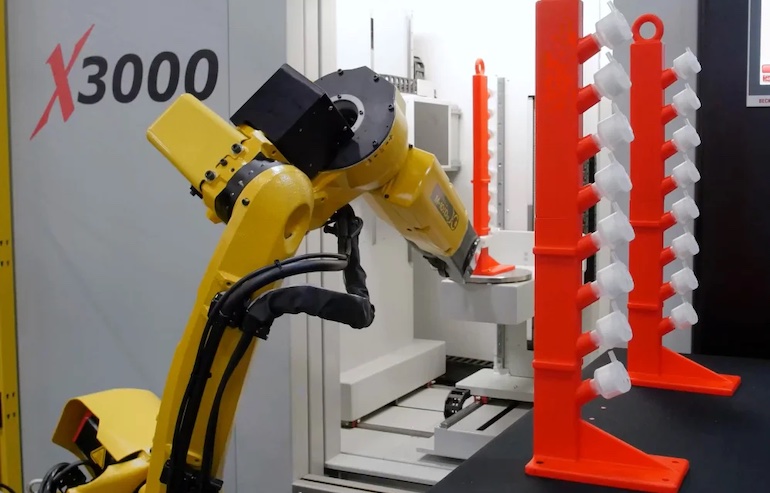
Today’s CNC machine tending robots handle a range of tasks. Source: FANUC America
Robotic arms and CNC machines have long shared factory floors, but now they’re working hand-in-hand, dramatically expanding what manufacturers can achieve. What began as basic, single-purpose automation has evolved into fully integrated production workflows.
Robots can now enhance and actively broaden what CNC machines are capable of — enabling longer operating times, greater output, and significantly reduced reliance on manual labor.
Key factors fueling the rise of modern CNC machine tending
For years, automation in CNC settings meant a standalone unit handling one specific job. Today’s setups look very different. A robotic arm now picks up a raw blank, moves it between machines, inspects the completed part, and sends it further down the line — all without any human involvement.
According to a Deloitte study, as many as 1.9 million of the 3.8 million manufacturing roles that need to be filled by 2033 may remain vacant due to skills shortages. That workforce challenge is one of the most compelling reasons manufacturers are adopting robotic machine tending.
A single robotic arm can now handle part positioning, in-process quality checks, deburring, and transfers between machines — all within the same automated cell. This eliminates entire stages of the production process that previously depended on manual labor. It’s not just a small workflow tweak; it’s a fundamental redesign of the production model.
CNC machines represent significant capital investments that often sit unused outside of staffed shifts when operated manually. Robotic arms make lights-out manufacturing possible, autonomously handling material changes overnight and throughout weekends.
This tight integration also removes the inconsistencies of manual loading. Operator fatigue, uneven grip, and slight misalignments build up over a shift and show up as scrap or rework. Robotic arms position every part into a chuck or fixture with identical orientation and force, every single time — allowing CNC machines to consistently perform at their full designed capacity.
How top manufacturers are leveraging robotic CNC integration
Manufacturers are shifting from trial programs to large-scale rollouts, and the companies at the forefront provide a clear snapshot of where robotic CNC integration stands today. From ready-to-deploy hardware solutions to brand-neutral software platforms, here are five industry leaders putting robotic arms to work alongside CNC machines.
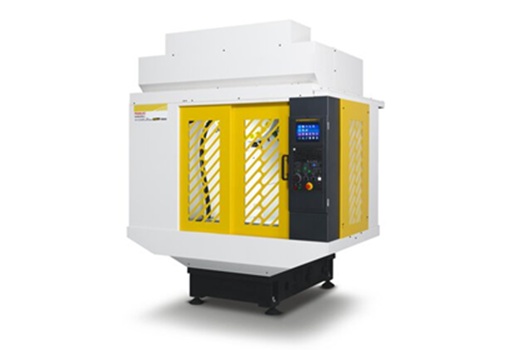
The ROBODRILL vertical machining center, with five-axis integrated technology. Source: FANUC
FANUC’s ready-made systems for ROBODRILL machines
FANUC engineers its robotic arms to seamlessly pair with its own ROBODRILL vertical machining centers. In 2024, the company introduced the ROBODRILL α-D28LiB5ADV Plus Y500 with the R-50iA controller, featuring a built-in vision system for part identification and placement confirmation.
A case study from APT Manufacturing Solutions also recorded a 33% boost in efficiency on a FANUC-tended ROBODRILL line. Production rose from 100 to over 150 parts per eight-hour shift, with return on investment (ROI) reached in just 33 weeks.
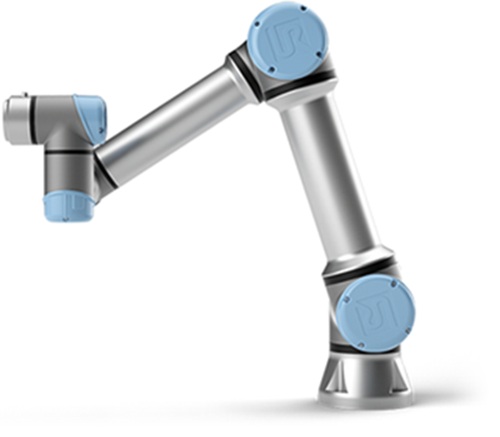
Toolcraft used the UR5e cobot to improve medical device production. Source: Universal Robots
Universal Robots and collaborative machine tending
Universal Robots designed its cobot range specifically to operate safely alongside workers without the need for safety cages. This is a crucial advantage for small-to-midsize shops with limited floor space. Toolcraft, a Seattle-based machine shop, implemented the UR5e cobot for a three-step CNC process on a medical device component.
The UR5e’s 30-micron repeatability allowed multi-threaded parts to be precisely positioned across three sequential fixtures, resulting in a 23% cut in production costs and a 43% jump in throughput.
KUKA’s strategy for high-precision operations
KUKA has earned its reputation on high-payload, high-precision systems built for tough industrial settings. Its KUKA.CNC software lets robots be programmed using G-code — the same language CNC operators are already familiar with. The KR Quantec Nano has been deployed in CNC tending cells equipped with automated tool changers, probes, and 3D scanners for in-process measurement.
In aerospace and defense, these capabilities are essential. When a KUKA robot repositions components between operations, its precision must match the machining precision. Any placement deviation carries directly into dimensional errors in the finished part.
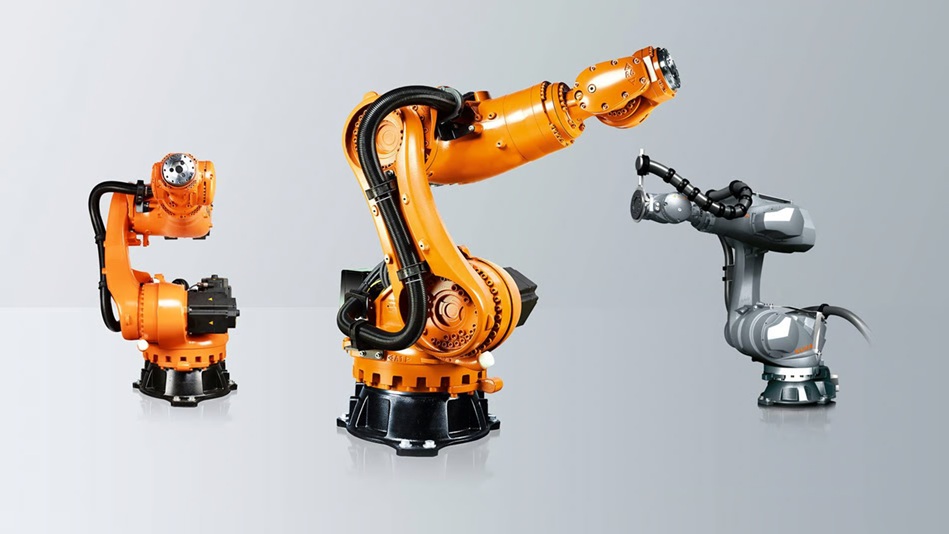
The KR Quantec Nano works seamlessly with the KUKA.CNC software platform. Source: KUKA
ABB and the growth of standardized flexible loading
The complexity of deployment has long been a major obstacle when integrating robots into CNC operations. ABB addresses this challenge with its FlexLoader M—a pre-built, modular tending cell offered in six different configurations for lathes, milling machines, and machining centers. Most installations are completed in just one to two days.
An integrated setup wizard allows operators to introduce new workpieces in under five minutes, while switching between pre-programmed parts takes less than a minute. According to ABB, the FlexLoader M achieves machine utilization rates above 97%, compared to the 40% to 60% typically seen in manually staffed setups.
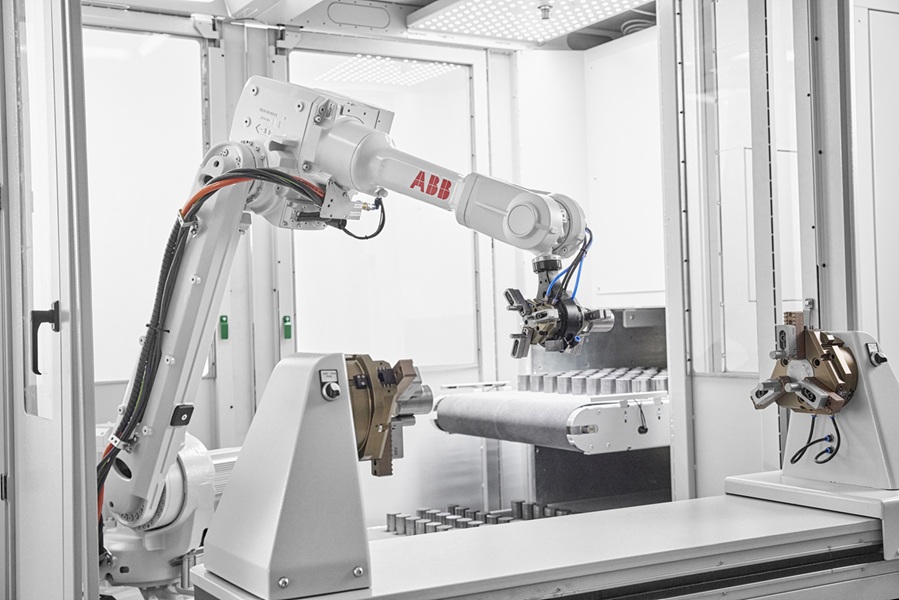
The ABB FlexLoader highlights its modular and versatile capabilities. Source: ABB
RoboDK’s simulation and offline programming tools
Each major robot manufacturer relies on its own proprietary programming language, which has traditionally required shops to develop and maintain separate expertise for every brand they use. RoboDK solves this problem with a manufacturer-independent platform that supports more than 1,200 robot models from over 50 different brands.
The software produces native code for ABB RAPID, FANUC LS, KUKA KRC, and Universal Robots—all from one unified interface. It also translates five-axis G-code directly into robot programs, allowing robotic arms to carry out machining operations that once demanded dedicated CNC machinery.
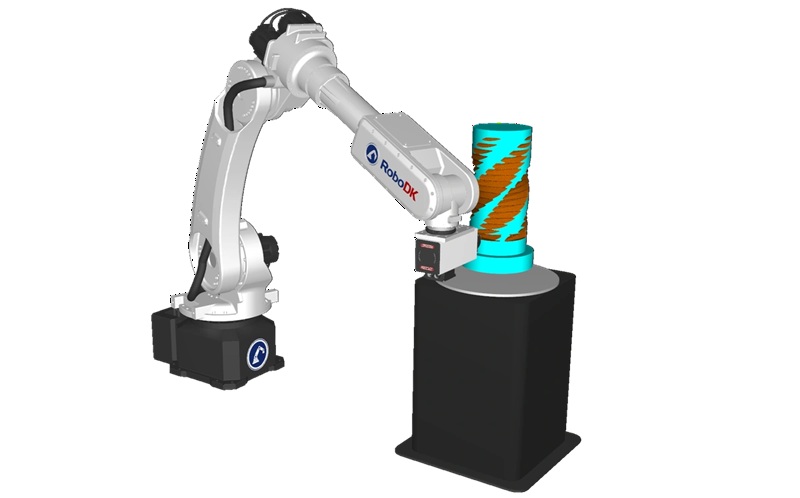
A visualization screen from RoboDK’s cutting-edge CAM software platform. Source: RoboDK
The future of CNC machining is fully autonomous
The groundwork being laid today by FANUC, Universal Robots, KUKA, ABB, and RoboDK is already delivering real results. The open question is just how much more central robots will become as artificial intelligence continues to advance.
A robot that loads parts today operates based on fixed instructions. But a robot that monitors spindle load, identifies tool wear in real time, and independently determines whether a part meets quality standards represents a fundamentally different role in the manufacturing process.
 About the author
 About the author
Lou Farrell is a senior editor at Revolutionized, where he has covered robotics, computing, and technology for many years. He brings a deep passion to both the subjects he writes about and the craft of writing itself.
This article is reposted with permission.
