



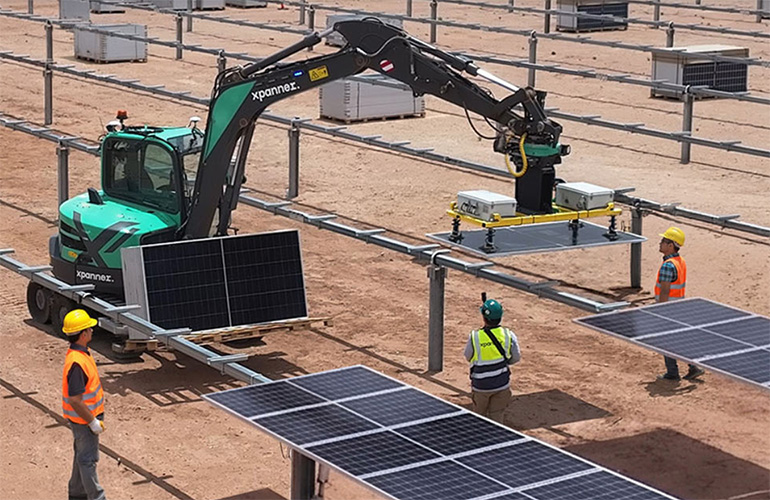
**Xpanner’s X1 Panel Lift: Automating Solar Installation for a Skilled Labor Market**
The solar energy industry continues to face a significant challenge: a shortage of skilled labor. Large utility-scale projects traditionally require extensive manual effort for handling and installing heavy photovoltaic panels. In response to this constraint, Xpanner Global has unveiled its X1 Panel Lift system, a robotics solution designed to automate material handling on solar job sites.
The platform represents an expansion of Xpanner’s existing capabilities. Originally developed for solar pile-driving, the X1 Panel Lift has been adapted for automated panel lifting and replacement when used with excavators. According to the company, the system is engineered to handle the repetitive task of moving panels, allowing installation crews to focus on higher-value activities such as alignment, fastening, and quality checks.
**How the X1 Panel Lift Works**
The X1 Panel Lift is built around the proprietary Mango controller, which uses sensor fusion to enable real-time decision-making. The system integrates data from lidar, vision, and GNSS sensors to create a live 3D map of the jobsite. This situational awareness is intended to ensure consistent performance even when field conditions vary.
Because the software and sensing hardware operate on top of a standard excavator, Xpanner says the same architecture can be extended to other workflows through software updates, without requiring new equipment purchases.
The system is delivered through an “Automation-as-a-Service” subscription model. This package includes the hardware, the X1 kit and license, access to the Xpanner Connect dashboard, and on-site field operations support.
**Key Features and Deployment Details**
During a question-and-answer session, Xpanner leadership provided further insight into how the technology is being deployed:
* **Operator Requirements:** Only one operator is needed to control the system from outside the excavator cabin, using a single-button interface to execute the full installation process. While panel bolting is still performed manually, a three-person crew is recommended under ideal conditions to maintain workflow efficiency. The system allows the operator to manage panels across two adjacent rows simultaneously.
* **Site Mapping:** Mango does not require pre-mapping of the jobsite. Instead, it builds its understanding based on customer-provided site information. After installation, the data is reflected in real time to create a digital twin of the work completed.
* **Equipment Integration:** The X1 Kit is designed as a retrofit solution and is not tied to specific excavator brands. Contractors can use their existing equipment by integrating the Xpanner suction device, automation tech box, and user interface.
* **Training and Safety:** The system is designed for ease of use, typically requiring only one to two hours of safety and automation training. Safety is prioritized through guided operation via the integrated user interface.
* **Return on Investment:** Potential ROI is driven by reduced labor needs, lowered physical strain, and decreased injury risk, which can reduce workers’ compensation costs. The digital twin functionality also improves schedule predictability, helping to avoid costly delays.
**Frequently Asked Questions (FAQ)**
**Q: How many people are required to operate the X1 Panel Lift robot? Is the bolting of panels onto a frame done manually?**
A: Only one operator is required to operate the system using a controller from outside the cabin. Panel bolting is performed manually. Under ideal conditions, a three-person crew is recommended for optimal efficiency.
**Q: Does Mango require prior mapping of the jobsite?**
A: No. Mango builds its understanding of the site based on customer-provided jobsite information during setup. Once work is complete, the installation data is updated in real time to create a digital twin.
**Q: How much integration is required between X1 Panel Lift and existing excavators? Are there certain brands you work with?**
A: The X1 Panel Lift is a retrofit kit and is not dependent on specific excavator brands. It can be integrated with existing equipment through the Xpanner X1 Kit, suction device, automation tech box, and user interface.
**Q: How much training is required? Are there safety standards that need to be complied with?**
A: Operators typically need about one to two hours of safety and automation training. The system is designed to be safe to operate from Day 1, provided users follow the interface guidance.
**Q: What is the estimated return on investment (ROI) for the new system?**
A: ROI is achieved through labor efficiency, reduced physical strain and injury risk, and more consistent installation quality. The digital twin system also provides real-time visibility into progress, improving schedule predictability and reducing the risk of costly delays.
**Conclusion**
Xpanner’s X1 Panel Lift offers a direct response to the skilled labor shortage affecting the solar industry. By automating repetitive material handling tasks, the system enables smaller crews to manage larger projects while maintaining focus on precision work. Its retrofit design, subscription-based model, and sensor-driven autonomy make it a flexible solution for both new and existing solar installations. As the company expands its reach, the X1 Panel Lift could play a key role in improving efficiency, safety, and cost predictability across the solar supply chain.
