



**Walden Robotics: Pioneering the Next Generation of General-Purpose Robotics**
In a significant development for the field of physical AI, Walden Robotics has emerged from stealth mode with a staggering $300 million in funding. The company, born from the innovative research at MIT and the Toyota Research Institute, is on a mission to deploy robots that don’t just perform repetitive tasks, but continuously learn and improve while working. With a valuation of $1.1 billion, Walden is positioning itself as a leader in the race to build general-purpose robotics capable of delivering real-world value.
### The Birth of a General-Purpose Robot
Walden Robotics was founded by Dr. Russ Tedrake, a renowned professor at MIT and former senior vice president of large behavior models at Toyota Research Institute (TRI). He has assembled a powerhouse team of experts from MIT, Stanford, and Amazon, many of whom are credited with inventing core innovations now used by nearly every physical AI and humanoid startup.
The company’s name is a deliberate nod to Henry David Thoreau’s book, “Walden.” This choice reflects the company’s foundational principle: to use transformative technology not to replace humans, but to expand human potential and enable people to work, craft, and live with greater purpose. As Dr. Tedrake stated, the excitement surrounding physical AI has created a window of opportunity for “disruptive change,” but this change must be grounded in a deep understanding and respect for how manufacturing is done today.
### Technology and Approach: Learning by Doing
Walden Robotics combines large behavior models (LBMs) with real-world operations. Their approach is built on a decade of research into diffusion policy, the Universal Manipulation Interface (UMI), OpenVLA, and the Drake open-source simulator. This technological foundation allows their robots to quickly learn new tasks, such as machine tending, tool setting, parts kitting, and assembly.
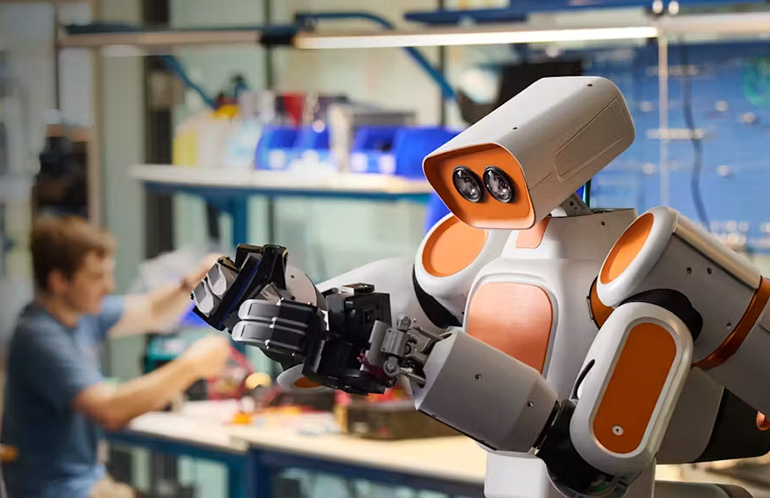
Their robots feature a humanoid torso with two arms and a wheeled base. This semi-humanoid design is a pragmatic choice, as it is easier to certify for safety in factory environments. To train their robots, Walden employs a blend of imitation learning, simulation, and teleoperation, ensuring the machines can handle complex dexterous manipulation. The company is developing its technology in-house, maintaining a “full stack” of hardware, software, AI, and application layer to ensure complete control over the system’s capabilities and performance.
### From Pilot to Production
A key focus for Walden is deployment. Since February, their general-purpose robots have been operational at a Toyota plant in North America, successfully transitioning from a pilot program to handling production manufacturing and logistics tasks in under two months. This rapid deployment is a testament to the company’s pragmatic approach, which prioritizes real-world application over theoretical perfection.
Walden Robotics asserts that its robots and AI are designed to address critical industry challenges, including labor shortages, demographic shifts, competitive pressure, and increased demand. They envision their robots being useful across a wide array of sectors, with strategic partners already established in automotive, aerospace, semiconductors, electronics, and life sciences.
### Conclusion
Walden Robotics represents a new wave in robotics, moving beyond simple automation toward systems that are adaptable, intelligent, and collaborative. By focusing on continuous learning and real-world deployment, the company aims to create tools that augment human capabilities and make work more purposeful. With substantial funding from industry titans like Toyota and NVIDIA, and a team of proven experts, Walden Robotics is well-positioned to move from the factory floor to a transformative force in the global manufacturing landscape.
***
### FAQ Section
**Q: What is Walden Robotics?**
A: Walden Robotics is a company developing general-purpose robots powered by physical AI. The company emerged from stealth with $300 million in funding and a valuation of $1.1 billion. Its mission is to build robots that continuously learn while working to perform real tasks in industrial environments.
**Q: Who are the founders of Walden Robotics?**
A: Walden Robotics was founded by Dr. Russ Tedrake, a professor at MIT and former senior vice president of large behavior models at Toyota Research Institute (TRI). His co-founders include experts in robotics and AI from Stanford University and Amazon.
**Q: What makes Walden’s robots different?**
A: Walden’s robots are designed as general-purpose systems capable of learning new tasks continuously, rather than being programmed for a single, specific job. They utilize large behavior models (LBMs) and are built with a pragmatic “full stack” approach, combining hardware, software, and AI for real-world deployment.
**Q: Where are the robots being used right now?**
A: As of the article’s publication, Walden’s general-purpose robots are actively working at a Toyota plant in North America, performing manufacturing and logistics tasks.
**Q: What technologies does Walden Robotics use?**
A: The company’s technology stack is built on decades of research into diffusion policy, the Universal Manipulation Interface (UMI), OpenVLA, and the Drake open-source simulator. They also employ imitation learning, simulation, and teleoperation for training their robots.
**Q: What is the significance of the company’s name?**
A: The name “Walden” is an allusion to Henry David Thoreau’s book, “Walden.” It reflects the company’s core principle of using robotics to expand human potential and enable people to work and craft with greater purpose, rather than to simply replace them.
