



## Benjamin Cowen’s Q4 2026 Bitcoin Bottom Forecast: Key Insights
Benjamin Cowen, a member of BeInCrypto’s Market Intelligence experts council, recently outlined a compelling case for the next Bitcoin bottom occurring in the fourth quarter of 2026. His seasonal analysis suggests a potential floor near $44,000, aligning closely with the $44,000 to $47,000 range identified by BeInCrypto’s models just one week prior. The framework has now formally transitioned into bottom-watch mode, emphasizing that the upcoming bottom will likely be defined by time rather than a specific price level.
### The 2019 Analog Runs Out of Time
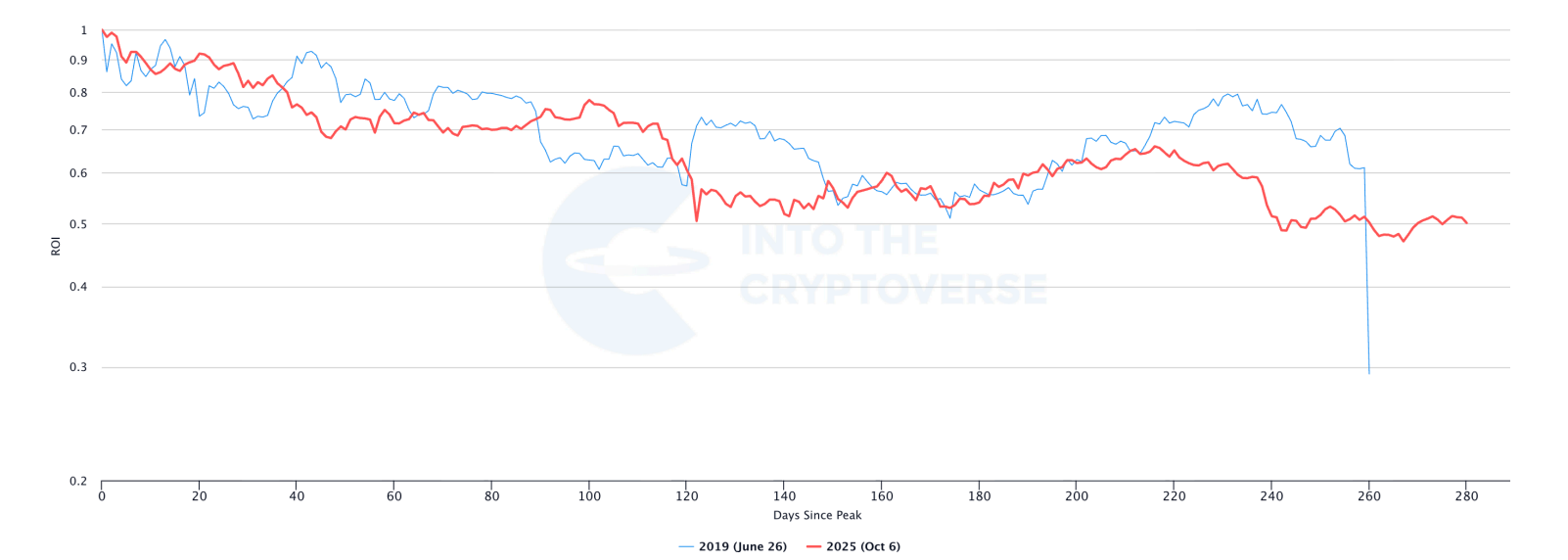
Cowen’s analysis draws a direct comparison between the October 2025 peak and the June 2019 top. Both occurred during periods of market apathy, prior to the conclusion of quantitative tightening. Bitcoin has been in a drawdown for 282 days—slightly longer than the 261-day drawdown seen in 2019 before the pandemic-induced reset.
Cowen attributes the previous reset to an external shock (the pandemic), but suggests this cycle may require only time to achieve a similar reset. Indicators such as retail attention remain subdued, with YouTube views near 389,000, a stark decline from the 4 million seen during the 2021 peak. This “apathy signature” reinforces the notion that we are in a quiet, consolidation phase rather than an accumulation zone.
### Midterm Years Save the Worst for Last
2026 is a midterm election year, historically the weakest segment of Bitcoin’s four-year cycle. Reviewing past midterms (2014, 2018, 2022), each experienced declines in the second half, with August and September typically posting losses of 15% to 18%.
While July 2026 has shown relative strength, historical trends point to weakness in the coming months. Cowen’s year-to-date measure has rebounded to 0.731, above the midterm average, but projecting historical decay patterns would place it near 0.49 by year-end, correlating to a price around $43,800. Although these are illustrative projections, the directional trend aligns with prior midterm cycles. Compounding this pressure are macroeconomic factors including elevated real interest rates as the Federal Reserve maintains a restrictive stance while disinflation takes hold.
### Why the On-Chain Reset Isn’t Done
On-chain metrics provide further evidence that the bottom has not yet formed. The MVRV Z-Score currently sits at 0.395, and historical bottoms have occurred only after this metric dropped below zero. For price to trade below the realized price (near $53,000) is a prerequisite for a reset, with early summer lows approaching but not breaching this level.
Cowen’s $43,800 estimate places Bitcoin within the corridor between the realized price and the balanced price ($37,700). Supporting this view, on-chain risk scores (Bitcoin risk at 0.311 and supply profit/loss risk at 0.188) remain far lower than peaks seen during previous cycles. While the on-chain reset is underway, it remains less extreme than the distressed conditions of July 2022. BeInCrypto’s models had signaled this zone one week earlier, with a final bottom projected between $44,000 and $47,000 by early October.
A logarithmic Fibonacci retracement midpoint sits at $44,428, closely aligning with Cowen’s estimate. Institutional forecasts echo this range, with Standard Chartered positing a $59,000 floor and Galaxy outlining a $40,000 scenario—both rejecting a deeper crash for this cycle.
### Bitcoin Bottom Watch Is On, But Confirmation Is Far Away
A key trigger for Cowen is the supply profit and loss cross. The brief period where supply in loss exceeded supply in profit during the summer bottom historically preceded entry into bottoming phases. Since then, supply in profit has rebounded to 56.83%, and Cowen interprets this whipsaw as typical of a multi-month bottoming process rather than a single event.
Structural demand has cooled, with ETF holdings peaking above 1.25 million BTC in late 2025 and subsequently declining, particularly in recent weeks. Price action also tells a similar story; although Bitcoin reclaimed its 200-week SMA near $63,100, a similar pattern in 2022 preceded the final low. Confirmation of a bottom requires two consecutive weekly closes above the 50-week SMA near $86,500—a level currently 37% below the present price of $63,158.
However, the bull case remains intact. Bitcoin is trading at the first percentile of its long-term quantile model, ETF demand could provide a supportive floor, and forced selling may remain limited. For now, the convergence of the calendar, on-chain data, and BeInCrypto’s models points to the same window: the fourth quarter of 2026. The immediate test comes quickly, as August 2026 will reveal whether the midterm pattern repeats or breaks.
## Frequently Asked Questions (FAQ)
**What is Benjamin Cowen’s Bitcoin bottom prediction?**
Benjamin Cowen predicts that the next Bitcoin bottom will occur in the fourth quarter of 2026, with a potential floor near $44,000.
**Which framework is Cowen using for his analysis?**
Cowen uses a seasonal and on-chain framework that compares the current cycle to the 2019 analog, incorporating metrics such as the MVRV Z-Score, supply profit and loss, and historical midterm cycles.
**How does the 2019 analog influence the 2026 prediction?**
The 2019 analog suggests that without an external shock like the pandemic, the current cycle may require time to complete its reset, aligning the bottom with Q4 2026.
**Why is 2026 considered a critical year for Bitcoin?**
2026 is a midterm election year, which historically has been the weakest period in Bitcoin’s four-year cycle, often resulting in declines during August and September.
**What role do on-chain metrics play in this analysis?**
On-chain metrics like the MVRV Z-Score indicate that the market has not yet bottomed, as values have not dropped below zero, a condition seen prior to previous cycle lows.
**What is the “supply profit and loss cross”?**
This metric tracks the balance between supply held at a profit versus at a loss. A shift where supply in loss temporarily exceeds supply in profit has historically signaled entry into bottoming phases.
**How do ETF holdings affect the current outlook?**
ETF holdings peaked in late 2025 and have since declined, reducing the marginal bid that previously absorbed selling pressure, which supports a lower price floor scenario.
**What confirmation is required to signal a bottom?**
Cowen states that confirmation requires two consecutive weekly closes above the 50-week SMA near $86,500, a level currently not near present prices.
**How does BeInCrypto’s analysis align with Cowen’s?**
BeInCrypto’s models projected a bottom between $44,000 and $47,000 one week before Cowen’s memo, showing strong alignment on timing and price range.
**Is there a bull case despite the bearish outlook?**
Yes, Cowen notes that Bitcoin is at the first percentile of its long-term quantile model, and absent forced sellers could lead to a final flush, though this may take months rather than weeks.
## Conclusion
Benjamin Cowen’s July memo, supported by on-chain data and historical seasonality, paints a picture of Bitcoin entering a bottoming phase with the next major low likely occurring in the fourth quarter of 2026. The convergence of the 2019 analog, midterm year patterns, and on-chain metrics such as the MVRV Z-Score and supply profit/loss cross all point toward a potential floor near $44,000. While confirmation of a bottom remains months away, the alignment between multiple frameworks strengthens the argument for a Q2026/early Q42026 bottom. For now, the market appears to be in a period of accumulation and consolidation, with the next critical tests coming during the August 2026 midpoint and beyond.
