



**Navigating the New Frontier: How California’s AV Regulations Are Reshaping Autonomous Vehicle Deployment**
California has long been a bellwether for technology and transportation policy, and its latest regulatory moves underscore its pivotal role in shaping the future of autonomous vehicles (AVs). Recent changes to California’s AV regulations mark a significant shift from the industry’s early “move fast and break things” ethos to a framework emphasizing accountability, safety, and rigorous compliance. These new rules are not only setting a high bar for AV deployment but also highlighting the critical role of advanced remote monitoring and control systems in meeting regulatory demands.
### A New Era for Autonomous Vehicles
Harold Braun, executive chairman and CEO of Guident, shared insights with *The Robot Report* on how these regulatory changes are influencing the AV landscape. “From what California did, it shows very clearly that California is continuing to lead the way in autonomous vehicle technology deployment,” Braun noted. “What happened in California at the moment is very important, is a game changer, because it opens the pathway to not only testing in a geo-fenced area but also allowing it to happen right on a public road.”
This shift is significant because it allows AVs to interact directly with public roads, bringing both opportunities and challenges. As AVs move from controlled testing environments to real-world scenarios, ensuring their safety and reliability becomes paramount.
### The Regulatory Framework: Safety and Accountability
California’s new regulations are comprehensive, addressing everything from emergency responses to data reporting. Here are the key requirements that AV developers must navigate:
1. **Notice of Noncompliance**: Police officers can issue formal citations to driverless vehicles for traffic violations, with reports sent directly to manufacturers and the state DMV.
2. **72-Hour/24-Hour Reporting**: Manufacturers must submit vehicle data and telemetry within 72 hours of receiving a noncompliance notice, or within 24 hours for “priority review” violations.
3. **Emergency Geofencing**: Authorities can impose digital geofencing during crises, requiring AVs to reroute or leave the area within two minutes.
4. **First Responder Communication**: Driverless vehicles must include a two-way communication system accessible to first responders, with remote human operators required to respond within 30 seconds.
5. **Pre-Collision Data Capture**: Vehicles must store at least 30 seconds of read-only sensor data prior to any collision, ensuring investigators can access crucial information.
6. **Stepped Testing Mileage**: Light-duty AVs must log 50,000 autonomous miles with a safety driver and another 50,000 miles under a testing permit before commercial deployment.
7. **Heavy Freight Mileage Hurdles**: Autonomous trucks over 10,001 lbs must log 1 million autonomous miles, including 200,000 miles on California public roads, before commercial deployment.
8. **Weigh-Station Compliance**: Autonomous semi-trucks must adhere to the same weigh station rules as human-driven trucks.
9. **Remote Driver Requirements**: Remote operators must be physically located in the U.S. and hold a valid California driver’s license, along with a state-issued AV operating permit.
10. **Permit Revocation**: The DMV can immediately suspend permits for fleets with repeated hardware or software failures or those that interfere with emergency responses.
### How Guident is Enabling Compliance
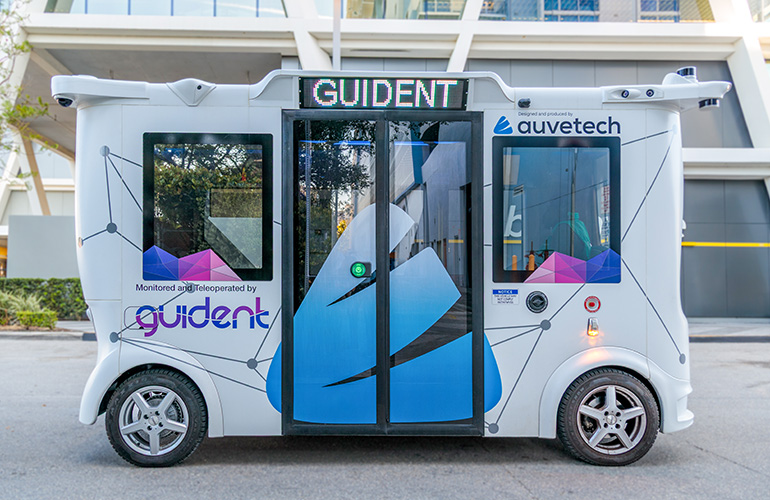
Guident’s Remote Monitor & Control Center (RMCC) is designed to meet these regulatory demands head-on. The RMCC provides capabilities for remote monitoring, assistance, control, teleoperation, and analytics, ensuring AV developers can comply with California’s stringent requirements.
For instance, the RMCC facilitates real-time interaction between remote operators and AVs, enabling quick responses to emergencies and first responder requests. Its embedded personal communication module ensures seamless two-way communication between remote operators, vehicle passengers, and external stakeholders.
### The Road Ahead
As California leads the way in AV regulation, other states and regions are likely to follow suit. The framework established in California not only prioritizes public safety but also provides a clear pathway for AV developers to innovate responsibly. For companies like Guident, these regulations underscore the importance of robust remote monitoring and control systems as the backbone of compliant and safe autonomous vehicle deployments.
In a world where autonomy is increasingly becoming reality, the ability to navigate regulatory complexities while ensuring safety and reliability will define the leaders in this transformative industry.
—
**Original Article Source:**
[Tickets, geofences, and 1M miles: The new reality of California AV compliance](https://www.therobotreport.com/tickets-geofences-1m-miles-new-reality-california-av-compliance/) by The Robot Report.
