



Based on the provided content, here is a new structured article with added FAQ and Conclusion sections.
—
# Error Diffusion: Training Dale-Compliant Networks Without Weight Transport
Sakana AI’s recent paper “Diffusing Blame” introduces **Error Diffusion (ED)**, a local learning rule that challenges the dominance of backpropagation in deep learning. By respecting **Dale’s principle**—that neurons should have uniform synaptic sign constraints—and avoiding weight transport entirely, ED offers a biologically plausible alternative to conventional training methods.
## What is Error Diffusion?
Error Diffusion is a local learning rule where each weight update depends on only three signals: presynaptic activity, a postsynaptic activation derivative, and a single global error sign. Unlike backpropagation, ED does not require transposed forward weight matrices, eliminating the **weight transport problem** that is unlikely to be supported by biological circuits.
Previous implementations of ED were limited to binary classification and MNIST datasets. The Sakana AI work extends its applicability significantly.
## The Dual-Stream Architecture
To satisfy Dale’s principle while enabling powerful learning, the researchers split every layer into two non-negative streams:
– An **excitatory stream (p)**
– An **inhibitory stream (n)**
Forward computations involve excitatory-minus-inhibitory pre-activations, with all learnable weights constrained to be non-negative. Cross-stream connections are inhibitory by design, resulting in approximately **4× more parameters** than a single-stream network.
## Modulo Error Routing
The key innovation enabling ED to move beyond binary classification is **modulo error routing**. Each hidden unit is assigned a fixed output channel via:
[
r(i) = i mod C
]
where (C) is the number of output classes. Hidden units learn from the error component routed to their assigned channel, without reliance on random feedback matrices.
## Three Classification Innovations
To make ED effective for multi-class classification, three additional techniques are introduced:
1. **Layer-specific sigmoid widths**: Wider sigmoids prevent saturation and maintain strong gradients through deep layers.
2. **Batch-centered class error**: Per-class error centering reduces bias from imbalanced targets.
3. **Asymmetric initialization**: Excitatory weights are initialized 1.5× larger than inhibitory ones, stabilizing the E/I balance.
## Performance Results
With these innovations, ED achieves:
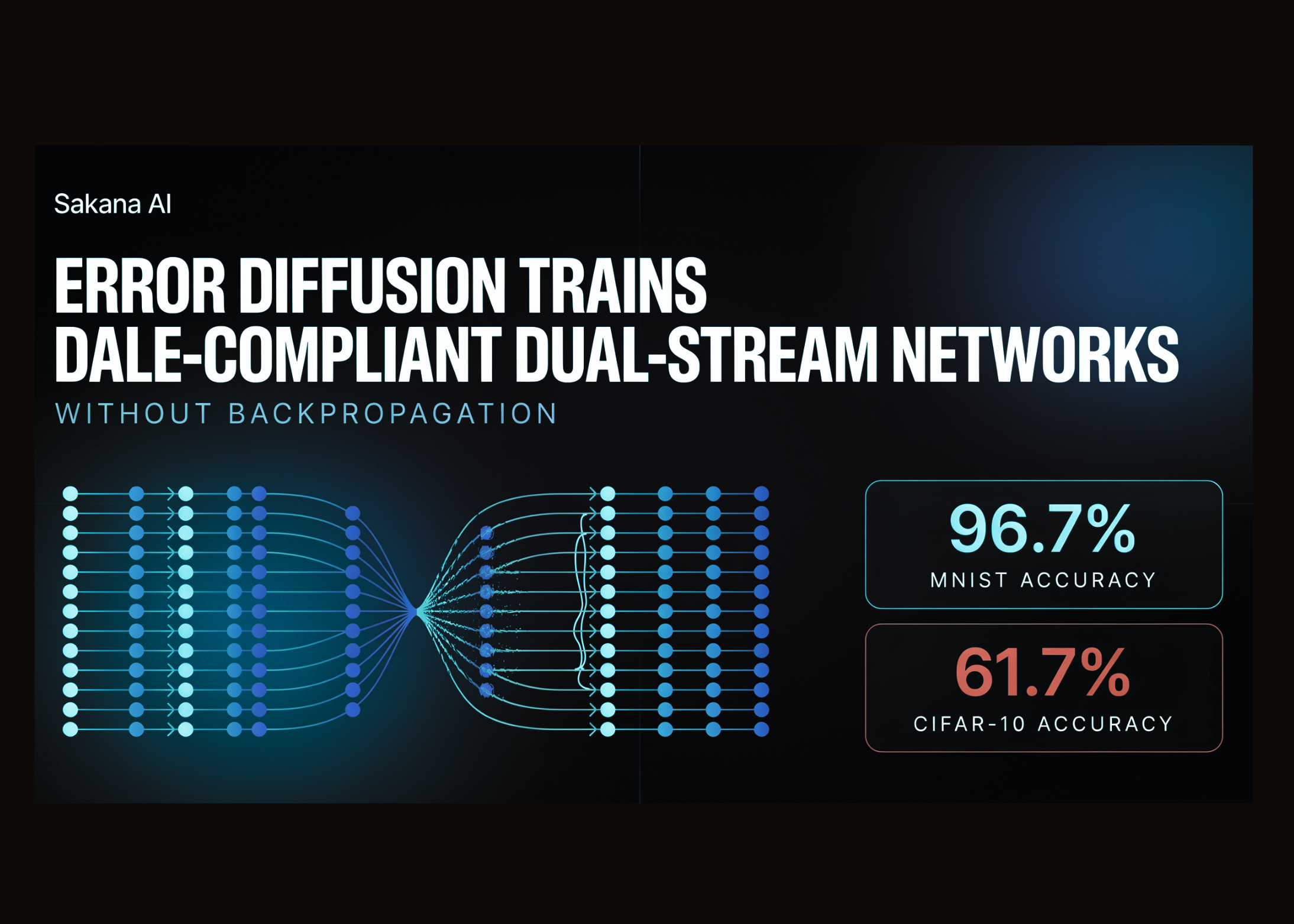
– **96.7% accuracy on MNIST**
– **61.7% accuracy on CIFAR-10**
While slightly behind DFA (97.6% / 69.1%), ED satisfies Dale’s principle, avoids negative weights, and represents the first application of ED to convolutional networks.
## Error Diffusion in Reinforcement Learning
The researchers also integrate ED with Proximal Policy Optimization (PPO), creating **ED-PPO**. Tested across Brax environments, ED-PPO:
– Matches DFA-PPO performance
– Outperforms backpropagation on certain locomotion tasks
– Shows robustness in open-ended RL settings where random feedback struggles
## Use Cases and Advantages
Error Diffusion is particularly suitable for:
– **Neuromorphic and photonic hardware**, where non-negative weights are physically natural
– **Model compression**, since inhibitory connections are heavily pruned
– **Continual and open-ended learning**, thanks to its inhibitory stream
## Comparison to Other Methods
Unlike most backpropagation-free rules, ED maintains biological plausibility without sacrificing performance. It bridges the gap between strict Dale-compliant architectures and high-accuracy deep learning.
## Minimal Code Sketch
Below is a simplified implementation of the dual-stream forward pass and routed error update:
“`python
import torch
def dual_stream_forward(p, n, Wpp, Wnp, Wnn, Wpn, bp, bn, phi):
p_next = phi(p @ Wpp – n @ Wnp + bp)
n_next = phi(n @ Wnn – p @ Wpn + bn)
return p_next, n_next
def routed_error(S, H, C):
M = torch.zeros(H, C)
for i in range(H):
M[i, i % C] = 1.0
return S @ M.T
def ed_update(A_p, Z_p, R, phi_deriv):
U_p = phi_deriv(Z_p) * R
return A_p.T @ U_p
“`
## Key Takeaways
– Sakana AI’s Error Diffusion enables **Dale-compliant learning** without weight transport
– **Modulo error routing** extends local learning rules to multi-class and convolutional problems
– Three architectural innovations reverse in importance depending on the task
– ED-PPO brings the same framework to reinforcement learning with competitive results
– While slightly less accurate than DFA, ED offers a **biologically realistic** path forward
—
## Frequently Asked Questions (FAQ)
**What is the weight transport problem?**
The weight transport problem refers to the need in backpropagation for exact transposes of forward weight matrices during the backward pass. Biological networks are unlikely to support this due to the constraints of Dale’s principle and synaptic constraints.
**What is Dale’s principle?**
Dale’s principle states that a neuron should release the same neurotransmitter at all of its synapses. In network terms, this means neurons should have uniform synaptic signs—either excitatory or inhibitory—rather than mixing positive and negative weights within a single layer.
**How does Error Diffusion differ from traditional backpropagation?**
ED uses only local signals and a single global error sign. It does not require weight matrices to be transposed or transported backward through the network, making it more biologically plausible.
**Why is modulo error routing important?**
Modulo error routing assigns each hidden unit to a specific output class channel. This allows ED to scale beyond binary classification by routing errors directly to the corresponding hidden units without random feedback.
**Does Error Diffusion work better than backpropagation?**
Not always. While ED achieves strong, biologically plausible results, backpropagation—via DFA—still leads to slightly higher accuracy on standard benchmarks. The trade-off is adherence to biological constraints.
**Can Error Diffusion be used for reinforcement learning?**
Yes. The paper demonstrates that ED can be integrated with PPO, producing competitive or superior results in certain continuous control and sparse-reward environments.
—
## Conclusion
Sakana AI’s “Diffusing Blame” presents a compelling step toward biologically plausible learning in deep networks. By introducing **Error Diffusion**, the researchers show that high-accuracy training is possible without weight transport or random feedback matrices. Through dual-stream architectures, modulo error routing, and carefully designed normalization strategies, ED achieves state-of-the-art compliance with Dale’s principle.
While not surpassing backpropagation outright, ED proves that performance and plausibility are not mutually exclusive. Its extension to reinforcement learning further broadens its applicability. For researchers interested in **neuromorphic computing**, **continual learning**, or **theoretical neuroscience**, Error Diffusion offers both a practical tool and a conceptual breakthrough in how credit assignment can be reimagined.
—
