



**The 370-Billion-Dollar Race: How Integrated Design Can Help Humanoid Manufacturers Succeed in a Rapidly Growing Market**
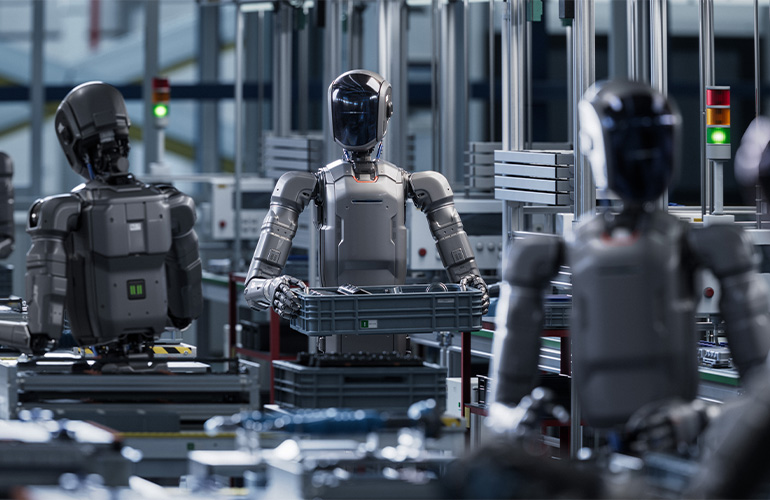
**Image Caption:** *The future of humanoid robotics involves machines that are as adaptable and intelligent as they are powerful. (Image: Siemens sponsored feature for The Robot Report)*
**Introduction: The Dawn of Adaptive Robotics**
Imagine a manufacturing floor where robots don’t just repeat the same motion thousands of times but adapt to new tasks. They’re able to navigate cluttered spaces, manipulate unfamiliar objects and switch between tasks as fluidly as human workers. They can climb stairs, squeeze into tight assembly areas and collaborate seamlessly alongside people in environments designed for human bodies.
This is the future of humanoid robotics, and it’s closer than most people realize. The implications are staggering. Humanoid robots could revolutionize manufacturing by bringing unprecedented flexibility to production lines. Unlike traditional industrial robots bolted to factory floors, humanoid robots can move between workstations, handle diverse products and adapt to changing production needs without expensive retooling. They could transform warehouses, logistics operations and hazardous environments where human workers face risk.
The market agrees. In their report “The future of robotics: Intelligent, adaptable, and on your team,” McKinsey reported that while the general-purpose robotics market is valued at under $1 billion today, if progress continues at the current rate, it could reach a value of $370 billion by 2040. Major players from Tesla to Figure AI are rushing to commercialize humanoid platforms. However, due to the sheer complexity of these robots, significant hurdles remain before they are broadly commercially adopted.
—
### The Core Challenge: Disconnected Design and Simulation
The technical challenges of building humanoid robots are immense. An average humanoid robot has dozens of articulated joints which must be carefully coordinated with precise mass, inertia and center of gravity control. Even the slightest change in structure can lead to cascading impacts on balance, gait, reach and energy efficiency.
To effectively navigate these design hurdles, manufacturers need sophisticated software tools that seamlessly integrate design and simulation. Unfortunately, while most manufacturers have mature computer-aided design (CAD) processes, their overarching workflows were built for a completely different environment and era. One of the key challenges is that most humanoid programs still lean on disjointed methods to bring mechanical designs into robotic simulation and control environments.
On many teams, kinematic models are still rebuilt by hand, with key variables like mass and inertia approximated rather than derived from real geometry and joint definitions. This causes drift between design and control representations, which compromise simulation accuracy and lead to early freezes of mechanical designs to avoid complicated downstream reworks. And while virtual prototyping can save millions for manufacturers, it’s only a viable option if those simulations stay perfectly synchronized with evolving designs.
For manufacturers racing against time and competitors, overcoming these inefficiencies will be key to staking out broader market share. To create viable, fully functioning humanoids for the factory, manufacturers need a solution that eliminates systemic design obstacles associated with such disconnected systems.
—
### The Solution: Siemens Xcelerator and Integrated Design
Siemens now offers an exciting path forward for addressing this Gordian knot of design complexity. With **Siemens Xcelerator**, humanoid manufacturers can connect mechanical design, motion simulation, PLM, manufacturing and service so your team can move from concept to deployed robot faster, all on one platform.
In **Siemens Designcenter**, humanoid robot manufacturers can leverage native URDF support, which allows for exporting URDF models from a CAD platform with a single click, while mapping links, joints and kinematic hierarchies. These URDF models are compatible with PhysX-based simulation engines. With this unparalleled design simulation interoperability, manufacturers can perform earlier validation of balance, gait and reachability, reducing reliance on costly physical prototypes.
Altogether, Siemens Xcelerator creates a unified digital thread connecting every workflow from mechanical design, electrical systems, simulation and validation to software development and manufacturing planning. Design changes propagate automatically. Simulations stay synchronized. Teams collaborate in a shared digital environment globally and seamlessly.
With these capabilities, teams can move beyond “design it right once” to “design it right, train it right and deploy it right – every time.”
—
### The Window is Closing
The humanoid robotics market is entering its defining phase. The companies that reach production-ready, commercially viable robots first will capture enormous market share. Those that get bogged down in development inefficiencies risk becoming footnotes in someone else’s success story.
The technical challenges are formidable, but they are solvable. The real question is whether your development process can keep pace with your ambitions and your competition.
In a race measured in months, not years, the teams that eliminate design bottlenecks will cross the finish line first.
**Download our e-book *From design concept to robot intelligence* to learn more about how Siemens Designcenter enables one-time-right humanoid design.**
*Sponsored content by Siemens Industry Software*
—
## FAQ Section
**Q: What makes humanoid robots different from traditional industrial robots?**
A: Humanoid robots are designed to be flexible and adaptable. Unlike traditional industrial robots which are fixed in place and programmed for specific, repetitive tasks, humanoids can move between workstations, handle a variety of objects, and adjust to changing production needs without expensive retooling. They are built to operate in human-centric environments and collaborate safely alongside people.
**Q: What is the market potential for humanoid robotics?**
A: The market is projected to grow exponentially. According to McKinsey, while the current general-purpose robotics market is under $1 billion, it could surge to $370 billion by 2040, driven by the increasing capabilities and applications of intelligent, adaptable robots.
**Q: What are the biggest technical hurdles in building humanoid robots?**
A: The primary challenges include the immense complexity of coordinating numerous articulated joints, precisely managing mass and inertia, and ensuring balance, gait, and reach. A major bottleneck is the disconnect between mechanical design, simulation, and control, which leads to inaccuracies and inefficiencies in the development process.
**Q: How can Siemens Xcelerator help overcome these challenges?**
A: Siemens Xcelerator provides a unified platform that integrates mechanical design, motion simulation, PLM, manufacturing, and service. It uses native URDF support to seamlessly transfer designs from CAD to simulation, allowing for early validation of balance, gait, and reach. This creates a synchronized digital thread, eliminating design bottlenecks and accelerating the path to a production-ready robot.
**Q: Why is “virtual prototyping” so important for humanoid robot development?**
A: Virtual prototyping allows manufacturers to test and validate robot designs digitally, saving millions of dollars that would otherwise be spent on physical prototypes. However, its true value is only realized when the virtual model stays perfectly synchronized with the evolving physical design, ensuring that simulations accurately reflect reality and catch issues early.
—
## Conclusion
The race to commercialize humanoid robotics is not a distant dream; it is a present-day competition with a massive $370 billion prize at stake. The technology is advancing rapidly, but success will not go to those with the biggest budgets, but to those with the most efficient and integrated development processes.
The complexity of humanoid robots is a formidable challenge, but it is not insurmountable. The key to unlocking their potential lies in breaking down the data silos between design, simulation, and manufacturing. By adopting a unified platform like Siemens Xcelerator, manufacturers can ensure their designs are built right the first time, stay synchronized throughout development, and ultimately, bring their innovations to market faster than ever before. The window of opportunity is open, but it won’t remain open forever.
