



**Agtonomy Brings Autonomous Multi-Point Turning to Agriculture**
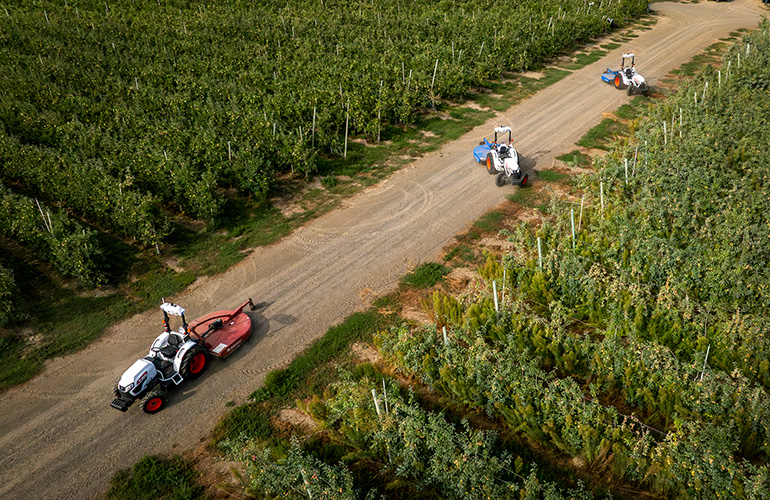
In a significant development for agricultural robotics, Agtonomy, an off-road physical AI company, has unveiled enhanced capabilities for its autonomous vehicle platform. The update, focused on fully autonomous multi-point turning and passive data collection, is designed to solve two critical challenges in farming: navigating tight spaces and gathering reliable field intelligence.
The technology allows farm equipment, retrofitted by OEM partners like Kubota and Bobcat, to execute complex maneuvers in reverse with precision, eliminating the need for human intervention. This is particularly valuable in orchards and vineyards, where space is limited and headland turns are a major operational bottleneck. By enabling machinery to operate safely and accurately in previously inaccessible areas, the system moves beyond simple point-to-point movement toward complete task automation.
Beyond maneuverability, Agtonomy is leveraging the data generated by its fleet. Each vehicle processes over two terabytes of data per hour, creating a continuous stream of field intelligence. This passive data collection, drawn from diverse environments and tasks, serves a dual purpose. It provides real-time insights for operations like yield counting and canopy management, while simultaneously feeding a learning system that improves the autonomy software. The company has also expanded its platform to support more than 500 different implements, from sprayers to discs, and has introduced an Implement Library to standardize integration.
According to Tim Bucher, Agtonomy’s co-founder and CEO, the core philosophy is a direct loop between commercial operation and product development. “Growers don’t have time to wait for innovation to show up in the field; they need autonomous fleets that work today and get better tomorrow.” This customer-driven approach, he argues, is what will push practical automation into rugged, off-road sectors where innovation has historically been slow to arrive.
As the system gathers anonymized data from an growing fleet, it is forming a foundational dataset for broader ecosystem applications. This data is being made available to qualified partners in agronomy and analytics, promising further advancements in operational analytics and fleet optimization.
***
### FAQ
**Q: What is “multi-point turning” in the context of Agtonomy’s technology?**
A: Multi-point turning is a complex maneuverability feature that allows an autonomous vehicle to execute precise turning sequences in confined spaces. Unlike a simple turn, it involves navigating the machine through a series of points, typically in reverse, to complete a task like turning around at the end of a row in an orchard or vineyard without colliding with crops or boundaries.
**Q: Which vehicles does Agtonomy’s autonomy package retrofit?**
A: Agtonomy’s full-autonomy packages are designed to retrofit vehicles from its original equipment manufacturer (OEM) partners, specifically Kubota and Bobcat. These platforms are often suited for smaller-scale growers and farmers who need efficient automation without major capital investment in new machinery.
**Q: How does the data collected by Agtonomy vehicles get used?**
A: The data is used in two primary ways. First, it provides immediate, actionable insights for the operator, supporting tasks like yield monitoring, crop canopy management, and fuel efficiency analysis. Second, the massive stream of anonymized data from a growing fleet is used to train and improve the AI system, leading to better performance and the development of new data-driven services for partners in the agronomy and analytics space.
**Q: What types of farming tasks can the Agtonomy platform handle?**
A: The platform is highly versatile and now supports more than 500 different implements. This range includes large-capacity air blast sprayers, ground-engaging discs for soil preparation, and precision toolbars for various applications. The system is designed to handle a wide variety of field tasks, from spraying and data collection to specialized operations.
***
### Conclusion
Agtonomy’s latest advancements represent a crucial step toward practical, large-scale adoption of autonomy in agriculture. By solving the immediate problem of tight-space maneuverability and building a data-driven feedback loop, the company is creating a solution that works in the real world today while preparing for future innovation. For an industry struggling with labor shortages and the need for greater efficiency, Agtonomy’s combination of hardware autonomy and continuous data learning offers a powerful blueprint for the future of farming.
