



# Humanoid Robots and AI: The New Era of Machines That Learn, Work, and Adapt
## The Rise of Machines That Move Like Us
For years, robots were confined to factories doing the same repetitive task over and over. Today, a new generation of humanoid robots is changing the game. Powered by cutting-edge artificial intelligence, these machines are stepping out of research labs and into real workplaces — sorting parts, navigating obstacles, and performing tasks that once seemed impossible for a machine.
The shift is happening fast. Major companies and startups around the world are pouring billions of dollars into developing robots that can think, learn, and move like humans. Some of the biggest names in the race include technology giants, automakers, and even national governments looking to secure a leading position in this emerging field.
## How Modern Humanoid Robots Learn
One of the most remarkable breakthroughs in robotics is how these machines are trained. Instead of engineers writing every single movement by hand, robots now learn through demonstration and repetition.
Here’s how it works: a human operator wears a virtual reality headset and controls a robot arm or hand step by step. Every movement is captured and recorded. That data is then fed into a machine learning system that teaches the robot how to perform the task on its own. To speed up the process, thousands of digital simulations run simultaneously, testing the robot in different environments — slippery floors, tight spaces, awkward angles — until the skill is perfected.
Once one robot masters a task, the knowledge is shared across every other robot in the system. This means that training never starts from scratch. Each new skill builds on what came before.
## From Factory Floors to Everyday Work
The practical applications are already taking shape. In some of the most advanced manufacturing plants, humanoid robots work side by side with people, lifting heavy parts, conducting inspections, and performing quality checks. These robots are equipped with cameras, thermal sensors, and acoustic detectors that allow them to “see” and “hear” their surroundings in ways humans can’t.
At the same time, their smaller robotic counterparts — four-legged machines designed for rugged terrain — patrol facilities, detect problems, and collect data that keeps operations running smoothly. Together, these systems form an ecosystem of intelligent machines that are slowly becoming essential parts of modern industry.
## AI Is Giving Robots Something Closer to Common Sense
What separates today’s robots from yesterday’s is their “brain.” Modern processors, the same kind that power the latest advances in conversational AI, give robots the ability to understand their environment and make decisions on the fly.
In demonstrations, these robots have shown they can follow vague, natural-language instructions. For example, when told to “pick up the block that matches the color made by mixing yellow and blue,” the robot correctly identified green and selected the right object. This kind of reasoning represents a major leap forward in how machines interpret and interact with the world.
## The Global Race to Lead
The competition to dominate the humanoid robotics market is intense. Countries and corporations are racing to develop the most capable, versatile, and affordable machines. Experts believe that within a decade, the humanoid robot market could be worth tens of billions of dollars.
Some nations are making strategic investments on a massive scale, betting that robotics and AI will define the next era of economic growth. Companies that once focused only on software are now building physical machines. Defense contractors are exploring autonomous systems for military applications, arguing that unmanned vehicles could reduce human risk in dangerous operations.
## What About Jobs?
It’s a fair concern. As robots become more capable, some jobs — especially repetitive, physically demanding, or dangerous ones — will likely be taken over by machines. But the picture isn’t as simple as robots replacing humans entirely.
These robots still need people to design, build, train, and maintain them. The role of human workers is evolving rather than disappearing. Instead of performing dull or hazardous tasks, people may increasingly oversee and guide intelligent machines, focusing on higher-level problem-solving and creativity.
## Frequently Asked Questions (FAQ)
**Q: What exactly is a humanoid robot?**
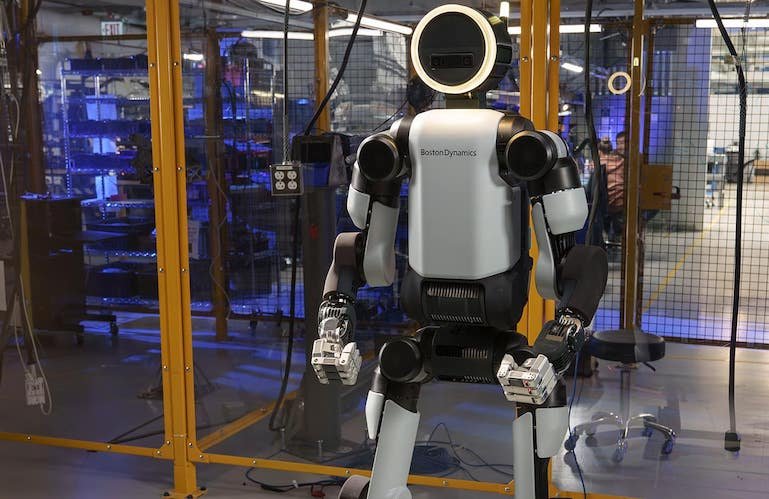
A: A humanoid robot is a machine designed to resemble the human body in shape and movement. It typically has a head, torso, arms, and legs, allowing it to navigate environments built for people.
**Q: How are humanoid robots different from traditional robots?**
A: Traditional robots are usually built for a single specific task and follow pre-programmed instructions. Humanoid robots use artificial intelligence and machine learning to adapt, learn new tasks, and operate with a degree of independence.
**Q: Can humanoid robots think for themselves?**
A: Not in the way humans do. They use advanced AI models to process data from sensors and make decisions, but they don’t have self-awareness or consciousness. They follow patterns learned from training data.
**Q: Are humanoid robots safe to work alongside people?**
A: Safety is a top priority in their design. These machines are built with sensors and fail-safes that help them detect and avoid collisions with humans. They are not autonomous enough to operate without oversight in most current applications.
**Q: Which companies are leading the humanoid robot industry?**
A: Several organizations are at the forefront, including well-known robotics companies backed by major investors, automotive manufacturers integrating robots into their factories, and emerging players from around the world, including state-supported initiatives in Asia.
**Q: When will humanoid robots become common in everyday life?**
A: Experts predict that we’ll see more widespread use in industrial settings within the next few years. Everyday household helpers — like a robot that can cook or clean — are likely further off, as those tasks require a level of dexterity and understanding that is still being developed.
**Q: What are the biggest challenges facing humanoid robots today?**
A: Key challenges include improving balance and dexterity in unpredictable environments, reducing costs, extending battery life, and ensuring AI systems make safe and reliable decisions in real time.
## Conclusion
Humanoid robots are no longer science fiction. Fueled by breakthroughs in artificial intelligence and powered by machines that learn from demonstration rather than rigid programming, they are stepping into factories, warehouses, and potentially our homes. The journey is still in its early stages — these machines can’t yet dress themselves or pour a cup of coffee — but the pace of progress is undeniable.
The coming decade will likely see robots become common fixtures in workplaces around the world, working alongside humans to handle dangerous, repetitive, or physically demanding tasks. The real question isn’t whether humanoid robots will become a part of our daily lives — it’s how quickly and how responsibly we can integrate them into the fabric of society.
Thank you for reading
