



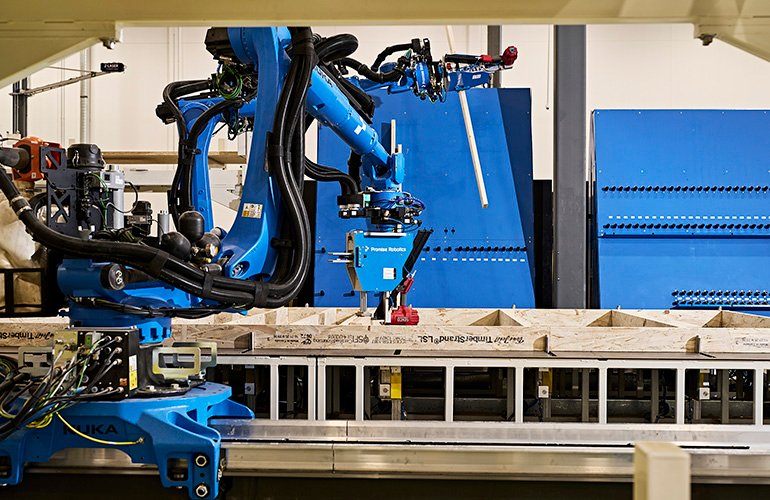
# How Robotic Factories Are Reshaping Homebuilding Across North America
The way homes are built is undergoing a dramatic transformation. A Canadian startup has launched an innovative manufacturing platform that combines robotics, artificial intelligence, and software to produce building components at scale — and it just landed its first major deal with one of the largest homebuilders in the United States.
## A New Model for Building Homes
The company, which was founded in 2021 and is headquartered in Toronto, has announced a multi-year partnership with D.R. Horton, the biggest homebuilder in the country by volume. Under the agreement, D.R. Horton will use the company’s production services to manufacture components for more than 1,250 homes across the United States.
The startup operates a “Factory-as-a-Service” model, which means homebuilders can tap into advanced robotic production facilities without having to build or manage those systems themselves. This approach removes the financial and operational burden that traditionally comes with investing in custom manufacturing infrastructure.
At the heart of the company’s offering is a concept called physical AI — a system that integrates robotics, machine learning, computer vision, and large language models into a unified production environment. Unlike traditional construction, where every house has unique layouts and components, the company’s systems are designed to handle enormous variability while maintaining consistent output.
## Why the Construction Industry Needs This
The homebuilding sector has long struggled with persistent labor shortages, rising material costs, and unpredictable timelines. Traditional construction is highly fragmented, with dozens of different subcontractors managing everything from framing to electrical work. There is little standardization, and each project presents unique challenges.
“Every single home we produce has different floor plans, wall configurations, and structural requirements,” explained a company spokesperson. “But our process for handling those variations is the same every time.”
The company’s technology works by interpreting digital home designs, translating them into robotic instructions, and then orchestrating the entire manufacturing workflow. Components like wall panels, floor sections, and stair frames are produced in what the company describes as microfactories — smaller, specialized production hubs that can be deployed in different regions.
## Speed and Scale in Practice
The results so far are striking. The company claims it can produce enough components for a two-story, two-family home with a basement and garage in a single day. That same process typically takes two to three weeks using conventional methods. The finished components are then transported to job sites for quick assembly.
The company focuses primarily on townhomes and multi-unit buildings between three and four stories tall, which represent a sweet spot for its current capabilities. Taller buildings require additional fire suppression and structural reinforcement that are beyond the system’s present scope.
## Where Production Is Happening
The company has established its first three production facilities in North America — two in the Canadian province of Alberta (Edmonton and Calgary) and one in Phoenix, Arizona. Each facility is operated by the company’s own crew, ensuring a tight feedback loop between production data and system improvements.
What’s particularly notable is how the system adapts to local conditions. Building requirements in the Canadian climate differ significantly from those in the Arizona desert. In Phoenix, for example, the system uses substantially less exterior sheeting and different bracing techniques compared to Canadian facilities. The AI-powered platform adjusts these specifications automatically based on regional building codes and environmental demands.
## Technology That Learns
The company’s software stack is built to improve over time. For each home produced, the system generates roughly 300 new images, 5,000 tactile data points, and numerous process logs. This rich dataset feeds the AI models, allowing the platform to refine its operations and reduce costs as it gains experience.
The hardware side is intentionally flexible. The company uses industrial robot arms from KUKA in its current setups, but its systems are designed to work with different robotic platforms. This robot-agnostic approach gives builders more freedom in choosing their equipment partners.
## A Partnership, Not a Takeover
D.R. Horton’s leadership expressed enthusiasm for the collaboration. “We are always looking for innovations that can help us improve how we build,” said a senior executive at D.R. Horton. “This gives us a new capability to support our goals of improving cycle times and increasing production capacity.”
The startup emphasized that it is not competing with homebuilders or becoming a vertically integrated developer. Instead, it positions itself as a behind-the-scenes production partner that scales alongside builders’ needs.
“This is just the beginning,” the spokesperson said. “We want builders to know they can access as much capacity as they need, and we’ll help them grow that across multiple markets.”
—
## Frequently Asked Questions
**What is physical AI in construction?**
Physical AI refers to the use of artificial intelligence, robotics, and software systems to automate and optimize the manufacturing of building components. It goes beyond traditional automation by integrating machine learning, computer vision, and data-driven decision-making into the production process.
**How does Factory-as-a-Service work for homebuilders?**
Rather than investing in their own manufacturing facilities, homebuilders can contract with a provider like the company discussed here to produce building components on their behalf. The provider handles everything from design interpretation to robotic production, and the builder receives finished components ready for onsite assembly.
**Why is the construction industry ready for this kind of change?**
Homebuilding has faced mounting challenges including skilled labor shortages, unpredictable project timelines, and rising material costs. Standardized robotic manufacturing offers a way to bring the speed and consistency of modern manufacturing to the construction sector.
**What types of buildings does the company produce components for?**
The system is currently optimized for townhomes and multi-unit buildings between three and four stories, including duplexes, fourplexes, and single-family homes with basements and garages.
**How fast is the production process compared to traditional construction?**
The company claims it can produce enough components for a two-story, two-family home in a single day — a task that typically takes two to three weeks using conventional methods.
**Where are the production facilities located?**
Initial facilities are in Edmonton and Calgary, Canada, as well as Phoenix, Arizona. Plans for expansion into additional North American markets are underway.
—
## Conclusion
The partnership between this robotics-driven manufacturer and one of America’s largest homebuilders signals a turning point for the construction industry. By bringing repeatable, scalable production to homebuilding through physical AI and robotic microfactories, the model has the potential to address some of the sector’s most persistent challenges — from housing supply shortages to cost overruns and project delays. As the company scales its operations across more markets, it will be closely watched as a proof of concept for whether factory-floor methods can genuinely reshape how homes are built in North America.
Thank you for reading
