



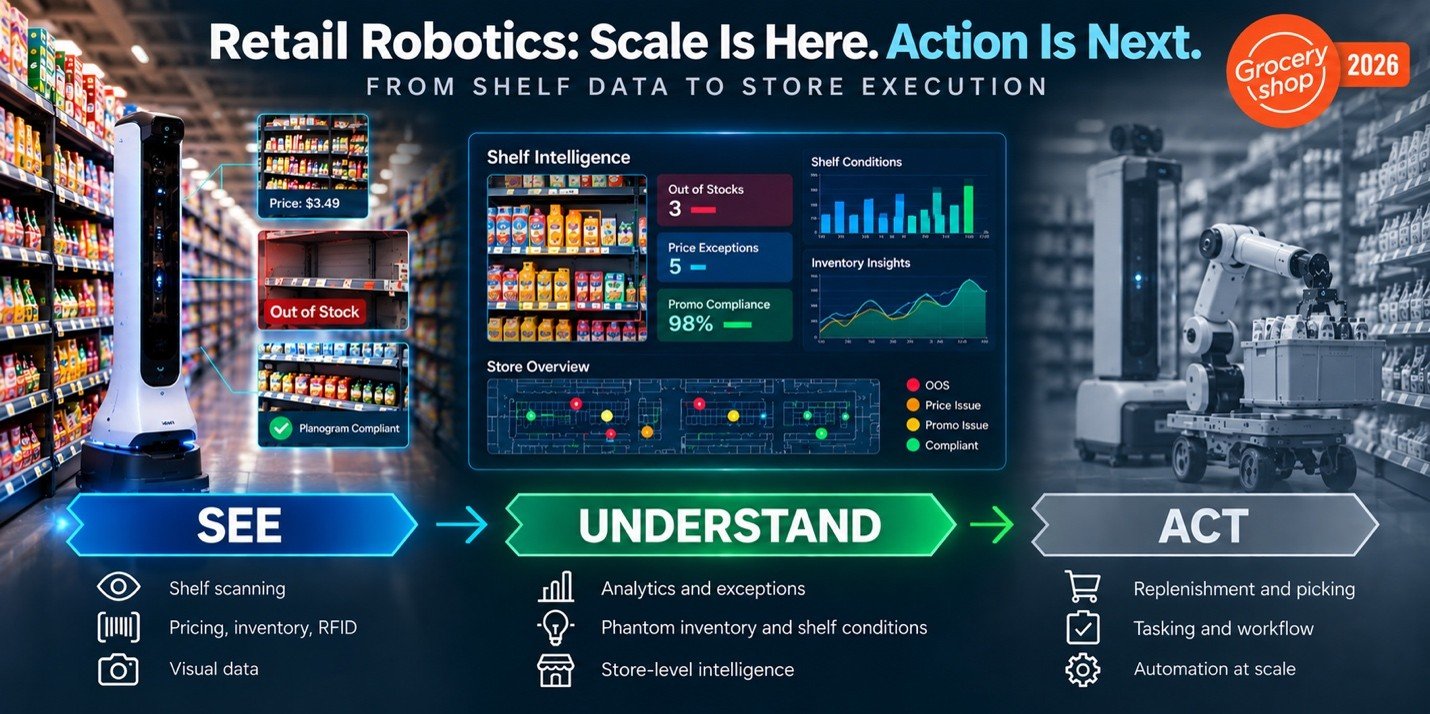
# How Retail Robots Are Transforming Grocery Operations at Scale
The grocery retail landscape is undergoing a fundamental shift, driven by robotic systems that are now embedded in stores across dozens of countries. What was once met with skepticism and hesitation has matured into a quiet but powerful force reshaping how shelves are monitored, products are managed, and decisions are made on the shop floor.
## Scaling Up: From Novelty to Necessity
Retail robotics has entered a phase of genuine scale. One major robotics company announced it has deployed its shelf-scanning system across 3,000 retail locations worldwide, with additional rollouts at top-tier chains on the horizon. This milestone signals that the technology has moved beyond pilot programs and early adoption into mainstream commercial deployment.
With this scale comes a new opportunity: the ability to generate continuous, near-real-time insights about shelf conditions, pricing accuracy, and inventory levels across an entire retail footprint. The question is no longer whether these systems work, but how quickly the broader industry can put this data to use.
## From Data Collection to Data Action
Several companies at the forefront of retail robotics are now pivoting their focus from hardware to intelligence. Rather than simply collecting images and sensor readings, they are building analytics platforms, dashboards, and actionable insights designed to improve decisions at the individual store level.
One company has begun shifting its identity from a robotics firm to a retail intelligence platform. Its mobile units continue to gather shelf data, but the emphasis is now on transforming that information into concrete actions — such as predicting when stock will run low, estimating remaining product quantities, and flagging items that are approaching peak freshness.
Another firm is making its data accessible through virtual store tours and detailed analytics dashboards, giving retail operators an unprecedented view of how their shelves are performing in real time. These capabilities are becoming essential differentiators as the market becomes more competitive.
## New Deployment Models for Different Store Formats
Not every retailer needs a robot stationed in-store full-time. One company is addressing this by targeting smaller-format stores — including drugstores, convenience shops, dollar stores, and regional grocery chains — with a foldable, portable robot that can be escorted between locations by a human team member.
This approach dramatically reduces the capital commitment required per store and enables recurring audits across a wider geographic footprint. It represents a practical, economics-first strategy for bringing robotic shelf intelligence to retail formats that were previously too small or too fragmented to justify permanent deployment.
## Physical Execution: The Next Frontier
While most current retail robots focus on observation and scanning, a new generation of startups is tackling a far more complex challenge: physically moving products within the store. One newcomer to the space is developing a mobile robot designed to pick items from shelves and place them into shopping carts, bridging the gap between shelf and customer.
This use case demands a combination of advanced navigation, computer vision, robotic manipulation, and back-end integration working in concert. The company has completed startup pitch competitions and is now moving toward customer trials and commercialization, signaling that the industry sees this as the long-term vision for in-store robotics.
Other innovators are exploring modular platforms that can be configured for multiple functions, including customer guidance, promotional support, product transportation, restocking assistance, security patrols, and even floor cleaning.
## The Path Toward Fully Automated Shelves
As robots continuously collect pricing data, inventory counts, RFID tag information, and visual details, the competitive advantage will no longer lie in the data itself. It will lie in how effectively that intelligence drives automated action.
Legacy retail solutions that have relied on planograms, random compliance audits, and point-of-sale data for years stand to gain enormously when they begin ingesting real-time shelf conditions. This integration will be a significant step toward end-to-end shelf automation, rendering some existing tools obsolete while making others far more powerful.
The industry is entering a period of rapid, tangible progress where innovation is delivering reliable, repeatable, and fast results at scale — something the retail sector has long awaited.
—
## Frequently Asked Questions (FAQ)
**Q: What types of retail robots are currently being deployed in grocery stores?**
A: Most retail robots in use today are autonomous shelf-scanning units that navigate store aisles, capture images of products, and use computer vision to monitor pricing accuracy, inventory levels, planogram compliance, and out-of-stock conditions. More advanced platforms are now being developed for physical product handling, customer guidance, and multi-purpose store operations.
**Q: How many retail robots have been deployed globally?**
A: One leading robotics company reported deploying over 3,000 units across multiple retailers and countries, with additional rollouts underway at major chains. The number continues to grow rapidly as more retailers adopt the technology.
**Q: Are retail robots replacing human workers?**
A: Current deployments are designed to augment store operations rather than replace human labor. Robots handle repetitive shelf-monitoring tasks, freeing up associates to focus on restocking, customer service, and other higher-value activities. In smaller-store models, robots are even escorted by staff members between locations.
**Q: What data do retail robots collect?**
A: Retail robots gather a variety of data points including pricing accuracy, inventory counts, shelf availability, planogram compliance, product freshness indicators, and in some cases RFID tag data. This information is then processed into actionable insights for store managers and retailers.
**Q: Can small retailers benefit from retail robotics?**
A: Yes. Companies are developing flexible deployment models, including portable and foldable robots that can travel between multiple smaller store locations. This lowers the cost and logistical barrier, making robotic shelf intelligence accessible to drugstores, convenience shops, and regional grocery chains.
**Q: What is the next major development for retail robots?**
A: The industry is moving from passive observation to active execution. Upcoming capabilities include robots that physically pick and move products on shelves, assist with restocking, guide customers to items, and eventually integrate into fully automated shelf management systems.
**Q: How does AI factor into retail robotics today?**
A: AI is central to the value proposition. Machine learning models analyze the visual and sensor data collected by robots to detect trends, predict replenishment needs, estimate remaining shelf life, and generate insights that would be impossible to derive manually at scale.
—
## Conclusion
Retail robotics has reached an inflection point. What began as cautious experimentation has evolved into a scalable, data-driven industry that is reshaping how grocery stores manage their shelves and operations. From shelf-scanning robots deployed across thousands of locations to emerging platforms capable of physical product handling, the sector is advancing rapidly.
The real opportunity lies ahead: transforming raw shelf data into automated, real-time actions that improve product availability, reduce waste, enhance the shopping experience, and drive measurable business outcomes. As legacy systems begin to consume this new stream of intelligence, the gap between data collection and operational execution will finally close.
The retail industry is entering a new era — one defined by accuracy, speed, and scale — and the robots leading this transformation are only getting started.
Thank you for reading
