



# From Spectacle to Sustainability: Why Robots Need to Earn Their Place on the Factory Floor
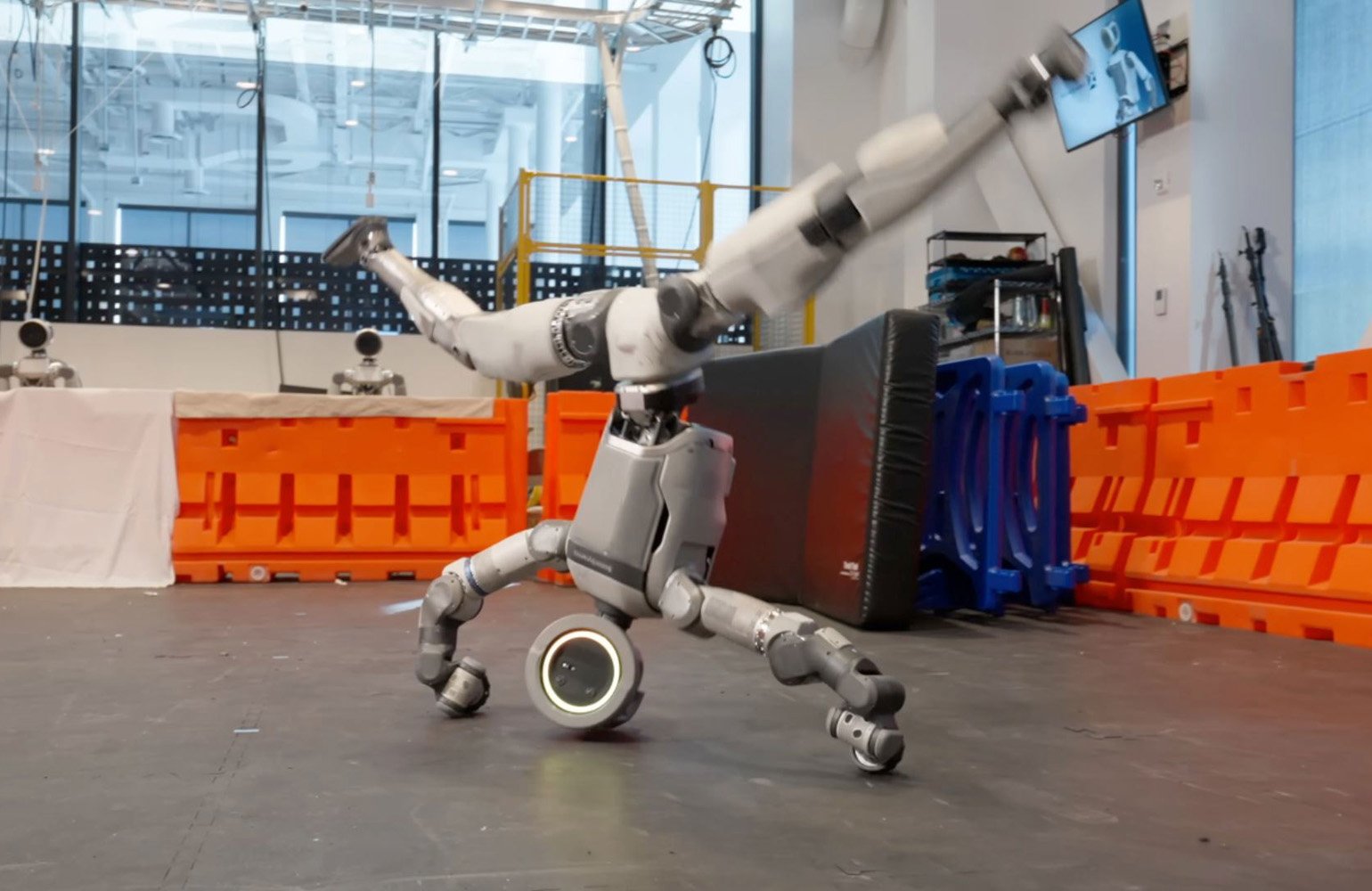
The robotics industry is in the middle of an identity crisis — and it’s not about whether machines can walk or flip. It’s about whether they can actually stick around. For years, the most compelling robot videos have shown humanoid machines doing backflips, navigating rubble, folding towels, and moving with an almost unsettling grace. These clips accumulate millions of views because they feel like science fiction made real. But spectacle, as impressive as it is, has never been a business model.
The industry now stands at a crossroads. On one side is the allure of building ever-more-capable physical platforms. On the other is the sobering reality that commercial customers care very little about a robot’s ability to do a cartwheel — they care about whether it can repeat a single task thousands of times a day, without failure, at a cost that justifies the investment. Bridging that gap requires a fundamental rethinking of how robots are designed, specified, and deployed.
## The Design Trap
There is a recurring pattern in robotics development that goes largely unexamined. Companies invest heavily in creating a remarkable physical platform — one with dexterous hands, agile legs, advanced perception arrays, and human-like proportions — and only then try to figure out what to do with it. The instinct is to build the most impressive machine possible and then search for a use case that matches its capabilities.
This “platform-first” approach has a seductive elegance to it. It mirrors the way software is often developed: build a powerful engine, attract developers, and let the ecosystem discover applications over time. But physical hardware does not scale the way software does. A robot cannot be cloned in a data center. Every unit must be manufactured, transported, maintained, and eventually replaced. The cost of getting the form factor wrong is not a few hours of re-architecture — it is an entire fleet of underperforming machines that tie up capital and occupy floor space without delivering value.
The result is a growing catalog of robots with extraordinary capabilities that find themselves without a home. They are technically stunning and commercially adrift. The question is no longer whether the engineering is good enough. It is whether the design process itself is backwards.
## Working Backwards From the Task
A more disciplined approach starts with the opposite assumption. Instead of asking what a robot can do, ask what a specific job demands — and then determine whether a robotic solution is justified.
Consider a task like inserting a precision connector into an automotive component during assembly. The alignment tolerance might be as tight as 20 micrometers. The force required to mate the connector could be as low as 5 Newtons. Under these conditions, the robot needs force-sensing resolution below 0.1 Newtons and control bandwidth sufficient to detect a jam before the connector is damaged. A failure in this task means a scrapped part, a production delay, and a direct hit to the bottom line.
Now take a completely different task: stacking and palletizing heavy goods in a distribution center. Here, the priority shifts dramatically. Precision at the sub-newton level becomes irrelevant. What matters is payload capacity, structural rigidity, and the ability to endure millions of repetitive cycles without mechanical degradation.
If you design a single “general-purpose” machine intended to handle both, the engineering compromises can leave you with a system that excels at neither. A force sensor chosen for its versatility might lack the resolution required for precision insertion while also falling short of the durability needed for heavy lifting. The platform becomes a compromise that satisfies no one’s operational requirements.
This is why task definition must come before hardware selection. The workflow dictates every engineering decision — from the type of sensors needed to the control architecture, the structural materials, and ultimately the physical form of the robot itself.
## The Sensor Stack Follows the Workflow
Sensor selection is one of the most consequential choices in any robotic system, yet it is frequently treated as a line item to be filled in late in the design process. The reality is that the specific demands of a given task determine what kind of sensing is required, at what accuracy, and under what environmental conditions.
When precision connector insertion is the target workload, contact-force resolution becomes the single most important parameter. A sensor capable of measuring forces at ±0.2 Newtons, for example, can materially improve quality outcomes. In controlled testing, maintaining contact force within that window reduced connector scrap rates from 1.2 percent to 0.5 percent — a reduction that translates to estimated annual savings of hundreds of thousands of dollars on a single production line. This kind of economic return only becomes visible when you start from the task and work forward to the sensor specification.
Conversely, a palletizing robot operating in a dusty, temperature-variable warehouse has entirely different sensing priorities. It needs robust position feedback, collision detection, and wear monitoring — but it does not need micron-level force resolution.
The point is not that one sensor type is universally superior. The point is that sensor architecture must be chosen at the design stage, not bolted on as an afterthought when compiling a bill of materials. When sensing is integrated into the core architecture, it becomes a functional asset. When it is treated as an accessory, it becomes a cost center with marginal returns.
## Form Factor and the Nature of the Operating Environment
The question of what a robot should look like is often answered with aesthetics or brand identity in mind. A more practical lens starts with the physical environment in which the robot must operate.
Industrial sites fall into two broad categories. Greenfield environments are new builds where the facility layout is designed from scratch, allowing engineers to optimize the workspace for the specific robotic equipment that will occupy it. Brownfield environments, by contrast, are existing facilities — refineries, warehouses, manufacturing plants — that were constructed around human workers and their physical needs. They feature narrow aisles, stairs, floor grating, standard doorframes, and workstations sized for bodies roughly 1.5 to 1.9 meters tall.
In greenfield settings, specialized robot designs almost always outperform humanoid forms. There is no need to accommodate human spatial constraints, which means wheeled, tracked, or uniquely articulated platforms can be optimized for speed, payload, and energy efficiency. Equinor’s Northern Lights carbon capture facility is a real-world example: by designing the environment around the equipment, engineers achieved unit economics that would have been impossible with a generic humanoid form.
But brownfield environments are far more common in practice. Most industrial operations cannot afford the luxury of rebuilding their facilities to suit a new class of machine. In these settings, a form factor that is inherently compatible with human-designed spaces — one that fits through standard doors, climbs the same stairs, and navigates the same floor layouts — offers a genuine advantage. The robot does not need to look human, but it does need to move through the world the way a human does.
This is not a philosophical preference. It is an economic calculation. Modifying a facility to accommodate a non-humanoid robot can cost millions of dollars in structural changes, rerouted utilities, and lost production time during retrofitting. Adapting a robot to an existing space is almost always cheaper — provided the robot’s form factor allows it.
The key insight is that human-compatible spatial requirements remain constant regardless of the robot’s external shape. Foot placement, joint torque, wrist articulation, and ground contact dynamics are governed by the same physical laws whether the machine has legs, wheels, or a more unconventional morphology. Strain-based sensing, for instance, provides fundamental force and torque measurement regardless of how the platform is configured. The sensor physics do not care about the robot’s aesthetics.
## From Demo to Deployment: The Real Test
Viral demonstrations generate excitement, but they prove very little about commercial viability. A single clean run through a task in a controlled setting — with ideal lighting, calibrated equipment, and a choreographed environment — tells you that a robot is capable in principle. It says nothing about whether it can sustain that performance across thousands of cycles in a real factory.
The true benchmark for deployment is not the first successful demonstration. It is the second, fifth, and hundredth production run without intervention. A robot that can perform a task once has demonstrated a laboratory result. A robot that can perform the same task 10,000 times without drift, recalibration, or mechanical failure has demonstrated a product.
The difference between these two outcomes is rarely about clever algorithms. It is about engineering discipline — specifically, the ability to manage the physical realities of hardware over time. Thermal expansion changes sensor calibration. Mechanical wear introduces subtle drift. Actuator gear trains produce non-linear behavior that is extremely difficult to model accurately in simulation. These are not edge cases. They are the dominant failure modes in real-world operations.
Addressing them requires a holistic view of the machine that treats power consumption, thermal dissipation, and mechanical endurance as first-class design constraints — not afterthoughts to be addressed by software patches.
## The Hardware Balance Sheet
Software teams have a well-known advantage: they can scale by making copies. A server running a new algorithm can serve millions of users with marginal additional cost. Physical hardware does not work this way. Every additional robot must be purchased, powered, mounted, and maintained. Its components age. Its joints wear. Its sensors degrade.
This difference creates what might be called the “physical AI balance sheet.” Every design decision involves tradeoffs between competing constraints. An actuator that produces more torque may also generate more heat. A heavier structural member may improve rigidity but increase power draw and reduce battery life. A sensor with higher resolution may introduce latency that destabilizes the control loop.
One principle that helps manage this complexity is backdrivability — the ability of a robot’s joints to be physically moved by external forces and for those forces to be reflected back into the control system. In a backdrivable joint, an unexpected collision or overload is immediately visible to the controller, enabling fast and appropriate responses. Without backdrivability, the robot’s control system is partially decoupled from the physical world, creating safety blind spots and making it harder to diagnose unexpected behavior.
What ties all of these constraints together is force. Knowing the actual force under load, at operating temperature, after extended run time — this is the data that transforms a robot from an expensive toy into a reliable production asset. Force measurement is not just a sensing modality. It is the connective tissue that links power management, thermal monitoring, safety systems, and control algorithms into a coherent whole.
## The Metrics That Matter
Finance departments do not evaluate robots based on their dexterity or their ability to entertain. They evaluate them based on outcomes. The metrics that determine whether a physical AI deployment succeeds or fails are fundamentally operational.
Mean time between interventions (MTBI) is arguably the single most important — and most underreported — figure in the industry. If a human operator must intervene every 20 minutes to clear a jam, reset a drifted sensor, or swap a worn component, then the system’s autonomy claims are largely meaningless. High MTBI means the robot is genuinely self-sustaining over a full shift, and it is the clearest indicator that the underlying hardware and sensing stack are robust enough for production use.
Beyond MTBI, several other metrics define commercial readiness:
– **Cost per unit of work**: Calculated on a per-pick, per-meter, or per-inspection basis, this metric determines whether a robot fleet is genuinely cheaper than human labor — or simply a different kind of expensive.
– **Redeployment time**: The speed with which a robot can be reconfigured for a new task determines whether it is a versatile asset or a single-purpose curiosity. A platform that requires weeks of custom engineering to retask is not suitable for dynamic manufacturing environments.
– **Safety incidents per operating hour**: The number of safety events directly determines whether a robot can operate outside of a protective cage — and whether insurance and regulatory approvals are attainable.
– **Drift over time**: Any sensor that requires frequent recalibration adds hidden labor costs and production interruptions that erode the business case.
A viral video can make a robot look capable. These operational metrics determine whether it actually is.
## Frequently Asked Questions
**Q: Why are humanoid robots so prevalent in the industry right now if specialized designs are often better?**
Humanoid robots capture attention and investment because they are visually compelling and culturally familiar. They also have a practical advantage in brownfield environments — existing facilities designed for humans — where a non-humanoid shape would require costly retrofitting. In greenfield environments, specialized forms almost always win on economics, but brownfield sites are far more common in the existing industrial base.
**Q: What is strain-based sensing, and why is it considered fundamental?**
Strain-based sensing measures the deformation of a material under load, converting mechanical stress into an electrical signal that can be read with high precision. It is considered fundamental because it provides direct, ground-truth measurement of force and torque that is independent of the robot’s form factor, control methodology, or software architecture. The underlying physics remain the same whether the robot has legs, wheels, or a custom manipulator.
**Q: How can a company determine whether a robot is the right solution for a specific task?**
The starting point is a rigorous analysis of the task itself: What are the precision requirements? What forces are involved? What is the throughput needed? How does the task fit into the existing facility layout? Only after these questions are answered should the company evaluate whether a robotic solution can outperform human labor on the relevant metrics — cost per unit, error rate, and consistency over time.
**Q: Why do most physical AI deployments fail, and what can be done about it?**
Most failures are not caused by fundamental flaws in AI reasoning or hardware design. They stem from practical issues like sensor drift, mechanical wear, thermal drift, and the need for frequent recalibration. Addressing these requires investing in robust sensing technologies, designing for manufacturability and serviceability, and validating performance over thousands of real cycles — not just a handful of curated demonstrations.
**Q: Is the goal for robots to look human?**
The goal is not to make robots look human. The goal is to make them functional in human-designed environments. In many cases, this means a form factor that shares key spatial and kinematic properties with the human body — legs, arms, hands, and a size that fits through standard doorways and onto standard work surfaces — without replicating the human shape for its own sake.
**Q: What role does backdrivability play in robot safety?**
Backdrivability allows external forces — such as a person bumping into the robot or an object obstructing movement — to be immediately detected by the control system. This creates a faster and more reliable safety response than systems that rely solely on external sensors like cameras or proximity detectors. It is particularly important for robots that may need to operate in close proximity to human workers.
## Conclusion
The robotics industry is at a stage where the engineering has outpaced the business model. Robots can do extraordinary things, but extraordinary capability does not automatically translate into commercial value. The path from impressive demonstration to sustained industrial deployment runs through a single disciplined principle: start with the task, not the platform.
Every engineering decision — from the choice of sensors to the shape of the chassis — should be driven by the specific demands of the workflow. Strain-based and force-sensitive technologies belong in the architectural design phase, not in a late-stage bill of materials. Human-compatible form factors make economic sense in brownfield environments. Specialized designs earn their keep in greenfield builds. And no deployment should be judged on a single flawless demo but on the ability to repeat, reliably, for thousands of cycles without human intervention.
The robots that will shape the future of physical work are not necessarily the flashiest. They are the ones designed with operational reality in mind — measured in MTBI, cost per unit, redeployment time, and safety performance. The era of robots-for-show is giving way to an era of robots-for-work. The winners will be those who build for the job, not for the spotlight.
Thank you for reading
