



**ATDev’s Autonomous Wheelchair Initiative: The RAMMP Program**
There are millions of powered wheelchair users in the United States today, yet the technological advancements for this essential medical equipment have lagged far behind other consumer electronics. To address this disparity, Assistive Technology Development Inc. (ATDev) is spearheading an ambitious initiative to revolutionize wheelchair technology using robotics and artificial intelligence.
The cornerstone of ATDev’s mission is the **Robotic Assistive Mobility and Manipulation Platform (RAMMP)**, an Advanced Research Projects Agency for Health (ARPA-H) funded program led by the University of Pittsburgh. The program’s overarching goal is to leverage robotics, AI, and smart mobility to empower individuals with mobility issues, granting them a greater degree of independence and freedom in their daily lives.
ATDev, an Orange, California-based company, serves as a key industry partner within the RAMMP consortium, focusing specifically on the development of autonomous wheelchairs.
### Redesigning Mobility from the Ground Up
Unlike incremental updates, ATDev is taking a revolutionary approach by designing the wheelchair from the ground up. “We’re really starting from the ground and rebuilding a lot of the electronics and software architecture that hasn’t allowed for innovation in this space,” explained Owen Kent, ATDev’s founder and Chief Marketing Officer.
The current wheelchair market relies on outdated power electronics, a stark contrast to the powerful computing capabilities found in modern smartphones. Kent, a power wheelchair user himself for over 30 years, has been a vocal critic of this stagnation, noting that every phone possesses more computing power than any wheelchair has ever had.
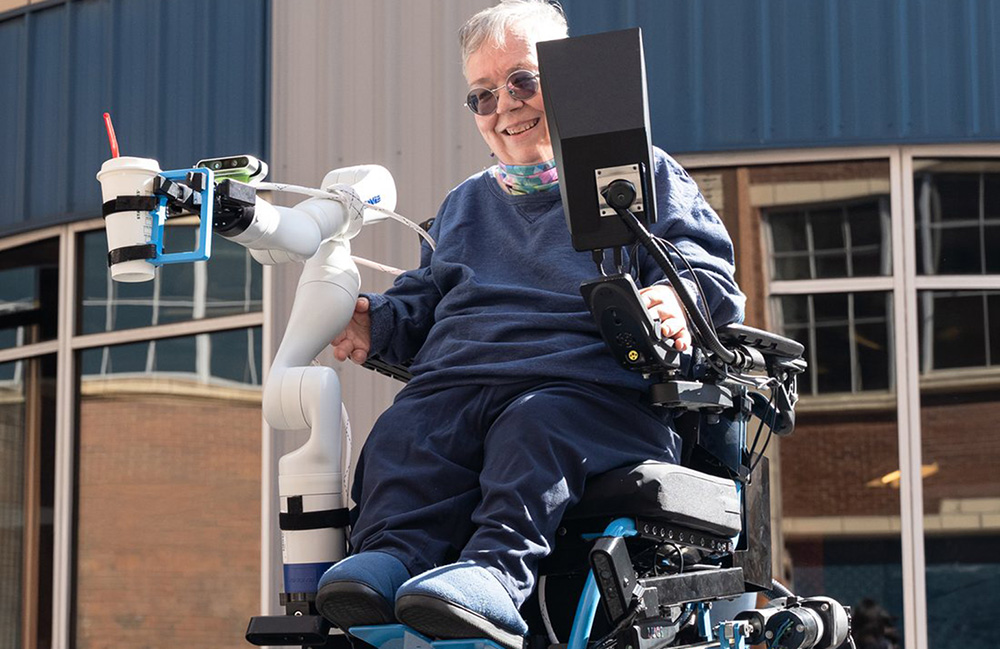
The ATDev solution involves pairing a modern power wheelchair with a coordinated robotic arm on an open software platform. This robotic arm is designed to perform reaching and lifting tasks that the user cannot manage independently, effectively turning the wheelchair into a supportive assistant for daily activities.
### A New Era of Assistive Robotics
The potential applications for this technology are vast. The wheelchair can assist with fundamental tasks such as eating, drinking, turning on lights, and opening doors. Looking further ahead, ATDev is integrating teleoperation features, which would allow a user in bed to remotely command the chair to retrieve a drink from the refrigerator.
Safety, however, remains the paramount concern for developers working with vulnerable populations. Todd Roberts, co-founder and CEO of ATDev, emphasized the critical need for reliability. “One of the biggest challenges is safety when it comes to robotics and working with this population,” he said. “Robotic manipulation is getting more and more impressive each day, but there’s a huge difference in the level of reliability and repeatability that you need.”
To mitigate these risks, the chair is not designed for full autonomy like a self-driving car. Instead, it operates on a **spectrum of autonomy** that prioritizes shared control between the user and the machine. “When you have a person in the wheelchair who is participating in shared autonomy with the chair, if the chair starts to make a wrong decision, then they can provide some corrective input,” Roberts noted.
This design philosophy places the user in the driver’s seat, allowing them to decide moment-to-moment how much assistance they need, rather than completely handing over control to the machine.
### Building Community and Navigating Regulation
Looking forward, ATDev envisions creating a community-driven ecosystem. A key feature on the horizon is a **federated learning approach**, where wheelchairs can learn from one another. If a user discovers a new way to manipulate their chair, they can share that knowledge with the community via an app store, accelerating collective innovation.
From a regulatory standpoint, ATDev is in a unique position. While exoskeletons and similar devices face significant regulatory hurdles, wheelchairs already have an established regulatory roadmap with the FDA. “There is an existing regulatory roadmap for chairs that exist today for their FDA-regulated products, but there is not an existing regulatory roadmap for self-driving, self-manipulating robotic personal mobility platforms,” Roberts stated.
As a federal program participant, ATDev also benefits from a direct line of communication with agencies like the FDA, which is crucial for navigating the approval process.
### The Road Ahead
ATDev is currently in the early research and development phase. While there is no definitive timeline for an FDA-approved, insurance-reimbursable model, the company’s founders are optimistic they can achieve this milestone within the next five years. Throughout this journey, the focus remains on user-led design, ensuring that the voice of the end-user is louder than ever.
“The voice of the ultimate user of the product is very loud within the program, which is amazing,” Kent concluded. “So often you have these engineering teams, and maybe you do a focus group where you talk to your end users every once in a while. You’ve got to be in the room. Instead of user-centered design, we like to think of it as user-led design.”
***
## Frequently Asked Questions (FAQ)
**What is RAMMP?**
RAMMP stands for the Robotic Assistive Mobility and Manipulation Platform. It is an ARPA-H funded research program led by the University of Pittsburgh that aims to develop the next generation of powered wheelchairs integrated with robotics and AI to increase user independence.
**What is ATDev’s role in RAMMP?**
ATDev is an industry partner within the RAMMP consortium. The company is specifically focused on creating the hardware and software for the next generation of autonomous wheelchairs, moving beyond traditional designs.
**How is the new wheelchair different from current models?**
Instead of just upgrading seating comfort, ATDev is rebuilding the wheelchair from the ground up. The new design integrates a robotic arm that can perform physical tasks like reaching for objects or opening doors, controlled by an open and modern software platform.
**What is the “spectrum of autonomy”?**
This concept allows the user to decide in real-time how much help the wheelchair provides. The chair handles micro-adjustments for safety and stability, but the user retains control over the larger path and goals, rather than handing over full autonomy to the machine.
**When can we expect these wheelchairs to be available?**
ATDev does not have a specific commercial release date yet, but the company expects to achieve an FDA-regulated and insurance-reimbursable product within the next five years.
***
## Conclusion
ATDev’s vision for the RAMMP program represents a significant leap forward for assistive technology. By treating the wheelchair not merely as a passive vehicle but as an intelligent robotic platform, the company is addressing a decades-long stagnation in the industry. With a focus on user-led design, safety, and shared autonomy, the initiative aims to transform powered wheelchairs from simple mobility aids into comprehensive robotic partners that grant users unprecedented independence and quality of life. As the program progresses, the integration of AI and community-driven learning could set a new standard for assistive robotics worldwide.
