



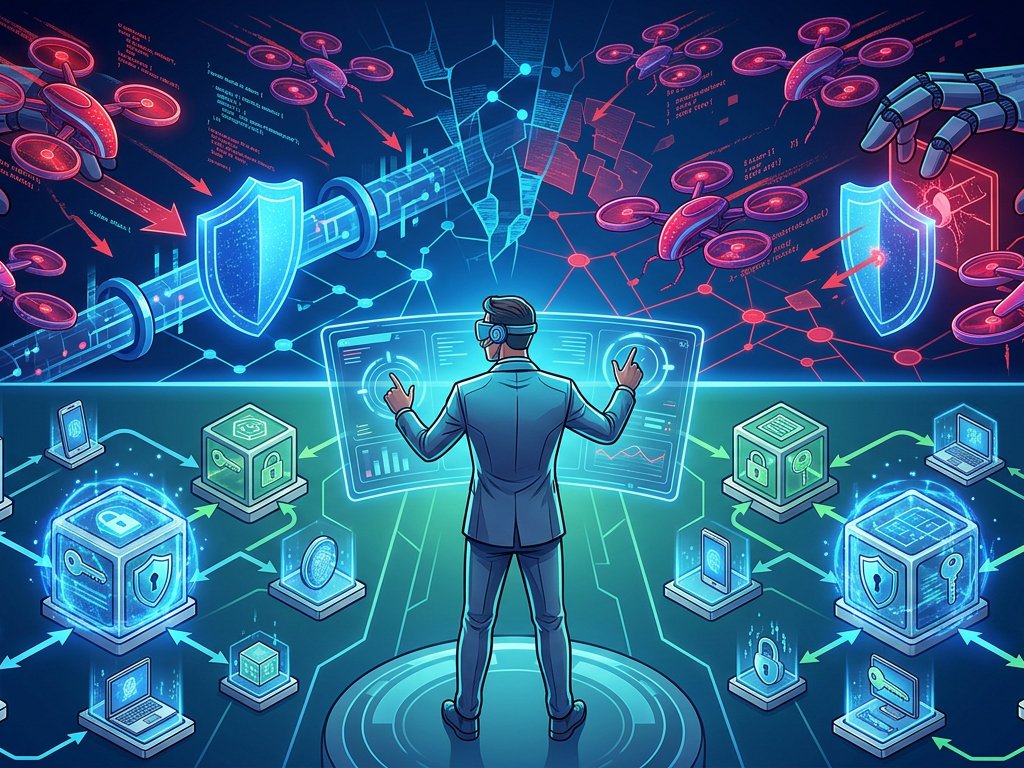
**The Imperative of Zero Trust in the Age of AI-Driven Threats**
The landscape of enterprise cybersecurity is undergoing a fundamental and irreversible transformation. Two powerful forces are converging to dismantle long-held assumptions about security: the collapse of the traditional network perimeter and the rapid weaponization of artificial intelligence (AI) by threat actors. The legacy model of trusting anything inside the firewall is obsolete, as the attack surface has become distributed, dynamic, and borderless. Consequently, for CISOs and security leaders, the strategic adoption of a Zero Trust architecture has shifted from a best practice to a critical business risk containment imperative.
### The Collapse of Traditional Trust Models
For decades, security was largely defined by a castle-and-moat mentality. This model operated on the simple premise of a trusted internal network protected by a hardened external perimeter. However, this assumption has been invalidated by several key trends:
* **Cloud-Native Infrastructure Fragmentation:** Applications and data now reside across multiple public clouds, private data centers, and hybrid environments, eroding the concept of a single, defined internal network.
* **Remote and Hybrid Workforce Identity Dispersion:** The widespread adoption of remote work has meant that users and devices are no longer consistently located within the corporate network.
* **API-Driven Interconnectivity:** Modern applications rely on complex APIs to communicate, creating a vast, interconnected ecosystem that extends far beyond the corporate firewall.
* **Third-Party Vendor Integration:** Business-critical workflows often require deep integration with vendors and partners, introducing additional, often less-controlled, entry points.
The result is an enterprise attack surface that is no longer a defined perimeter but a sprawling, distributed, and ever-expanding landscape of potential vulnerabilities.
### AI as a Cybersecurity Force Multiplier for Attackers
Just as the perimeter has dissolved, the capabilities of attackers have been supercharged by artificial intelligence. AI is no longer a future threat; it is a present-day weapon that increases both the scale and precision of cyberattacks. Key shifts include:
* **AI-Generated Phishing Campaigns:** These attacks achieve significantly higher engagement rates by using contextual personalization to craft highly convincing emails that are far more difficult to distinguish from legitimate communication.
* **Deepfake-Based Social Engineering:** High-fidelity voice and video impersonations of executives and other trusted individuals are being used to orchestrate sophisticated social engineering and fraud schemes.
* **Automated Vulnerability Discovery and Exploitation:** AI can scan code and systems for vulnerabilities and then automatically weaponize them, drastically reducing the “dwell time” available for defenders to respond.
* **Adaptive Malware Systems:** Malware can now modify its own behavior in real-time to evade traditional signature-based detection systems.
These advancements remove the bottleneck of manual effort from the attacker’s workflow, enabling them to operate at an unprecedented scale and speed.
### Why Zero Trust Has Become a Board-Level Requirement
In this new reality, Zero Trust is not merely a technical framework; it is a fundamental business risk strategy. The core principle of Zero Trust is simple: **”Never trust, always verify.”** It operates on the explicit assumption that compromise is inevitable and focuses on minimizing lateral movement and blast radius. A mature Zero Trust architecture enforces several critical controls:
* **Continuous Identity Verification:** Every access request, whether from a user, device, or application, is authenticated and authorized.
* **Least Privilege Access:** Access rights are granted on a need-to-know basis and are dynamically adjusted based on real-time risk assessment.
* **Micro-Segmentation:** Workloads and environments are isolated from one another to prevent an attacker from moving freely once inside.
* **Device Posture Validation:** The security state of a device is checked before and during a session to ensure it meets required standards.
* **Context-Aware Access Control:** Decisions are based on a holistic view of user identity, device health, location, and the sensitivity of the requested resource.
This model provides the granularity and control necessary to protect against the modern threat landscape.
### Implementation Challenges Facing CISOs
Despite widespread recognition of its value, achieving mature Zero Trust adoption is a complex journey fraught with challenges:
1. **Legacy Infrastructure Constraints:** Many organizations are burdened by on-premises systems and applications not designed for identity-centric security, making integration difficult and costly.
2. **Identity Sprawl:** The explosion of machine identities, APIs, and service accounts has created a massive, often unmanaged, attack surface.
3. **Security Tool Fragmentation:** A disparate collection of point solutions can lead to siloed data and a lack of unified visibility across identity, endpoints, and cloud environments.
4. **Executive Misalignment:** Zero Trust is sometimes misunderstood as a simple technology upgrade rather than a strategic overhaul of an organization’s security posture and cultural trust assumptions.
### Strategic Roadmap for Zero Trust Maturity
CISOs leading this transformation should prioritize a phased, identity-centric approach:
1. **Identity-Centric Security Architecture:** Make identity the new security perimeter and centralize identity governance as the core control plane.
2. **Continuous Monitoring and Adaptive Access:** Deploy real-time risk scoring to inform authentication and authorization decisions, dynamically granting or denying access based on behavior and context.
3. **Network Micro-Segmentation:** Implement strict access policies to isolate workloads and limit an attacker’s ability to move laterally.
4. **Security Telemetry Integration:** Aggregate and correlate data from endpoints, cloud workloads, and identity systems into a unified analytics platform for comprehensive visibility.
5. **Executive Risk Quantification:** Frame the Zero Trust initiative in terms of business outcomes, such as reduced breach impact, faster incident response, and improved regulatory compliance.
### The Role of Cyber Intelligence in Zero Trust Environments
A robust Zero Trust strategy must be augmented by continuous, high-fidelity cyber intelligence. Integrating external threat intelligence feeds into security operations is essential for detecting emerging adversarial patterns and TTPs (Tactics, Techniques, and Procedures). This intelligence allows organizations to move from a purely reactive defense to a proactive and predictive one.
### Conclusion
The convergence of the collapsed perimeter and AI-driven threats has rendered traditional cybersecurity models ineffective and dangerously outdated. For CISOs, the message is unequivocal: Zero Trust is no longer an optional enhancement but the foundational operating model for ensuring business continuity in a machine-speed threat environment. Organizations that delay adopting an identity-centric, continuously validated security architecture will remain structurally exposed, leaving them defenseless against the inevitable and potentially devastating impact of a modern cyberattack. The time for strategic action is now.
—
### FAQ
**Q1: What is Zero Trust, and why is it important?**
A: Zero Trust is a security framework that operates on the principle of “never trust, always verify.” It requires strict verification for every user and device trying to access resources, regardless of whether they are inside or outside the network perimeter. It is critical because traditional security models are no longer effective against modern, sophisticated cyberattacks, particularly those powered by AI. Zero Trust helps organizations minimize lateral movement, reduce their blast radius, and protect sensitive data and systems in a perimeter-less world.
**Q2: How does AI make cybersecurity threats more dangerous?**
A: AI dramatically enhances the efficiency and effectiveness of attackers. It enables the creation of highly personalized and convincing phishing emails, generates realistic deepfakes for social engineering, and automates the process of discovering and exploiting vulnerabilities. This automation and precision allow attackers to scale their operations, lower their costs, and increase their success rates, making threats faster and more dangerous than ever before.
**Q3: What are the biggest challenges to implementing Zero Trust?**
A: The primary challenges include legacy infrastructure that wasn’t built for identity-centric security, managing identity sprawl (especially with machine identities), integrating fragmented security tools, and securing executive buy-in for what is a fundamental architectural shift, not just a new product purchase.
**Q4: Where should an organization start on its Zero Trust journey?**
A: A successful Zero Trust implementation often begins with an identity-centric approach. Organizations should start by centralizing identity governance, as identity is the new security perimeter. From there, they can move towards implementing continuous monitoring, adaptive access policies, and network micro-segmentation.
**Q5: Is Zero Trust a one-time project, or an ongoing process?**
A: Zero Trust is an ongoing process of maturity, not a one-time project. It requires continuous validation, monitoring, and adaptation. As the threat landscape and business environments evolve, so too must an organization’s Zero Trust policies and controls.
### Conclusion
The traditional models of cybersecurity are fundamentally broken. The disappearance of the secure corporate perimeter, combined with the emergence of AI-powered threats, demands a paradigm shift. Zero Trust is not just a collection of technologies; it is a strategic imperative for modern enterprise security. By adopting a “never trust, always verify” mindset and building an identity-centric, continuously validated security architecture, organizations can build the resilience needed to withstand the machine-speed threats of today and tomorrow. The time for CISOs to act is now, before structural vulnerability becomes a devastating reality.
