



# How Artificial Intelligence Is Helping Scientists Discover the Genes Behind Our Health
## The Rise of Massive Health Studies
In recent years, scientists have been able to study the health of hundreds of thousands of people thanks to enormous research programs around the world. These studies collect detailed medical images of the brain, heart, eyes, and other organs, along with genetic information from participants’ DNA. The goal is to understand how our genes influence our bodies and our risk of developing diseases.
One such effort, based in the United Kingdom, has already scanned the brains, hearts, and eyes of over 100,000 volunteers. Other major projects in the United States, Germany, the Netherlands, Qatar, and elsewhere are following similar approaches. Together, these studies are creating an unprecedented picture of how human bodies work at the deepest level.
## Why Imaging Matters
Traditional genetics studies often rely on simple measurements like height, weight, or blood pressure. But many diseases — especially those affecting the brain — are far more complex. Conditions like Alzheimer’s disease, for example, involve subtle changes in brain structure and connectivity that can only be seen through advanced imaging.
By scanning the brains of thousands of people, researchers can measure things like the size of specific brain regions, the thickness of the cortex, or the strength of connections between different areas. Similar approaches work for the heart, where images can reveal the size and shape of chambers and the health of blood vessels. For the eyes, scans of the retina can show tiny changes in blood vessels and tissue layers that may signal broader health problems.
## The Challenge of Too Much Data
Here’s where things get tricky. Each brain scan can produce billions of data points. Each retina image contains millions of pixels. Traditional statistical methods simply cannot handle this kind of information. Scientists needed a new way to condense all those measurements into meaningful categories — called “phenotypes” — that could then be linked to genes.
This is where artificial intelligence came in.
## Teaching Machines to See Patterns
Researchers began using deep learning — a type of artificial intelligence inspired by the human brain — to analyze medical images automatically. These AI systems can learn to identify important features in scans without being explicitly told what to look for.
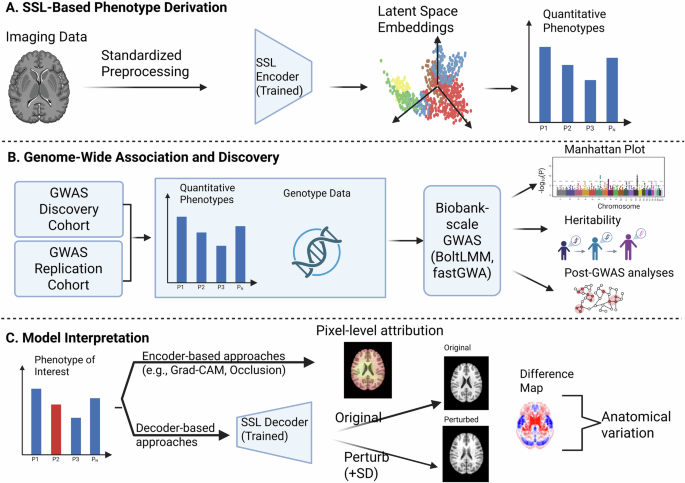
One particularly powerful approach is called “self-supervised learning.” Instead of needing thousands of labeled examples (which are expensive and time-consuming to create), these models learn by finding patterns in the data itself. For instance, they might learn to predict which parts of a brain scan belong together, or how to reconstruct a blurred image. Through this process, the AI develops a rich understanding of what makes one brain scan different from another.
Some methods use something called “contrastive learning,” which teaches the AI to recognize that two different views of the same person’s brain are similar, while two scans from different people are different. Other approaches use “autoencoders,” which compress images into a smaller representation and then try to reconstruct them, forcing the model to learn the most important features.
## From Images to Genes
Once the AI has extracted these meaningful features from the images, the next step is to find which genes are associated with them. This is done through a well-established statistical technique called a genome-wide association study, or GWAS. GWAS compares the genetic profiles of many people to find small DNA variations that are more common in those with a particular trait or feature.
Recent work has combined these steps into powerful pipelines. By applying AI to extract imaging measurements from thousands of scans and then running GWAS on those measurements, scientists have already identified dozens of new genes linked to brain structure, heart shape, and retinal features.
Some researchers have also developed methods to transfer knowledge between different imaging types. For example, insights gained from analyzing brain scans can sometimes be applied to improve the analysis of heart images, and vice versa.
## The Power of Collaboration
No single study can answer all the questions. That’s why scientists have begun sharing their methods and data across institutions and countries. Open-source software tools have been developed to help other researchers process brain scans, cardiac images, and retinal photographs in a standardized way. This sharing accelerates discovery and helps ensure that findings are reliable and can be replicated in different populations.
Studies involving diverse ethnic groups are especially valuable. Genes that influence health in one population may behave differently in another, and including a wide range of participants helps make sure that new discoveries benefit everyone.
## Looking Ahead
The combination of large-scale imaging, genetic data, and artificial intelligence is opening up entirely new ways to understand human health. Researchers hope that eventually, these tools will help identify people at risk of disease long before symptoms appear, allowing for earlier and more effective interventions.
New techniques like diffusion models and vision transformers are pushing the boundaries of what AI can do with medical images, making it possible to extract even richer and more detailed information from scans. Meanwhile, methods for making AI decisions more transparent are helping scientists understand exactly which features of an image are driving their findings.
—
## Frequently Asked Questions
**What is a biobank?**
A biobank is a large-scale research resource that collects biological samples (like DNA) and health data from thousands or even hundreds of thousands of volunteers. These resources allow scientists to study the links between genetics, environment, and disease on a massive scale.
**What is genome-wide association (GWAS)?**
GWAS is a method that scans the entire genome of many people to find small genetic variations that are statistically associated with a particular trait or disease. It has been used for decades to identify genes linked to conditions like diabetes, heart disease, and mental health disorders.
**What are imaging phenotypes?**
Imaging phenotypes are measurable features extracted from medical images. Examples include the volume of a specific brain region, the thickness of the retinal nerve fiber layer, or the diameter of a heart chamber. These features serve as bridges between raw images and genetic analysis.
**What is self-supervised learning?**
Self-supervised learning is a type of machine learning where a model learns to understand data without needing human labels. Instead, it creates its own learning tasks — for example, predicting missing parts of an image or distinguishing between different views of the same scan. This approach is especially useful in medicine, where labeling images requires expert time and effort.
**Why is AI needed for this kind of research?**
Medical images contain far more information than traditional measurements. A single brain MRI scan can generate gigabytes of data. AI can process and distill this information into meaningful, quantifiable features that would be impossible for humans to extract consistently from such large datasets.
**Are these findings ready for clinical use?**
While the discoveries are scientifically promising, most are still in the research phase. Translating genetic and imaging findings into clinical tools — such as predictive tests or personalized treatments — takes additional validation and regulatory approval. However, the pace of progress suggests that clinical applications are on the horizon.
**What makes these studies more reliable?**
Large sample sizes, diverse populations, open sharing of data and methods, and rigorous quality control all contribute to more reliable findings. Replication — confirming results in independent datasets — is also a critical step in ensuring that discoveries are genuine.
—
## Conclusion
The intersection of artificial intelligence, large-scale medical imaging, and genetics is transforming our understanding of human health. By combining deep learning with massive biobank datasets, researchers can now uncover the genetic roots of complex traits related to the brain, heart, and eyes. These advances are not just academic — they pave the way for earlier disease detection, more personalized medicine, and a deeper understanding of what makes each of us unique. The journey is still in its early stages, but the pace of innovation suggests that the coming years will bring even more exciting breakthroughs.
Thank you for reading
