



# Unlocking the Secrets of Gene Regulation in Immune Cells: A New Computational Approach
## Introduction
Every cell in your body contains the same DNA, yet a heart cell looks and functions completely differently from a neuron or an immune cell. How does this happen? The answer lies in gene regulation — the complex system of switches and dial settings that determines which genes are turned on, when they’re active, and how strongly they express their instructions.
Understanding these regulatory mechanisms is especially important in the immune system, where cells must rapidly change their behavior to fight infections. One particularly fascinating group of immune cells, known as germinal center B cells, undergoes dramatic transformations during an immune response. Scientists have long wanted to observe these changes in real time at the level of individual cells, but the tools to do so have been limited.
Recently, researchers have developed a powerful new computational framework that combines multiple types of molecular data to create detailed, time-resolved models of how genes and their regulatory regions behave as cells change state. This approach opens the door to understanding — and potentially predicting — how cells respond to disruptions in their regulatory systems.
## What Problem Are Scientists Trying to Solve?
When scientists study gene regulation, they typically face two challenges. First, they need to measure what’s happening with gene activity (which genes are being read to make proteins) and what’s happening with the accessibility of regulatory regions in the DNA (the “open” or “closed” state of chromatin that controls whether a gene can be accessed). Second, they need to understand how these two layers of information change over time as cells transition from one state to another.
Traditional methods could measure one or the other, but not both simultaneously in individual cells. Moreover, static snapshots of gene regulation told only part of the story. Scientists needed a way to capture the dynamic nature of these processes — to see not just where a cell is, but where it’s going and how it gets there.
## The New Approach: A Computational Framework
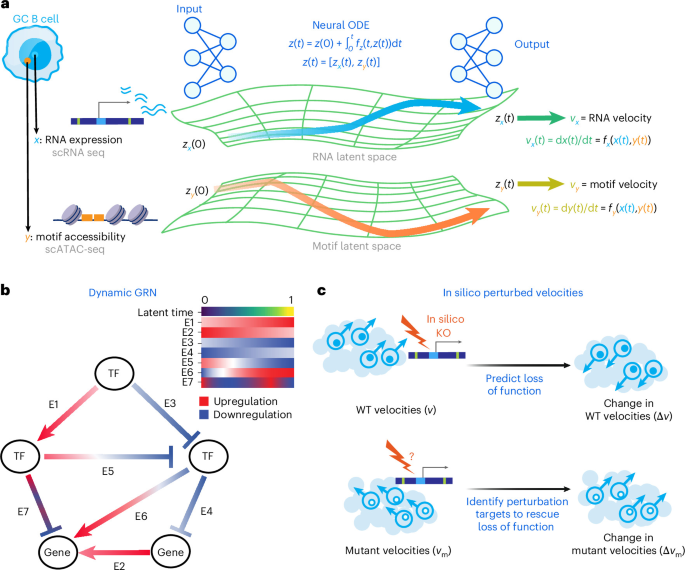
The breakthrough came from building a mathematical model that treats gene regulation as a dynamic system. The framework works by combining two types of single-cell data:
– **RNA sequencing data**, which reveals which genes are active and how strongly they’re expressed in each individual cell.
– **Chromatin accessibility data**, which reveals which regulatory regions of the DNA are “open” and available for gene regulation in each cell.
By pairing these two data types from the same individual cells, the model can learn how changes in regulatory region accessibility influence changes in gene activity over time.
At the heart of this framework is a neural network that learns the “rules” governing how cells transition between states. Think of it like learning the physics of a moving object — given enough observations of where something is and how fast it’s moving, you can build a model that predicts where it will be next. In this case, the “physics” describes how gene activity and chromatin accessibility evolve together.
## How the Model Learns Cellular Dynamics
The computational method works through several key steps:
**Step 1: Data preparation.** Cells are first sorted and their molecular data is collected. The RNA data tells us about gene expression, while the chromatin data tells us about regulatory region accessibility. Only high-quality data from cells with sufficient measurements is kept for analysis.
**Step 2: Learning the latent space.** The model compresses the complex, high-dimensional data into a simpler “representation space” where cellular states and transitions become easier to study. This is similar to how a map simplifies a real landscape while preserving the most important features.
**Step 3: Modeling time.** Rather than assuming cells are arranged in a fixed order, the model learns the timing of each cell’s position along a developmental trajectory. This allows researchers to see which cells are early, middle, or late in a transition process.
**Step 4: Predicting velocities.** Using the learned dynamics, the model can estimate the direction and speed at which each cell’s gene activity and chromatin accessibility are changing. This is like calculating the velocity vector of a moving object at every point in space.
**Step 5: Simulating perturbations.** Once the model understands the normal rules of cellular dynamics, it can simulate what would happen if a specific gene or regulatory factor were disrupted. This “virtual experiment” capability is one of the most exciting features of the approach.
## Validating the Model in Mouse Models
To test and refine this computational framework, researchers used mouse models with carefully controlled genetic modifications. Mice were housed under standard laboratory conditions with regulated temperature, humidity, and light cycles, and all procedures followed strict ethical guidelines for animal welfare.
The model was applied to study germinal center B cells, which play a critical role in generating antibodies during immune responses. These cells undergo rapid proliferation and differentiation, making them an ideal system for studying dynamic gene regulation.
By introducing specific genetic changes in mice — removing or altering key regulatory genes — researchers could observe how the disruption affected the normal trajectories of gene expression and chromatin accessibility. The model could then predict these effects computationally and compare them to what was actually observed in the lab.
## Key Insights and Applications
One of the most valuable outputs of this approach is the ability to construct **gene regulatory networks** — maps of how different genes and regulatory factors influence each other. Unlike traditional static networks, this method produces dynamic networks that change depending on the cell’s current state, offering a much more accurate picture of biological reality.
The framework can also:
– Identify which regulatory factors are most critical for maintaining specific cell states
– Predict how disrupting a particular gene will affect the entire cellular system
– Reveal previously unknown connections between chromatin accessibility and gene expression changes
– Quantify how much a disrupted system can recover toward normal function when a key factor is restored
## Broader Implications
This type of computational approach has implications far beyond basic biology. Understanding how gene regulatory networks malfunction is at the heart of many diseases, including cancers, autoimmune disorders, and immunodeficiencies. By providing a tool to simulate and predict the consequences of regulatory disruptions, this framework could accelerate drug discovery and help identify new therapeutic targets.
The approach is also generalizable — while this work focused on immune cells in mice, the same computational principles could be applied to any cell type or organism where paired gene expression and chromatin data can be obtained.
## Limitations and Future Directions
Like any powerful tool, this approach has limitations. It requires high-quality single-cell multiome data, which can be technically challenging and expensive to generate. The accuracy of predictions depends heavily on the quality of the input data and the biological system being studied. Additionally, while the model captures many aspects of gene regulation, it necessarily simplifies the full complexity of cellular processes.
Future work will focus on expanding the framework to include additional layers of biological information, improving its predictive accuracy, and applying it to study disease models more comprehensively.
## FAQ
**Q: What is single-cell multiome data?**
A: It refers to measurements taken from individual cells that capture multiple types of molecular information simultaneously — in this case, both gene expression (RNA) and chromatin accessibility (the openness of regulatory DNA regions).
**Q: Why is it important to study gene regulation dynamically rather than statically?**
A: Cells are not static entities; they constantly change their behavior in response to signals and during development. Static snapshots miss the timing, direction, and speed of regulatory changes, which are essential for understanding how cells make decisions about their identity and function.
**Q: How does the model predict what happens when a gene is disrupted?**
A: After learning the normal “rules” of how gene activity and chromatin accessibility change together, the model can simulate what happens when those rules are altered — for example, by removing a specific regulatory factor. It does this by calculating how the disruption would change the velocity (direction and rate) of cellular changes.
**Q: What are gene regulatory networks?**
A: These are maps showing which genes and regulatory factors influence the activity of other genes. Think of them as wiring diagrams for the cell, showing how signals flow from one molecule to another to control cellular behavior.
**Q: Is this approach applicable to human disease research?**
A: Yes, while this work used mouse models, the computational framework is general and can be applied to human cells as long as the appropriate data can be obtained. It has potential applications in studying cancer, autoimmune diseases, and other conditions involving gene regulatory dysfunction.
**Q: What makes this approach different from existing methods?**
A: Traditional methods typically analyze gene expression or chromatin accessibility separately and cannot model how they interact dynamically over time. This framework combines both data types into a unified model that captures the temporal dynamics and cross-regulatory relationships between the two layers.
## Conclusion
The ability to model gene regulation as a dynamic process at single-cell resolution represents a significant leap forward in our understanding of cellular biology. By integrating information about gene activity and chromatin accessibility, this computational framework provides researchers with a powerful lens through which to observe the inner workings of cells as they change, adapt, and respond to their environment.
The insights gained from such approaches bring us closer to a comprehensive understanding of how regulatory networks govern cell identity and function — knowledge that is essential for developing new strategies to diagnose and treat diseases rooted in gene regulation errors. As computational methods continue to advance and data generation becomes more accessible, we can expect even more sophisticated models that bring us ever closer to the complete picture of cellular life.
Thank you for reading
