



# Understanding Antimicrobial Resistance in Foodborne Bacteria: How Genomics and Machine Learning Are Helping Predict Risk
## The Growing Threat of Drug-Resistant Infections
Antimicrobial resistance (AMR) is one of the most pressing public health challenges of our time. When bacteria that cause foodborne illnesses develop resistance to antibiotics, treating infections becomes significantly harder — and in some cases, impossible. One of the most common foodborne pathogens worldwide is *Salmonella enterica*, a bacterium that can cause serious gastrointestinal illness and, in severe cases, life-threatening bloodstream infections.
A large-scale investigation across China set out to better understand how drug-resistant *Salmonella* strains move through different parts of society — from farms and food markets to hospitals and occupational settings. By combining genomic sequencing with advanced computational methods, researchers aimed to identify which resistance traits pose the greatest risk to human health and which factors might drive their spread over time.
## Tracking Resistant Bacteria Across the Food Chain
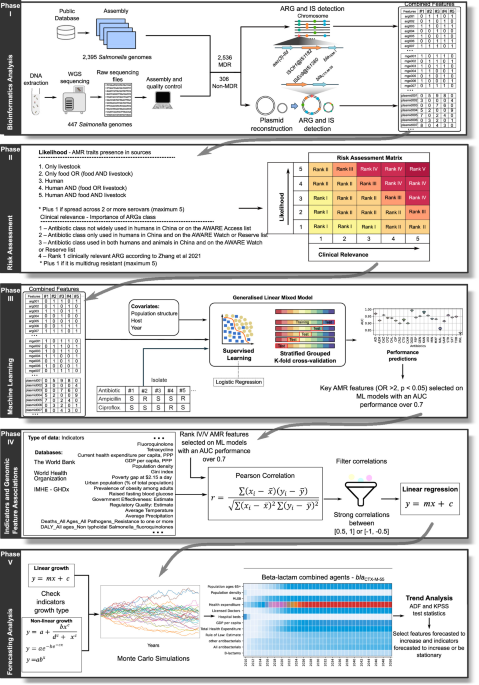
The study brought together nearly 3,000 bacterial samples collected over a 16-year period spanning 15 provinces of China. These samples came from a wide range of sources — humans, retail meat products like pork and chicken, and livestock environments on poultry farms. Importantly, the researchers separated samples based on whether they showed resistance to multiple antibiotics or not, allowing them to compare resistant and non-resistant strains side by side.
Human samples were collected from food workers, other workers, and patients showing symptoms of infection. Food worker and non-food worker samples were drawn from occupational health programs, where both groups underwent the same health monitoring, but differed in whether their jobs involved direct contact with food meant for consumption.
To confirm which antibiotics each bacterial strain was resistant to, the team tested all newly sequenced samples against a broad panel of drugs and used established international standards to classify results as susceptible, resistant, or intermediate. This careful quality control ensured that the data driving the analysis was both reliable and consistent.
## Reading the Bacterial Blueprint
Once samples were collected, each bacterium’s entire genetic code was sequenced and reconstructed into complete genomes. The team used rigorous quality checks to make sure the assembled genomes were accurate and complete enough for analysis. Any genome that was too fragmented or contaminated was excluded.
With high-quality genomes in hand, the researchers then searched for genes linked to antimicrobial resistance — essentially looking for the molecular tools that bacteria use to survive antibiotic exposure. They also searched for mobile genetic elements like insertion sequences and plasmids, which are known to help resistance genes travel between different bacteria.
Because some resistance arises not from acquired genes but from mutations in existing genes, the team also specifically checked for known mutations linked to fluoroquinolone resistance — an important class of antibiotics used to treat serious bacterial infections.
## Building a Risk Map of Resistance Traits
Not all resistance traits are equally dangerous. To make sense of the enormous amount of genetic data, the researchers built a risk assessment framework that scored each resistance trait based on two main factors: how easily it could spread across different hosts and bacterial types, and how clinically important it was.
The spread score considered whether a trait appeared only in animals, only in food, only in humans, or across multiple sources — with traits found in all three categories getting the highest scores. The clinical relevance score accounted for which antibiotics the trait affected, how important those antibiotics are for human and animal medicine, and whether the trait contributed to multidrug resistance.
Combining these two dimensions, each resistance trait was placed into one of five risk categories, from low concern to high concern. This ranking system helped focus attention on the traits most likely to threaten public health.
## Using Machine Learning to Predict Resistance
Perhaps the most innovative part of the study was the application of machine learning to predict which genetic features are most strongly associated with antibiotic resistance. Rather than looking at resistance one drug at a time, the team built separate predictive models for each antibiotic.
The models were fed detailed genetic information — including the presence of resistance genes, their association with mobile genetic elements, and the specific mutations known to confer resistance. The outcome they were trying to predict was whether a given bacterial strain would be resistant or susceptible to a particular antibiotic, as measured by laboratory testing.
To make sure the models were robust and not simply memorizing the data, the team used a rigorous cross-validation approach where the data was repeatedly split and tested. They also accounted for factors like bacterial lineage, geographic location, and the year samples were collected — all of which could influence results.
The models were only considered reliable if they achieved strong predictive performance, and the genetic features selected by the models had to meet strict criteria for effect size, statistical significance, and stability across multiple rounds of testing. This ensured that the results were both accurate and biologically meaningful.
## Looking Ahead: Forecasting Resistance Trends
Beyond identifying current resistance threats, the study also attempted to project how resistance might change in the future. The researchers identified socioeconomic, environmental, and health indicators — such as antibiotic consumption patterns, economic development metrics, and climate factors — that were strongly correlated with the prevalence of high-risk resistance traits.
Using statistical modeling, they built relationships between these indicators and resistance trait prevalence, then used forecasts of the indicators to project how resistance might change through the year 2050. To ensure these projections were reliable, the team ran extensive sensitivity checks and validated the robustness of their models against different assumptions.
This forward-looking approach is valuable because it can help policymakers and public health officials anticipate where resistance might become a bigger problem and take preventive action before it is too late.
## Why This Matters
Understanding how antimicrobial resistance moves through the food chain — from farms to markets to people — is critical for designing effective interventions. By combining genomic data with machine learning and risk analysis, this kind of research provides a more precise and predictive picture of resistance threats than traditional surveillance alone.
The findings underscore that resistance is not confined to any single setting; it flows between humans, animals, and food products, making a coordinated “One Health” approach essential. When we treat animal health, human health, and environmental health as interconnected, we gain a clearer understanding of the full picture and can develop more effective strategies to protect both people and animals.
—
## Frequently Asked Questions (FAQ)
**Q: What is antimicrobial resistance, and why should I care?**
A: Antimicrobial resistance occurs when bacteria evolve to survive the antibiotics designed to kill them. This makes infections harder to treat, increases the risk of severe illness, and can lead to higher healthcare costs and mortality. It affects everyone, not just people who work in healthcare or agriculture.
**Q: How does *Salmonella* become resistant to antibiotics?**
A: *Salmonella* can acquire resistance through two main routes. First, it can pick up resistance genes from other bacteria via mobile genetic elements like plasmids and insertion sequences. Second, it can develop mutations in its own DNA that naturally protect it against certain antibiotics, such as fluoroquinolones.
**Q: What does MDR mean?**
A: MDR stands for multidrug-resistant. A bacterium is classified as MDR when it shows resistance to at least three different classes of antibiotics. MDR strains are especially concerning because they limit the treatment options available to clinicians.
**Q: Why is the food chain important in the spread of resistance?**
A: The food chain connects farms, food processing, retail markets, and homes. Resistant bacteria can travel from livestock to meat products at the market, and then to humans through consumption or occupational contact. Understanding these pathways helps identify where interventions — such as improved food safety practices or antibiotic stewardship in agriculture — could have the greatest impact.
**Q: How does machine learning help in studying antimicrobial resistance?**
A: Machine learning allows researchers to analyze vast amounts of genetic data and identify patterns that would be impossible to detect by eye. It can reveal which specific genetic features are most predictive of antibiotic resistance, helping to prioritize surveillance targets and guiding the development of new diagnostic tools and treatments.
**Q: What is the “One Health” approach?**
A: One Health is a framework that recognizes the interconnectedness of human health, animal health, and environmental health. It encourages collaboration across disciplines — medicine, veterinary science, environmental science, and public health — to address health threats like antimicrobial resistance in a comprehensive and coordinated way.
**Q: Can we really forecast antibiotic resistance trends decades into the future?**
A: Forecasting is not about making exact predictions; it is about identifying likely trajectories based on current trends and their known drivers. By linking resistance prevalence to indicators like antibiotic use and economic development, researchers can produce informed projections that help guide policy decisions and resource allocation. These projections should be updated regularly as new data becomes available.
**Q: What can individuals do to help combat antimicrobial resistance?**
A: Individuals can play a role by using antibiotics only when prescribed by a healthcare professional, completing the full course of treatment, practicing good food safety at home (such as proper cooking and hygiene), and supporting policies that promote responsible antibiotic use in both human medicine and agriculture.
—
## Conclusion
Antimicrobial resistance is a complex and evolving challenge that requires equally sophisticated tools to understand and address. By combining large-scale genomic sequencing, risk assessment frameworks, and machine learning, researchers can move beyond simply tracking resistance to actually predicting where and how it is likely to spread. Studies like this one demonstrate the power of interdisciplinary science in tackling a problem that sits at the intersection of human health, animal welfare, and environmental sustainability.
The road ahead demands continued investment in surveillance, data infrastructure, and international collaboration. Every new piece of knowledge about how resistance genes move through bacterial populations brings us closer to more effective prevention strategies and, ultimately, a safer food supply for everyone.
Thank you for reading
