



# How to Become an AI Product Manager: A Practical Guide for 2026
## Why AI Product Management Is Different
Artificial intelligence is transforming the way teams build, launch, and measure products. Across industries, companies are discovering that the hardest part of an AI project isn’t the technology itself — it’s turning a working prototype into something real users can depend on. That challenge sits squarely in the hands of the AI product manager.
Traditional product managers oversee systems that behave predictably. AI product managers work with systems that produce uncertain, shifting, and sometimes unpredictable outputs. This role demands a unique blend of technical understanding, evaluation expertise, financial awareness, and the ability to communicate clearly with engineers, legal teams, and business leaders.
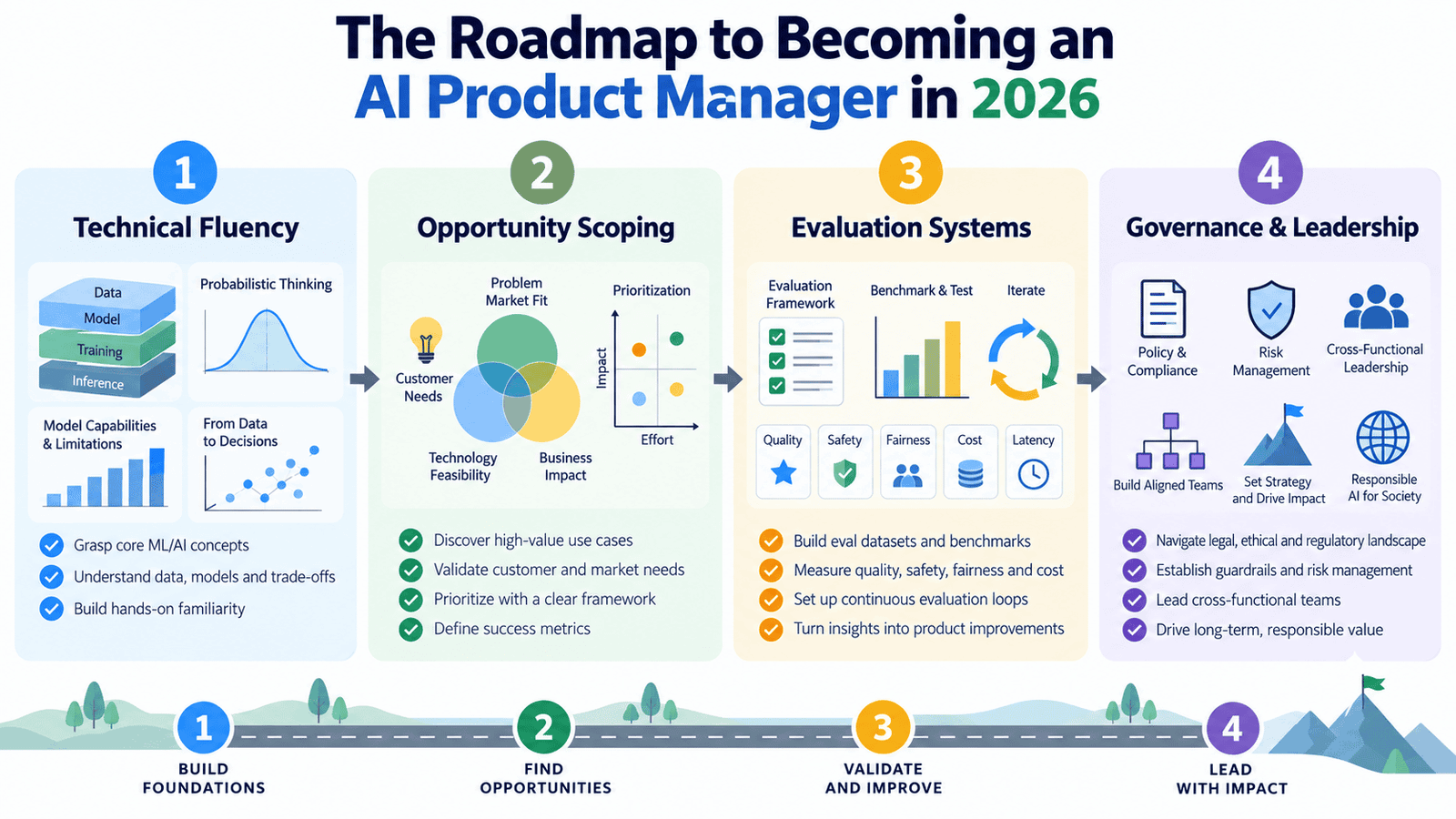
This guide walks you through a four-phase path from foundational knowledge to organizational leadership.
—
## Phase 1: Build Your Technical Foundation and Learn Probabilistic Thinking
The biggest mindset shift for anyone entering AI product management is moving from deterministic thinking to probabilistic thinking. In traditional software, the same input always gives the same output. With AI, the same input can produce different results depending on context, training data, and model version. This isn’t a bug — it’s the reality you’ll be managing.
Start by getting comfortable with the main ways AI systems are built and deployed today:
– **Foundation model APIs** (such as those from major AI providers) let you ship quickly with minimal setup, but they come with ongoing costs and limited customization.
– **Fine-tuning open-weight models** lets you adapt existing models to your specific domain at a fraction of the running cost of API calls.
– **Retrieval-augmented generation** connects AI outputs to verified data sources, reducing the chance of incorrect or made-up responses.
– **Small language models** can run locally, making them ideal when speed or data privacy is a priority.
You don’t need to build any of these yourself. You do need to understand the trade-offs so you can ask the right questions and challenge assumptions during planning sessions.
Throughout your career, three tensions will dominate your work: **speed vs. cost vs. accuracy**. You’ll constantly weigh how fast a system responds, what it costs to run, and how correct its outputs need to be for your use case.
### Suggested Learning Materials
– *Hands-On Large Language Models* by Jay Alammar and Maarten Grootendorst
– The **fast.ai** Practical Deep Learning course (designed for people without heavy math backgrounds)
### Practice Exercise
Create a comparison table that evaluates three different AI architecture choices for a single business scenario — such as automating customer support responses. Write down your reasoning for each trade-off you consider.
—
## Phase 2: Discover AI Opportunities and Scope Them Rigorously
Once you can speak the language of AI engineering, the next challenge is figuring out which opportunities deserve your team’s time — and which ones should be passed on.
A helpful framework is to map every potential AI feature along two dimensions: **the value it delivers when it works well** and **the risk it creates when it fails**. Low-risk, high-value tasks like categorization, summarization, or data extraction are excellent starting points. Tasks involving safety, legal compliance, or irreversible actions need much more testing before they can be released.
A critical skill at this stage is the **build, buy, or assemble** decision:
– When is it smarter to use a ready-made commercial API?
– When do open-source models offer better financial returns?
– When should you partner with a specialized vendor rather than build from scratch?
This decision has both technical and financial dimensions. You’ll need to understand **compute economics at the inference level** — how your margins hold up as usage scales, how hosting costs compare to per-call pricing at ten times your current volume, and how much each database query costs in retrieval pipelines.
AI product managers who can model costs accurately are the ones who ship products that don’t fall apart under real-world demand.
### Suggested Learning Materials
– *Continuous Discovery Habits* by Teresa Torres (for framing opportunities)
– The **a16z AI Canon** (a curated list of essential reading on the AI market)
– Public pricing pages from leading AI providers (use them to build your own cost intuitions)
### Practice Exercise
Write a one-page recommendation for a specific AI use case in an industry you know well. Include a basic estimate of how token consumption would translate into monthly costs.
—
## Phase 3: Design the User Experience, Build Evaluation Systems, and Iterate
This is where AI product management diverges most from traditional product work. When your product’s outputs aren’t deterministic, you can’t rely on simple pass-or-fail testing. You need a robust evaluation system.
Designing experiences for probabilistic systems introduces new challenges:
– How do you communicate uncertainty to users in a way that maintains trust?
– How do you design graceful fallbacks when the AI gets something wrong?
– Where should human reviewers step in, and what signals — ratings, click behavior, session recordings — actually help the system improve?
On the evaluation side, you’ll want to develop fluency with **evaluation-driven development**:
– Create a “golden dataset” of known inputs and expected outputs before you start iterating.
– Establish baseline benchmarks early so you can spot performance drops.
– Learn when automated metrics (like precision, recall, or similarity scores) are sufficient and when having an AI model evaluate outputs gives you better insights.
– Always connect model-level improvements to real business outcomes. A small boost in a technical metric only matters if you can trace it to higher resolution rates, lower escalation volume, or better user retention.
**Structured adversarial testing** — also known as red-teaming — should be a non-negotiable part of your pre-launch process. Test for prompt injection attacks, push the model to its limits, and simulate worst-case scenarios. Add red-teaming to your launch checklist from day one, not as a final-minute panic measure.
### Suggested Learning Materials
– *Designing Machine Learning Systems* by Chip Huyen
– Documentation for **RAGAS** (a toolkit for evaluating retrieval-augmented pipelines)
– **Braintrust** and **PromptFoo** (tools for building evaluation infrastructure)
### Practice Exercise
Draft an evaluation rubric for a specific AI feature. Include at least three automated metrics and describe how you would conduct a human evaluation alongside them.
—
## Phase 4: Navigate Governance, Compliance, and Organizational Influence
The final phase takes you from building products to scaling them — and from individual contributor to organizational leader. As AI products reach more users and more regulated environments, they encounter legal, ethical, and cultural challenges that require you to bridge gaps between technical, legal, and business teams.
**Regulatory awareness is now essential.** Laws like the EU AI Act, U.S. government directives on AI, and industry-specific rules in healthcare and finance all shape what you can build, where you can deploy it, and what documentation you must keep. You don’t need to become a legal expert, but you do need to recognize compliance risks early and collaborate effectively with legal counsel.
**Data privacy and lineage** are ongoing operational concerns. You’ll need to answer questions like: Which customer data gets sent to external AI providers? What steps exist to clean or anonymize data before it reaches a model? How do users opt out? In enterprise settings, requirements around SOC 2 and HIPAA will heavily influence your architecture choices.
Perhaps the most underrated skill at this level is **cross-functional orchestration** — the ability to align research teams focused on technical benchmarks, legal teams focused on liability, and business leaders focused on revenue and risk. Your job is to carry context across all of these groups without losing the meaning in translation.
### Suggested Learning Materials
– The **EU AI Act** summary from trusted policy organizations
– *Trustworthy Machine Learning* by Kush R. Varshney
– Your own organization’s compliance documents as a starting point for identifying gaps
### Practice Exercise
Write a one-page risk assessment for a product you use regularly. Identify one regulatory concern, one data privacy issue, and one user experience risk related to its AI features.
—
## Frequently Asked Questions
**Do I need a computer science degree to become an AI product manager?**
No. While technical fluency is important, you don’t need to write code or hold a degree in engineering. What matters is the ability to understand trade-offs, ask informed questions, and communicate effectively with technical teams.
**How long does it take to go through these four phases?**
It depends on your background. Someone with prior product management experience may move through the phases more quickly than someone starting from scratch. Expect months of focused learning and practice, not weeks.
**Is red-teaming only for large companies?**
No. Any team shipping user-facing AI features should conduct some form of adversarial testing. It can be done with small teams and simple checklists — the key is to make it a habit, not a luxury.
**Can I learn all of this on my own?**
Absolutely. Many of the recommended resources are free or low-cost. The real differentiator is consistent practice — building comparison matrices, writing cost projections, and designing evaluation rubrics on your own time.
**What’s the most important trait of a successful AI product manager?**
Intellectual honesty. The best AI PMs are upfront about what their systems can and cannot do, design strong fallback mechanisms, and treat evaluation as a core part of the product — not something to be added at the end.
—
## Conclusion
The role of AI product manager is still evolving, which means there’s a real opportunity for newcomers to help define its standards and expectations. The path outlined here moves from understanding technology to scoping opportunities, from building evaluation systems to leading governance efforts — but in real life, you’ll find yourself moving between all of these phases constantly.
What will remain constant is the core discipline: understand trade-offs deeply, scope with rigor, measure what truly matters to the business, and earn the trust of every person you work with along the way. The landscape will change quickly, but these fundamentals will serve you no matter what comes next.
Thank you for reading
