



# New Welding Technologies Are Transforming Modern Manufacturing
Manufacturers today face growing pressure to deliver higher-quality welds, shorten production cycles, and handle increasingly complex assembly jobs. In response, a new generation of welding equipment is hitting the market — from intelligent robotic systems that can navigate large structures on their own, to compact laser machines that slash programming time. Here’s a look at four innovations that are reshaping how manufacturers approach joining operations.
—
## A Walking Robot That Welds Large Structures
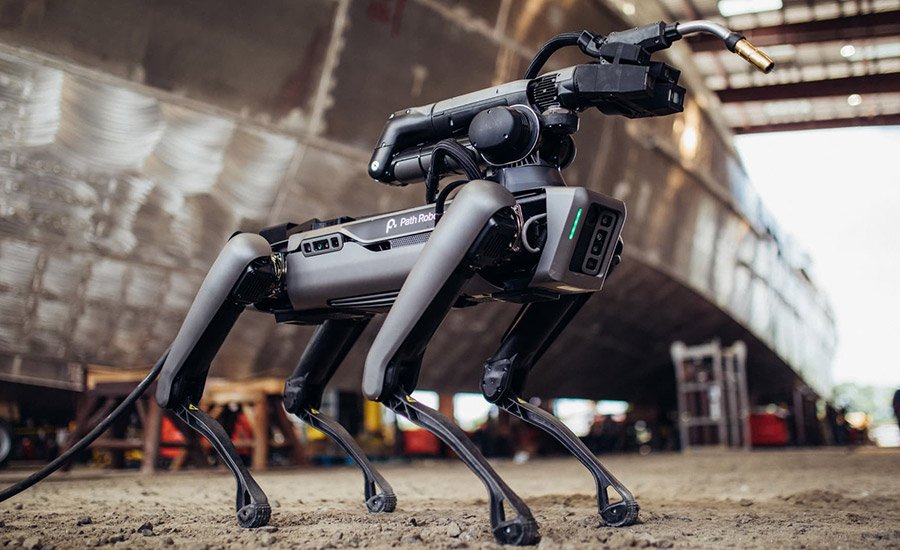
One of the biggest challenges in welding is working on parts that are simply too big — or too awkwardly shaped — to bring into a traditional robotic cell. Path Robotics has tackled this problem with **Rove**, a mobile robotic welding platform that pairs an advanced physical AI model called Obsidian with a quadruped walking robot.
Rove goes directly to the workpiece. Instead of moving a massive assembly into a welding booth, the system moves itself around the part. Its AI-powered perception technology continuously reads the joint geometry and adjusts the welding parameters in real time, making it well suited for environments where fit-up tolerances are inconsistent and conditions change from one spot to the next. Industries such as shipbuilding and heavy equipment manufacturing stand to benefit the most, where structures like vessel hulls and frame assemblies can span dozens of feet. Saronic Technologies, a shipbuilder in Louisiana, is already piloting Rove for autonomous vessel manufacturing, and Path Robotics has launched an early adopter program to invite additional manufacturers to test the system.
## A Human-Friendly Spot Welder That Cuts Fatigue
Manual resistance spot welding remains essential in many assembly lines, but it can be physically demanding on operators — especially when reaching into deep boxes, narrow channels, or tight corners. Koyo Giken’s **NK23 MySpot** resistance spot welder was designed with the operator in mind.
The NK23 features both vertical and horizontal welding guns mounted on ergonomic arms that allow a single person to comfortably access hard-to-reach weld locations. According to the manufacturer, the system reduces welding arm movement effort by more than half and cuts horizontal gun insertion effort by nearly 90 percent. A high-speed welding burst lasting just one millisecond minimizes the heat-affected zone, which helps preserve the appearance of the finished part and reduces the need for post-weld grinding or polishing.
The unit also includes automatic parameter selection, a touchscreen interface with barcode scanning, and built-in weld sequence optimization and production tracking. Common applications include electrical enclosures, switchboard panels, compressor housings, and automotive components.
## A Fiber Laser Welder Built for Heavy-Duty Shops
For shops that work with thicker materials and need strong, clean welds with minimal distortion, Quantum Machinery Group’s **Nargesa MS20** fiber laser welding machine offers a compelling option. Rated at 2,000 watts, the system delivers consistent weld quality across a range of metal thicknesses while keeping heat input low enough to reduce warping and simplify cleanup.
A standout feature is the dual wire feed system, which includes eight motorized feed rollers and the ability to run two wire spools at the same time — either with the same material or with two different metals. An onboard 7-inch touchscreen, Industry 4.0 connectivity for remote monitoring, Bluetooth-enabled resonator diagnostics, and an ergonomic laser torch with integrated LED lighting round out the package. The machine also includes dedicated storage for consumables, tools, and shielding gas cylinders, making it a self-contained unit ready for demanding fabrication environments.
## A Compact Laser Welding Cell That Programs Itself
Setting up a robotic laser welding cell traditionally required significant programming expertise and time. TRUMPF’s **TruLaser Weld 3000** changes that equation by combining compact robotics with AI-assisted programming.
The cell is designed for manufacturers who produce sheet metal assemblies and enclosures in small batches with frequent product changes. Its TeachLine Touch interface lets operators simply point to new weld locations on a touchscreen, cutting programming and setup time by up to 50 percent. An optional AI feature called TeachLine goes a step further by detecting where the actual part differs from the programmed path and automatically recalculating the robot’s trajectory to match.
The welding optics are roughly 40 percent smaller than earlier generations, giving the system better access into deep housings and confined spaces. The overall cell footprint is roughly 12 by 12 feet and uses a KUKA Iontec robot with an 82.68-inch reach. It is available with either a 3-kilowatt or 4-kilowatt laser and can weld stainless steel, structural steel up to about 8 millimeters thick, and aluminum up to roughly 6 millimeters thick.
—
## Frequently Asked Questions
**Q: What types of manufacturers will benefit from these new welding technologies?**
A: These innovations target a wide range of industries, including shipbuilding, heavy equipment, automotive, aerospace, electrical enclosure production, and general fabrication. The mobile robotic system is ideal for large-scale structures, while the compact laser cell suits small-batch production with frequent changeovers.
**Q: How does AI improve the welding process?**
A: AI helps in several ways — from real-time perception and adaptive welding parameters on the mobile robotic platform, to automatic path correction and programming shortcuts on the laser welding cell. These capabilities reduce human error, cut setup time, and improve consistency across welds.
**Q: Are these systems difficult to operate?**
A: Manufacturers have focused on ease of use. Features like touchscreen interfaces, automatic parameter selection, barcode scanning, and simplified programming tools mean that operators with moderate training can run these systems effectively.
**Q: What materials can be welded with the new laser systems?**
A: The fiber laser welder handles a broad range of metals, and the robotic laser cell is rated for stainless steel, structural steel up to about 8 mm thick, and aluminum up to about 6 mm thick. Both systems are designed to minimize distortion and reduce the need for post-weld finishing.
**Q: How do these technologies reduce production costs?**
A: By reducing setup time, minimizing operator fatigue, cutting rework and post-weld cleanup, and improving throughput, these systems help manufacturers lower labor costs and increase output per shift.
—
## Conclusion
The welding industry is undergoing a significant transformation driven by advances in artificial intelligence, robotics, and laser technology. Whether it is a mobile platform that walks to the job, a handheld spot welder designed to protect the operator, or a compact laser cell that programs itself, each of these innovations addresses a specific pain point in modern manufacturing. As early adoption programs expand and more manufacturers integrate these tools into their production lines, the result should be higher weld quality, faster turnaround times, and greater flexibility across a diverse range of assembly applications.
Thank you for reading
