



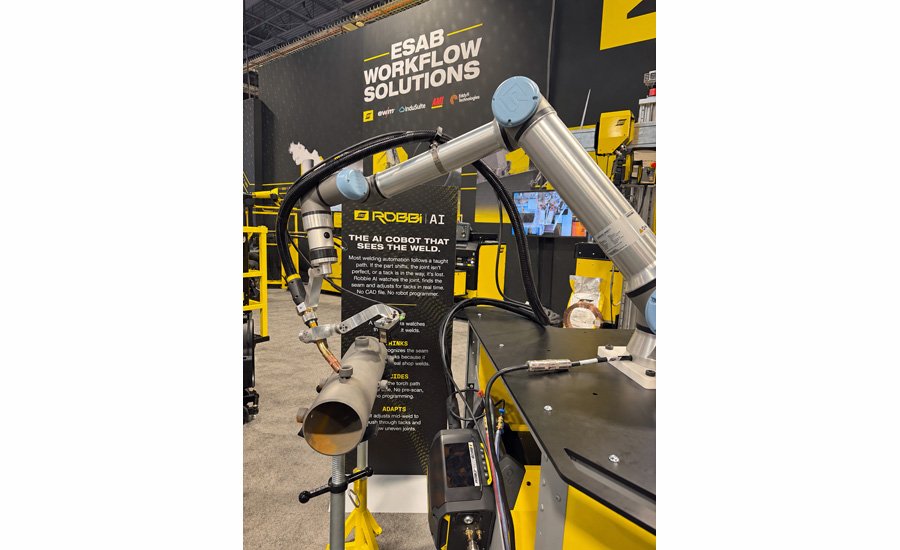
# ROBBI AI: How Physical Intelligence Is Changing the Way We Weld
## A New Approach to Automated Welding
ESAB has unveiled a groundbreaking welding system called ROBBI AI that brings a smarter, more adaptive approach to automated MIG and TIG welding. Instead of relying on rigid, pre-programmed welding paths that break down whenever a part is slightly different, ROBBI AI uses real-world sensing to think through each weld as it happens.
Think of it this way: traditional robotic welding is like following a recipe word-for-word, while ROBBI AI is more like having an experienced welder who can read the joint in front of them and adjust on the fly.
## How It Works
ROBBI AI combines a camera and laser-based sensing technology to evaluate the welding environment in real time. Before a single weld is made, the operator simply positions the system near the joint and inputs key parameters such as the material type, the welding procedure, and the consumables being used. The system then takes over from there.
Once welding begins, ROBBI AI continuously analyzes the joint and makes live decisions about:
– **Travel speed** – speeding up or slowing down based on the gap it sees
– **Welding parameters** – adjusting voltage, wire feed, or arc characteristics as needed
– **Motion patterns** – modifying oscillation and path to compensate for irregular fit-up
This means no time-consuming manual path programming, even when multiple parts are clamped down on a single table.
## Who Benefits Most?
The system is specifically designed for some of the toughest challenges in manufacturing. These include:
– **Low-volume, high-mix production** where every job looks different
– **Pipe fabrication**, especially for data centers and large-scale infrastructure
– **TIG welding**, which demands highly specialized skills and significant training
– Any application where **part variation** is the norm rather than the exception
By handling these complex jobs, ROBBI AI offers a practical way for manufacturers to reduce their reliance on scarce skilled welders while maintaining high-quality results.
## Learning From Every Weld
One of the most impressive features of ROBBI AI is its ability to learn. Before it ever reaches a customer’s facility, the system goes through a simulation-based training phase. Once deployed, it continues to collect data from every weld it completes, building up a knowledge base over time.
If the system detects a condition that could lead to a defective weld—such as an unexpected gap or misalignment—it has the ability to pause or stop the process entirely. Operators can then review recorded video and sensor data to understand what happened and provide feedback that helps the system recognize and handle similar situations in the future.
All of this processing happens locally on a computer within the facility, which means there is no dependency on internet connectivity or cloud-based systems. This keeps sensitive production data secure and ensures that every decision is made instantly, right at the point of welding.
## Staying Within Safe Boundaries
Even with all its intelligence, ROBBI AI is designed to operate within well-defined limits. ESAB’s InduSuite software acts as a safeguard, ensuring that every AI-driven adjustment stays within the boundaries of established welding procedure specifications and qualification requirements. The goal is to give manufacturers the benefits of adaptive intelligence without the risk of the system making unauthorized changes to the weld.
## Flexibility for Every Shop
ROBBI AI also supports conventional cobot operation, meaning operators can switch to a more traditional programming mode when full AI assistance isn’t needed. The system is built on a Universal Robots UR10e or UR20e six-axis arm, and it can be configured with a seventh axis for extended reach or mounted on a mobile cart for easy repositioning around the shop floor.
Power source options include the EWM Titan XQ, EWM Tetrix XQ, and the ESAB Aristo Edge 500R, each offering different welding capabilities from advanced MIG processes to specialized TIG modes with enhanced deposition rates.
—
## Frequently Asked Questions
**Q: What makes physical AI different from traditional AI in welding?**
A: Physical AI goes beyond software analysis by using cameras and lasers to directly observe and interact with the physical welding environment. It can make real-time decisions about motion and parameters based on what it actually sees at the joint.
**Q: Does ROBBI AI require extensive programming knowledge?**
A: Not necessarily. The system is designed to be intuitive. Operators provide basic welding parameters and position the tool near the joint, and the AI generates the weld path automatically.
**Q: Can the system be used for both MIG and TIG welding?**
A: Yes. ROBBI AI is compatible with both MIG and TIG processes, making it versatile enough for a wide range of applications.
**Q: What happens if the system encounters a problem it can’t handle?**
A: ROBBI AI is programmed to pause or stop welding when it detects a condition that could compromise weld quality. Operators can then review the recorded data and intervene if needed.
**Q: Is the system suitable for small manufacturing shops?**
A: Yes. Its design for low-volume, high-mix environments makes it particularly well-suited for smaller operations that deal with frequent product changes and part variation.
**Q: Where does the AI process its data?**
A: All AI processing takes place on a local computer within the customer’s facility, keeping data secure and enabling instant, real-time decision-making without relying on external servers.
—
## Conclusion
ROBBI AI represents a significant step forward in welding automation. By combining physical sensing, real-time decision-making, and continuous learning, it bridges the gap between traditional robotic welding and the unpredictable reality of shop floor production. Whether a manufacturer is struggling with labor shortages, tackling difficult TIG or pipe welding applications, or simply looking for more flexibility in their automation strategy, this technology offers a compelling solution. It brings a new level of intelligence directly into the weld—one joint at a time.
Thank you for reading
