By the end of May, ChatGPT held 46% of the AI assistant market, according to Sensor Tower’s State of AI 2026 report.
Google Gemini grew to 28%, while Claude reached 10%.
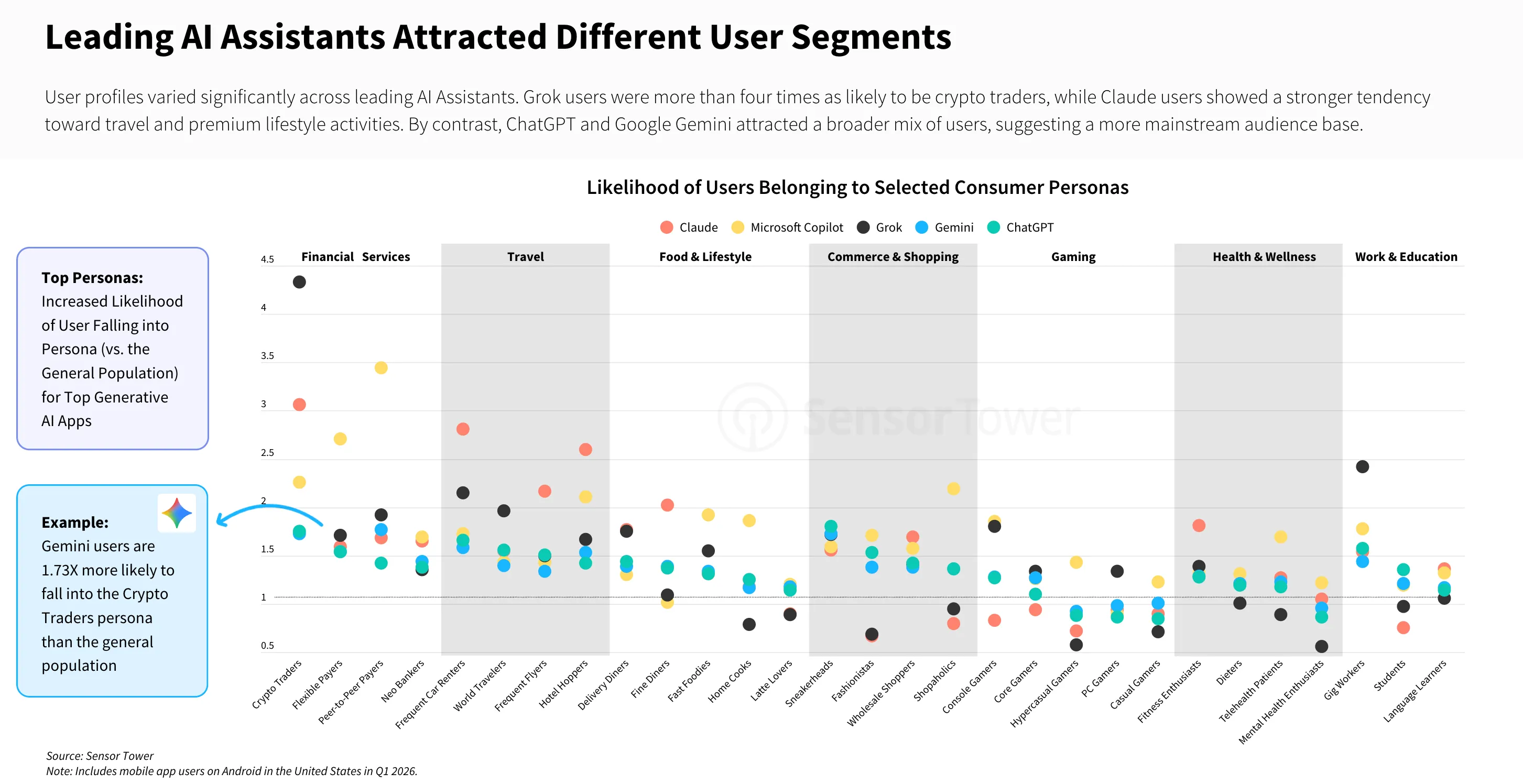
Grok users are roughly four times more likely than average to trade crypto—the strongest skew Sensor Tower found for any AI assistant, followed by Claude, Copilot, and ChatGPT.
For three years, ChatGPT enjoyed a rare edge in tech: its name *was* the category. People didn’t say they were using generative AI—they said they were “using ChatGPT,” just like earlier generations said they’d “Google” something.
But those golden days from 2023 may now be behind it.
ChatGPT’s share of the AI assistant market dipped below 50% for the first time in March 2026 and settled at 46% by May, per Sensor Tower’s latest State of AI 2026 report. Google Gemini now claims 28%, and Claude has risen to 10%.
None of this signals ChatGPT’s decline. In May, the app surpassed 1 billion monthly users—making it the fastest app ever to reach that milestone, outpacing TikTok, YouTube, and Instagram. OpenAI is now evolving ChatGPT into a superapp that bundles shopping and AI agents, aligning with an IPO process already underway.
What’s fading is its monopoly as the only AI tool most people know. As reported by Decrypt in May, ChatGPT’s web traffic share fell from 77.6% to 53.7% over the past year. Sensor Tower’s data confirms it has now dropped below majority share.
With more options available, users are becoming less loyal to any single brand.
Gemini’s growth is largely driven by Google’s massive reach—and the numbers vary by source. Google told investors Gemini had 750 million monthly users in February, then announced over 900 million at its May developer conference. However, Sensor Tower’s independent tracking—which only includes Gemini’s standalone app and website—recorded 662 million for the same month.
Both figures point in the same direction. ChatGPT’s commanding lead is slipping — not due to weaker technology, but because strategic distribution and default placements now outweigh pure functionality. Gemini’s deeply embedded presence across Android devices, Google Search, Chrome, and Workspace grants it a real-world edge that performance benchmarks simply cannot quantify.
Claude’s American user base nearly tripled between December and May, jumping from 5% to 14% — a surge with a clear backstory. In late February, Anthropic rejected Pentagon requests to remove safeguards against mass surveillance and autonomous weaponry; the Department of War (formerly the Department of Defense) responded by flagging the company as a supply chain risk. A few days afterward, OpenAI finalized its own agreement with the same branch.
Following that week of March 9, ChatGPT uninstall rates across the U.S. surged roughly 200% above the historical average, according to Sensor Tower. Claude essentially outsold ChatGPT for five consecutive days during March before the gap re-stabilized. Brand credibility revealed itself to be more than just a soft metric — it became a decisive factor.
The crypto trading crowd has made its preference crystal clear
Nestled within the user-behavior breakdown lies the report’s most revealing finding. Grok users are approximately four times more likely to be active cryptocurrency traders compared to the general population — the largest behavioral skew of any AI assistant Sensor Tower tracked.
Curiously, ChatGPT lands squarely in the “meh” category among degen traders. Claude trails distantly in second, edging out Copilot, while ChatGPT users barely register above the population average on crypto engagement.
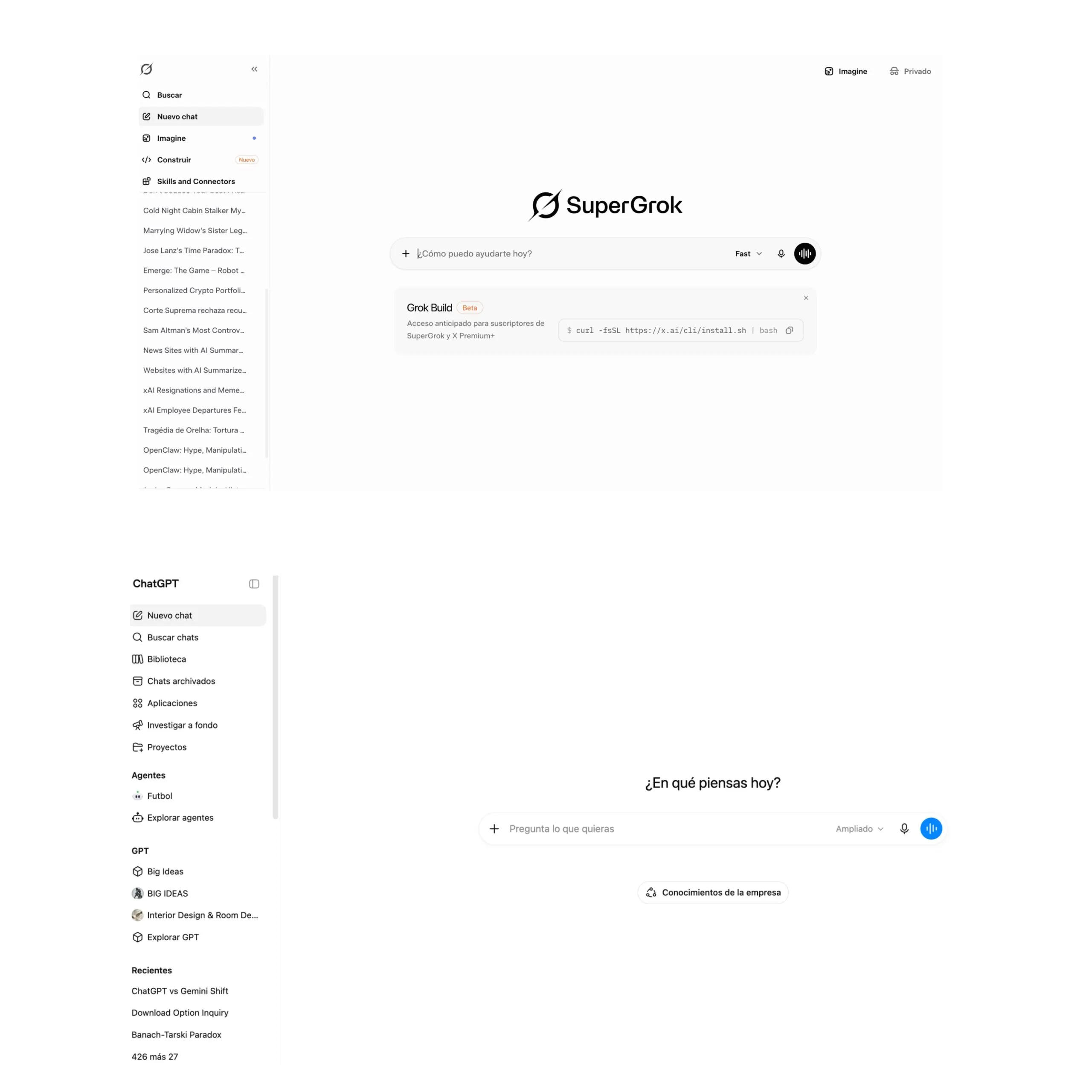
Grok’s competitive advantage stems from its deep integration with X, where it comes bundled free with Premium subscriptions and instantly scans live posts the moment a meme coin begins gaining traction—a capability no independent chatbot can match.
These structural advantages feed into one another in a powerful way: Grok lives inside X’s ecosystem where crypto traders are already active, it draws on real-time sentiment and meme coin discussions as they happen, Musk’s own passion for cryptocurrency shapes the platform’s tone, and the user base itself is heavily populated by people already immersed in crypto Twitter culture. Together, these forces create a feedback loop that naturally steers Grok toward crypto-centric content.
Grok also delivers a feature set comparable to ChatGPT in many areas—a conversational chat interface, artifacts, code generation, image creation, video generation (which ChatGPT lacks), web search, integrations, and more.
Claude’s position as runner-up aligns with results from last fall’s Alpha Arena competition, where Grok and Claude Sonnet both generated real-money trading profits on the Hyperliquid exchange, while GPT-5 and Gemini 2.5 Pro each lost over a quarter of their funds. Crypto Twitter doesn’t forget which AI tools delivered returns, so their chatbot loyalties may be well-founded.
The financial data confirms the usage trends. Claude’s average revenue per U.S. mobile user surged from below $0.50 last September to $2.76 in May, outpacing ChatGPT’s $1.74, and 13% of Claude’s users now subscribe to a paid plan—the highest conversion rate in the report. OpenAI is moving toward an IPO with the largest audience in AI history, yet its grip on what that audience actually favors is steadily loosening.
Daily Debrief Newsletter
Kick off each morning with the biggest headlines of the day, plus in-depth features, a podcast, videos, and more.