



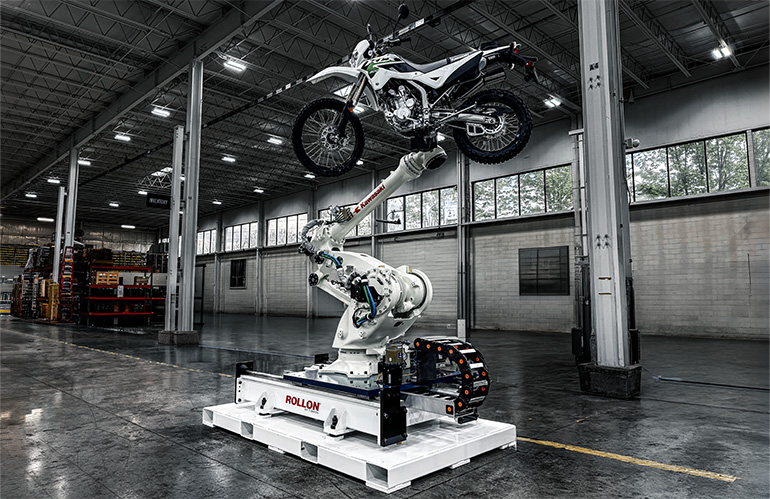
Kawasaki will showcase the MXP360L robot, built for heavy-duty material handling, in Chicago. Source: Kawasaki Robotics
Kawasaki Robotics is set to reveal several new systems at next week’s Automate event in Chicago. The company will demonstrate how robotics, artificial intelligence, machine learning, vision systems, and real-time control are reshaping industrial automation.
“At Kawasaki Robotics, we believe the future of automation lies in robotic systems that smoothly combine perception, movement, and decision-making,” said Seiji Amazawa, president of Kawasaki Robotics. “Automate 2026 represents a key milestone as we roll out technologies aimed at supporting emerging physical AI applications while maintaining the industrial reliability that manufacturers rely on.”
Since 1969, Kawasaki Robotics has provided industrial automation and robotics across a wide variety of sectors and applications. The Tokyo-based company said it continues to push innovation in physical AI, intelligent inspection, collaborative robotics, controllers, and autonomous systems.
“As a global manufacturer of vehicles—from aircraft and trains to recreational vehicles—we focus more on results than on the latest AI platform or humanoid,” said Paul Marcovecchio, director of general industries at Kawasaki Robotics. “Our proven robots help build millions of products each year, so we take a practical approach to adopting AI and full automation.”
At Booth S-2201 in Chicago’s McCormick Place, Kawasaki will present its new RL030N eight degree-of-freedom (DoF) platform, designed specifically for physical AI applications. The company will also showcase its patented Pulseboard inspection technology.
Additionally, Kawasaki will launch the MXP360L and BA013L industrial robots. The booth will feature systems highlighting advanced motion control and flexible manufacturing capabilities.
RL030N engineered for manipulation in tight spaces
Kawasaki Robotics, with its U.S. headquarters in Wixom, Mich., stated that the RL030N blends high-speed motion, improved dexterity, lightweight design, and real-time external orchestration capabilities for dynamic and confined environments.
“Startups excelled at creating motion-planning software, but traditional robots lacked the dexterity or suffered from latency,” Marcovecchio told The Robot Report. “We’re closing the gap between traditional robotics programming and the dexterity required for physical AI.”
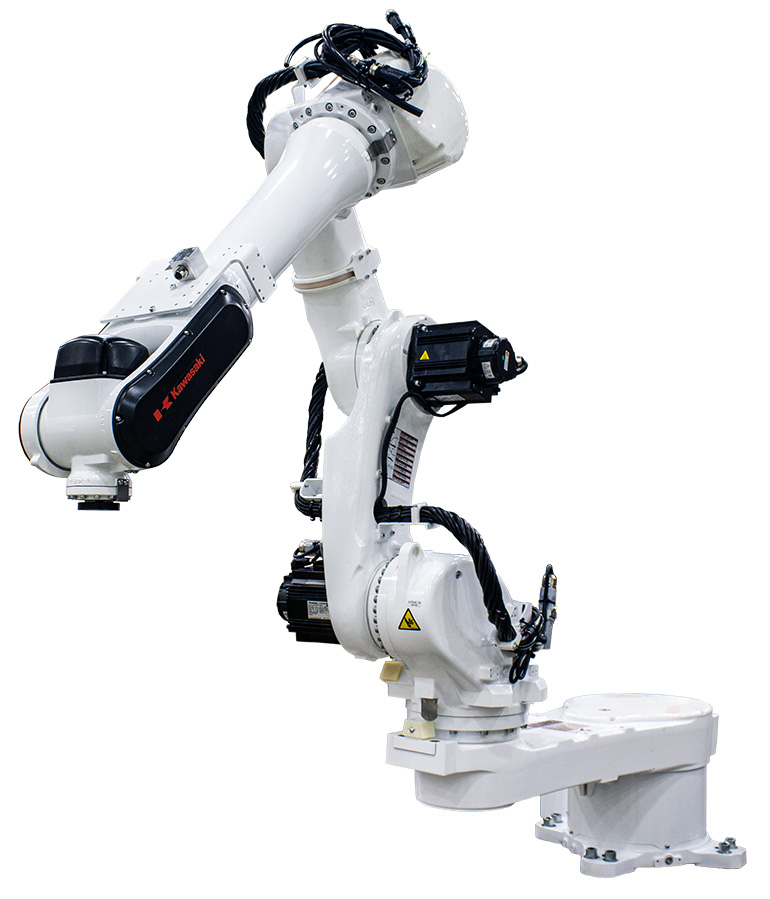
The RL030N is built to support AI-driven applications. Source: Kawasaki Robotics
Unlike standard industrial robots designed for repetitive tasks, the RL030N supports AI-driven applications that demand adaptive motion, obstacle avoidance, manipulation in tight spaces, and complex motion planning, according to Kawasaki. Its extra articulation axis provides greater dexterity and flexibility compared to traditional six-axis robots, the company noted.
“We used what we call a ‘diving board’ design—when you look at the 8 DoF, one of the axes extends out like a diving board—for additional reach,” Marcovecchio explained. “We added it to a traditional robot, which eliminated many accessibility issues caused by singularity, where multiple solutions exist to reach a single position.”
“It also delivered full range of motion without sacrificing payload capacity,” he added. “Often, when a robot is fully extended, payload becomes compromised. You’d have to impose limits—whether on velocity, inverse kinematics adjustments, dynamic loads, or other parameters—to prevent shaking and maintain trajectory.”
“Then, when companies began controlling our robots with this extra axis, they told us, ‘We’d love if you could customize this for our application,'” Marcovecchio recalled. “We recognized the need as well, so we developed a lighter, faster, though slightly less precise system. It’s like picking up a coffee cup—it’s not exact; your fingers might touch the edge first and then adjust to grip it.”
The RL030N leverages Kawasaki’s open KRNX real-time application programming interface (API). This allows external AI software, ROS environments, machine learning systems, vision platforms, and third-party orchestration systems to directly control the robot in real time.
From palletizing to humanoid applications, the KRNX API ensures long-term viability by being controller-agnostic, Marcovecchio noted.
 Submit your session proposal for the 2026 RoboBusiness
Patented Pulseboard technology enables faster weld inspection
Kawasaki Robotics will also showcase its patented Tool Tip Displacement Output Function technology, called Pulseboard, integrated into an advanced robotic weld inspection system developed alongside partner Fives DyAG Corp. The system combines a Kawasaki RS013N robot, a laser 3D profile camera, and Kawasaki’s high-speed motion-synchronization technology to enhance inspection performance for complex weld geometries and curved surfaces.
Unlike traditional inspection systems that require robots to stop repeatedly for static image capture, Pulseboard continuously synchronizes image acquisition in real time with the robot’s tool-tip displacement. This enables high-resolution imaging even during acceleration and deceleration, delivering up to 10x faster weld inspection, fewer setup requirements, and precise defect localization while maintaining accuracy.
“Pulseboard lets the robot operate at full speed without compromising, stretching, or blurring the image,” Marcovecchio noted. “It will also enhance traceability, allowing companies to limit recalls instead of having to recall hundreds of thousands of vehicles.”
“The solution developed in partnership withKawasaki’s Pulseboard system is delivering tangible benefits to its users, according to Wade Rickard, CEO of Fives DyAG. “It speeds up inspection processes, pinpoints flaws, and upholds top-tier quality standards without causing any delays or cutting into production time,” he explained.
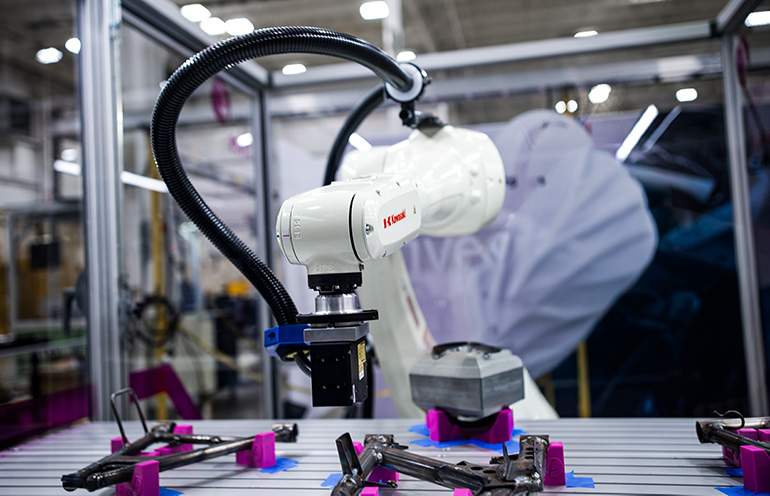
The Pulseboard system is capable of performing inspections while in motion. Source: Kawasaki Robotics
Kawasaki Robotics and Coherix Team Up for Closed-Loop Dispensing Demo
Kawasaki Robotics is set to showcase its BU015X seven-axis robot in a collaborative demonstration with Coherix, highlighting a closed-loop system for adhesive dispensing and inspection. This setup is designed to replicate an actual automotive manufacturing line, where the robot will apply sealant to a Ford F-150 door panel. Throughout the process, it will continuously measure and automatically fine-tune the placement of the adhesive bead at a rate of up to 400 adjustments per second.
Marcovecchio pointed out a common challenge: “When sheet metal is stamped, its dimensions aren’t always perfectly uniform. Kawasaki developed an interface that receives feedback from Coherix to precisely follow the part’s contours, ensuring a consistent bead of adhesive. Eliminating any gaps is critical, especially for applications requiring weatherproofing.”
This integrated solution combines Kawasaki’s hollow-arm robot design with Coherix’s 3D laser-based Adaptive Process Control technology. By leveraging machine learning and real-time optimization, the system aims to help manufacturers minimize defects, reduce material waste, lower labor costs, and decrease rework, all while keeping pace with full production-line speeds.
At the Automate exhibition, the demonstration will feature the BU015X robot accurately tracing the shape of an object, detecting any gaps, and returning to the exact location to fill them in.
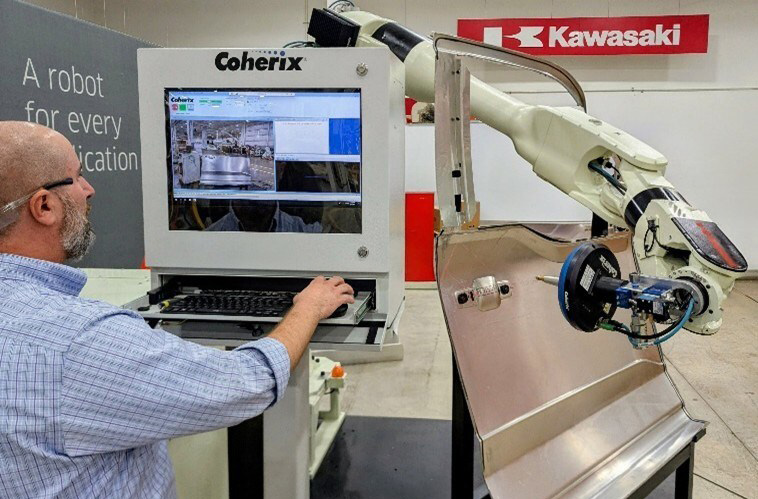
Steven Pagalos, a technical account manager at Coherix, fine-tunes the company’s 3D adhesive inspection technology on a door panel. Source: Coherix
BA013L and MXP360L Robots Broaden Automation Options
The BA013L, a 13 kg (28.6 lb.) arc-welding robot, will make its debut within a compact workcell engineered for high-performance welding tasks. This cell will include the BA013L robot, a Kawasaki PST500-L2 dual-axis positioner, a Rollon Glider RTU, a Strong Hand welding table, and a Miller power source, showcasing a flexible and highly precise automated welding solution.
Designed for rigorous production settings, the BA013L boasts a redesigned structure featuring a 50 mm (1.9 in.) hollow wrist for internal cable management. It supports high-current welding torches, minimizes cable wear, and enhances accessibility. With high-speed axis performance reaching 730°/s and an extended reach of 2,093 mm (82.4 in.), the robot helps improve cycle times while upholding weld quality, as stated by Kawasaki Robotics.
“We’re highlighting the adaptability of our positioners with this arc-welding package,” Marcovecchio noted. “Our target market includes smaller fabricators who produce a few thousand units annually and currently rely on manual processes. Fabricators of all sizes are facing significant challenges right now, whether they’re manufacturing data center racks, for example, where we used to source more affordable metal components from overseas. Currently, many are operating at full capacity.”
The MXP360L robot, with its impressive 360 kg (793.6 lb.) payload capacity, extended reach, and advanced vibration-control technology, is tailored for heavy-duty material handling. At Automate 2026, this robot will be seen maneuvering a Kawasaki Z125S motorcycle along a Rollon RTU linear axis.
Kawasaki Robotics will also present collaborative robot (cobot) demonstrations, featuring CL Series welding carts and a sanding application utilizing a FerRobotics sanding tool.
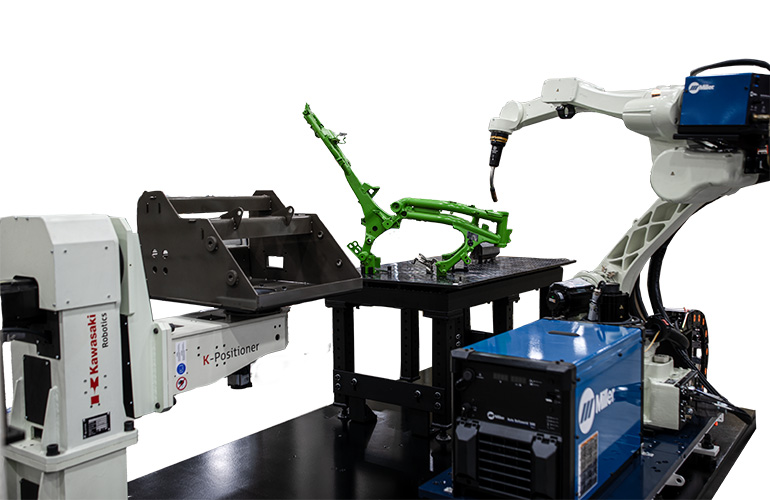
The BA013L arc welding cell, complete with integrated systems. Source: Kawasaki Robotics
