



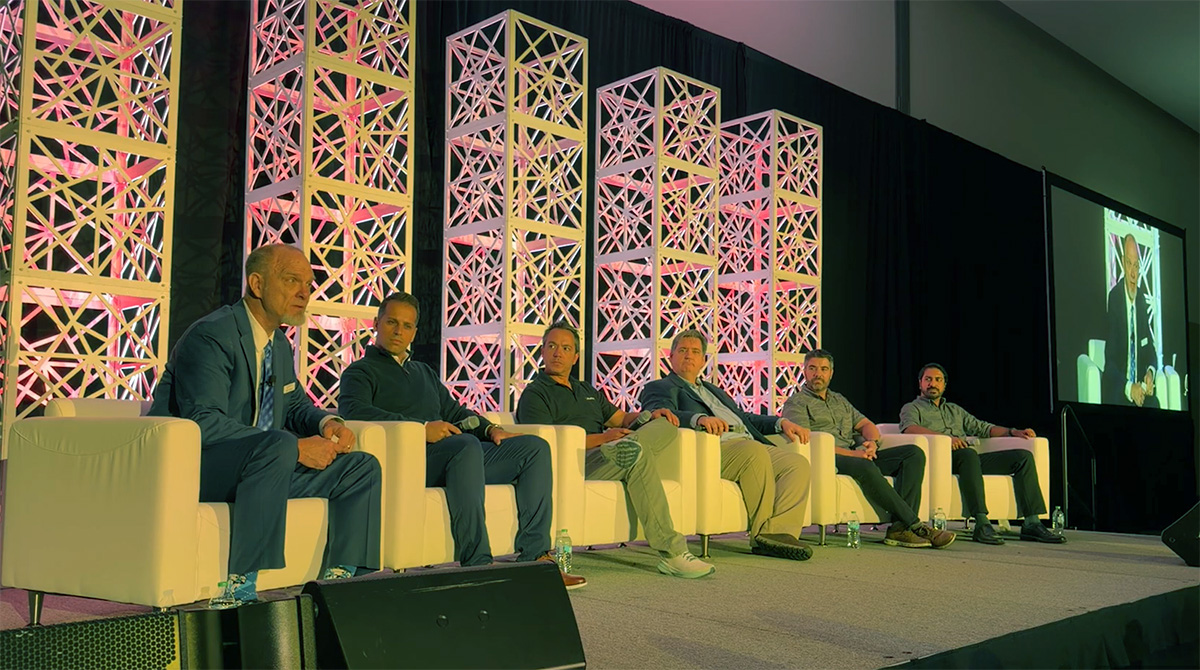
A panel of industry experts discussed the state of humanoid robot development at the 2026 Robotics Summit & Expo. Source: RealSense
While robotic arms have long been refined for manufacturing tasks, designing and building a two-legged robot capable of walking and handling objects is an entirely different challenge. On top of that, there’s the added difficulty of making such a system operate safely in busy environments alongside human workers, forklifts, and other equipment. At last month’s Robotics Summit & Expo, a keynote panel took a deep look at where humanoid robots currently stand.
The session featured an impressive roster of speakers:
The Robotics Summit & Expo, hosted at Boston’s Thomas M. Menino Convention & Exhibition Center, delivered outstanding keynotes, presentations, and panel discussions covering the full spectrum of robotics, from design to real-world deployment. Organized by The Robot Report, the event drew approximately 3,900 attendees who packed the sessions and roamed the exhibit hall, encountering everything from component suppliers to robots that shoot tennis balls.
 Submit your session idea for the 2026 RoboBusiness
Humanoid developers look beyond the demos
For Boston Dynamics, the guiding vision behind its Atlas program has been to create a versatile machine capable of performing physical labor across a wide range of tasks. Rodriguez shared that one of the key takeaways from extensive customer conversations is that, aside from a small number of highly standardized applications, nearly every job is unique in its own way.
“Our roadmap focuses on building the technology needed to support that general-purpose vision — at the hardware level, at the level of the models and architectures that drive behavior, and critically, at the level of deployment strategy,” he said. “When it comes to integration, if you can’t find a broadly applicable approach for any one of those three areas, the costs become unmanageable.”
Rodriguez explained that Boston Dynamics began with logistics in manufacturing — an area where the company and its parent organization, Hyundai, believe there’s a favorable balance between versatility and manageable complexity.
“You need to handle a wide variety of parts — for instance, retrieving items from a cart — but it’s still far enough from the assembly line that you don’t have to contend with the precise timing demands and safety requirements of working in close proximity to people,” he pointed out. “Last year, we brought Atlas into a factory as an initial exercise to conduct a first proof-of-concept demonstration of a fully data-driven architecture controlling behavior and task sequencing.”
“We showcased it at CES this January for an entire week of demonstrations, and we’ll be returning next year,” Rodriguez added. “This year, we’re heading back to the factory to present a more comprehensive, end-to-end demonstration of Atlas — a complete learning pipeline that doesn’t just manage behavior, but orchestrates the entire workflow, interfaces with factory systems, and handles exceptions.”
He also shared that as Boston Dynamics moves toward mass-production scale, the company has now secured enough customers — including Hyundai — to commit to deploying approximately 25,000 humanoid robots in factory settings. Additionally, Boston Dynamics has pledged to scale up its production capacity to 30,000 Atlas units annually by 2028.
Agility (formerly Agility Robotics) has similarly moved beyond early pilot programs. It has been deploying its Digit humanoid with partners including Amazon, GXO, Schaeffler, Toyota, and Mercado Libre.
“We’ve been significantly expanding the commercial side and using those experiences to identify what’s needed to close the remaining gaps that stand in the way of scaling,” said Velagapudi. “That involves several things: gaining insights into what the safety case requires, which has been a massive piece of the puzzle given an incredibly powerful, dynamically stable robot. How can we navigate these facilities and work alongside people more closely — or without safety barriers?”
Velagapudi also mentioned that Agility has established an ISO committee and working group alongside Boston Dynamics and other organizations to examine the safety challenge and develop solutions that will be integrated into the next generation of its robot.
He added that Agility is broadening its scope beyond its original focus on tote, case, and container handling, and is now preparing to move into individual item manipulation within the coming year or so.
Robotics safety and standards efforts continue
The landscape of robotic safety standards worldwide is advancing just as rapidly as the robots themselves. Prather noted that ASTM is tracking and participating in a wide range of initiatives.
“ISO has formed two new groups: one on safety, chaired by Boston Dynamics, and another on data, led by China,” he said. “This is the next initiative we’re collaborating with NIST on — a proposal for a humanoid test bed consisting of roughly 10 tests.”
Prather described how the test beds would evaluate capabilities such as locomotion and manipulation. Some manufacturers will receive these tests to use internally. But another objective is to deploy these test beds in future competitions, giving teams the chance to put their robots to the test in a public setting at robotics events.
These tests are also designed to support the development of robotics standards, Prather explained. “Safety work is actively progressing at ISO, ASTM, and NIST,” he said. “We’re beginning to develop performance repeatability tests, and there are numerous other efforts underway.”
When asked about humanoid safety specifically, Prather expressed his hope that the first safety standards would be drafted within the next two years.
However, the panelists acknowledged that AI fundamentally reshapes the safety landscape. Traditional deterministic safety approaches are less effective for complex systems that involve learned behaviors. Some of the emerging engineering challenges include:
- Accurately predicting how failures will manifest
- Ensuring consistent and repeatable performance
- Assessing risks in human-robot interactions
- Validating decisions made by AI systems
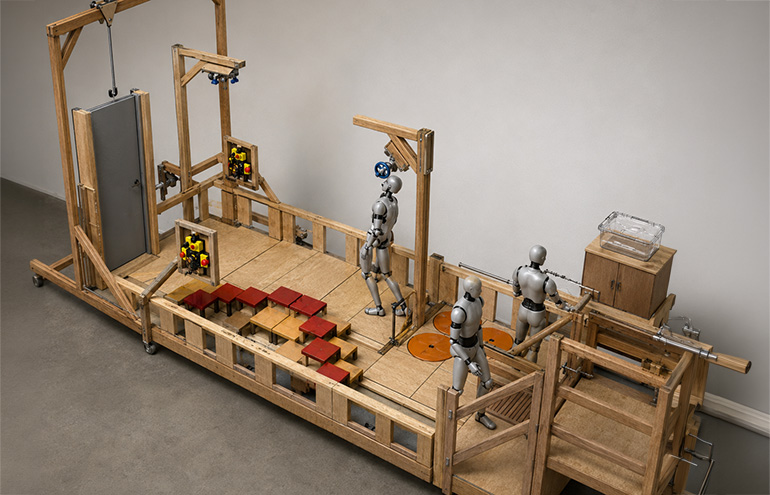
Rendering of a proposed apparatus for standardized testing of humanoid robot capabilities. Source: NIST, ChatGPT
Challenges in Robot Perception
During the Robotics Summit, Nielsen shared that RealSense has experienced “remarkable” growth and that the pace of progress is accelerating rapidly.
“We’re witnessing multiple trends at once, and our ability to execute has significantly improved,” he explained. “A key factor is our collaboration with technology partners in chip design and the wider artificial intelligence sector, particularly in simulation. The gap between simulated environments and real-world performance is shrinking steadily.”
“The progress has been outstanding, though significant challenges remain,” Nielsen added. “Notably, we’re collaborating with NVIDIA and other companies to create a universal vision system. This would allow RealSense cameras in any configuration to function within the Isaac platform for real-time deployment, complete with noise modeling.”
“The most significant hurdle is deploying a theoretical model in real-world conditions from the ground up,” he cautioned. “Without incorporating real-world constraints into the model’s design, you’re essentially relying solely on superficial appearance.”
Nielsen also highlighted that RealSense is gaining valuable insights from the Chinese market, where clients are advancing at an extremely rapid pace. He pointed out that product development cycles in China are roughly 30 to 40 times faster than in other markets, largely due to a higher appetite for risk.
“We’re also observing mechatronic boundaries being tested in exciting ways, such as robots designed for dancing, including the performance featured on SportsCenter recently,” he said. “The progression from slow-moving robots to those capable of athletic maneuvers like judo raises the next challenge: achieving self-directed decision-making. This brings into question whether the current autonomous control systems are adequate.”
Nielsen emphasized that humanoid robots face distinct perception challenges compared to other robotic systems.
“There are fundamental requirements involving the concentration of data at close proximity and varying velocities,” he clarified. “The required speeds change depending on the robot’s configuration, since a moving arm operates much faster than a rotating torso.”
“Falling objects behave very differently from stationary items — we actually had a situation where an engineer, while demonstrating a robot to a client in an unorthodox manner, ended up having the robot topple onto him,” Nielsen recounted. “This highlights the unique failure scenarios that heavily depend on perception systems — not only for detecting when failures occur, but also for managing varying velocities, distances, data density, and spatial reconstruction.”
Rodriguez also made an insightful observation about adapting high-resolution images to dimensions suitable for neural network processing.
“A major shift we’ve observed is deriving greater value from fewer, higher-quality pixels,” he said. “However, the behavioral frameworks controlling most humanoid robots today typically resize images down to approximately 240 by 240 pixels to fit neural network inputs. We simply cannot process extremely large images, so ultimately much of the captured detail is discarded.”
“What would be more beneficial are premium-quality pixels featuring superior dynamic range and, for instance, global shutters — which eliminate distortion during rapid torso movement — along with excellent resolution and sharp focus at close range,” Rodriguez suggested.
The Question of a $20,000 Humanoid Robot
One of the most persistent questions in the robotics industry concerns humanoid robot affordability: Will costs ever decrease enough to make a $20,000 price tag feasible? The panel participants offered measured optimism about reaching this goal, citing automotive-inspired mass manufacturing methods, growing production scales, streamlined sensor integration, improved actuator engineering, and partial hardware standardization as contributing factors.
“There’s considerable pressure from various stakeholders, including several people on this stage as well as our broader client base,” said Nielsen. “Sensor expenses can be substantial, particularly for autonomous mobile robots where costs escalate dangerously given their payload capacities.”
“The current perception system cost for a single robot reaches about $20,000 — practically matching our target price for the whole machine. That’s simply unsustainable,” he stressed. “Consequently, our research at RealSense focuses on merging multiple sensing modes. At times you need minimal data like barcode readings, while other situations require dense information — these are fundamentally different challenges, yet no one wants purchasing separate cameras for each function. That’s why we’re accelerating efforts at RealSense to reduce sensor counts without sacrificing complete 360-degree awareness.”
Makke recalled a conversation from the previous year’s Robotics Summit & Expo where another panelist expressed doubts about achieving this cost target.
“I responded by countering pessimism with optimism, and I’m even more convinced today,” Makke said humorously. “It becomes a classic catch-22: you need affordable component costs to justify return on investment, but that requires high-volume production.”
“Developing technologies with lower readiness levels means accepting some degree of failure,” he noted. “Critical components need to become more standardized and accessible. Actuators represent a major expense, alongside motors, sensors, and printed circuit boards.”
When asked about a realistic timeline for such pricing, Makke estimated it could happen within the next three to five years.
