



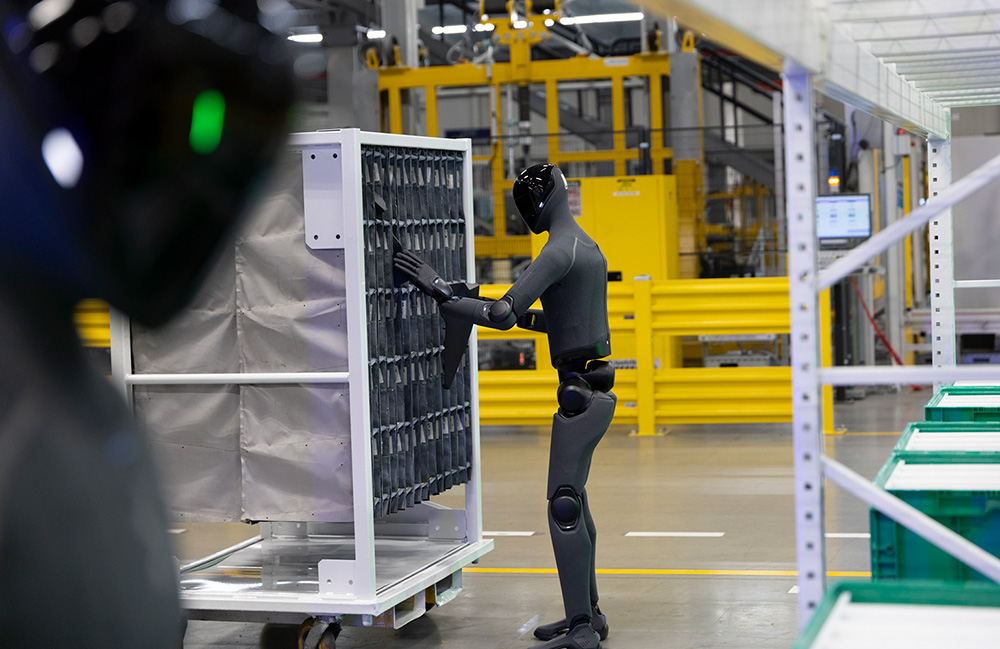
**Humanoid Robots in Manufacturing: When Economics Trump Technology**
The integration of humanoid robots into manufacturing has long been seen as a potential game-changer for automating complex tasks. However, despite significant advancements in AI, vision systems, and hardware capabilities, the widespread adoption of humanoids on factory floors remains elusive. A recent article from *The Robot Report* highlights a critical shift in the conversation: the technology may be ready, but the real barrier is no longer intelligence—it’s economics.
While tech advancements continue to push the boundaries of what robots can do, manufacturers are finding that the cost of deploying humanoids at scale is often not justified by the returns. The article emphasizes that the future of humanoid robots in manufacturing depends less on artificial intelligence and more on reducing unit costs to a level where automation makes financial sense.
—
### The Technology Is (Mostly) Ready
In recent years, physical AI has evolved rapidly. Robots are now capable of performing intricate manipulation tasks that were once considered out of reach. From warehouse operations to dexterous handling, the hardware has improved significantly—stronger actuators, better mobility, and increasingly effective end-effectors. Even the much-maligned “hand” problem is closer to being solved, with many use cases functioning effectively without perfection.
Organizations like Generalist, Agility Robotics, and Alt-Bionics have demonstrated real-world success. These advancements are paving the way for broader innovation and accessibility in industrial robotics.
As a result, many experts argue that the core technological challenges have been solved—or are close to being solved. Demonstrations are becoming more impressive, and the industry dialogue has shifted from “Can they do the work?” to “Can we justify the cost?”
—
### People Must Stay in the Loop
Despite these advancements, human oversight remains crucial. When robots encounter unexpected scenarios, they often require human intervention. Some developers rely heavily on teleoperation, where a human operator directly controls the robot. While effective, this approach is not scalable, as each robot typically requires a dedicated human supervisor.
A more viable model is to treat humans as high-level supervisors who intervene only when necessary. In this setup, one person can oversee dozens of robots, with each interaction serving as valuable training data for AI improvements. Over time, the need for human intervention may decrease, but it will likely never disappear entirely.
—
### Specialized Robots Still Outperform Humanoids
One of the key challenges facing humanoids is their inherent flexibility. While they promise versatility, specialized robots often outperform them in specific, high-volume tasks. For example, in parcel sorting, humanoid demonstrations might achieve around 1,000 picks per hour in controlled environments. In comparison, specialized parcel-sorting robots can handle between 1,300 and nearly 3,000 picks per hour.
For manufacturers, this performance gap raises important questions about return on investment. In many scenarios, conventional industrial robots offer greater productivity at a lower cost.
—
### The Economics Are the Real Problem
At the heart of the humanoid adoption challenge lies unit economics. Today’s humanoid robots can cost several hundred thousand dollars each. To justify this investment, manufacturers would need to operate them continuously across multiple shifts—a scenario that only makes financial sense in large-scale operations.
Interestingly, lower-cost humanoids from China demonstrate how economies of scale can reduce prices, though they often come with fewer capabilities. Regulatory challenges, such as the recent FCC ban on Chinese humanoid imports, further complicate the landscape. For humanoid developers, achieving commercial viability will require reaching production volumes that drive costs down.
—
### Manufacturing Scale Is the Advantage
While the robotics industry often focuses on AI models and dexterity demos, the most significant advantage lies in manufacturing at scale. Companies like Tesla highlight how production expertise can make the difference. Building electric vehicles presented numerous manufacturing challenges, but Tesla’s experience has given it a competitive edge.
Humanoid robots face a similar path. Designing them is difficult, but producing them efficiently on a large scale is even harder. Companies that can master this—reducing component costs, optimizing supplier relationships, and streamlining production—will have a decisive advantage in robotics unit economics.
—
### The Win Happens on the Factory Floor
The race to commercialize humanoids ultimately comes down to economics. To compete with existing automation solutions, humanoids must offer lower prices, which requires manufacturers at scale. Success will depend on companies that can combine sophisticated hardware with efficient, repeatable production methods.
As the industry continues to evolve, the winners may not be the ones with the most advanced AI but those who can build and deploy robots affordably and at scale.
—
## FAQ Section
### **1. Why aren’t humanoid robots widely used in manufacturing yet?**
While the underlying technology has advanced significantly, the primary barrier to adoption is cost. Humanoid robots remain expensive to produce and operate, making them financially viable only for a limited number of applications.
### **2. What advancements have made humanoids more capable?**
Progress in AI, vision systems, and hardware—including stronger actuators, improved mobility, and better end-effectors—has enabled robots to handle tasks that were previously impossible.
### **3. Can’t we just use traditional industrial robots instead?**
In many cases, yes. Specialized robots often outperform humanoids in high-volume, repetitive tasks, offering greater productivity at a lower cost.
### **4. What role does human oversight play in robotic automation?**
Human oversight is essential for handling unexpected scenarios. Developers are moving toward models where humans supervise multiple robots, intervening only when necessary to improve efficiency and train AI systems.
### **5. How can humanoid robots become more economically viable?**
Reducing costs through large-scale production is key. Companies that can manufacture humanoids efficiently and leverage economies of scale will be better positioned for commercial success.
—
## Conclusion
Humanoid robots represent an exciting frontier in automation, but their future in manufacturing hinges on solving economic challenges as much as technical ones. While the technology is nearing readiness, manufacturers will only adopt humanoids at scale when the cost-benefit equation makes sense. Companies that prioritize mass production and operational efficiency—much like Tesla—will likely lead the next wave of robotic innovation. Until then, specialized robots and human-supervised collaboration will remain the more practical solutions for most industrial applications.
