



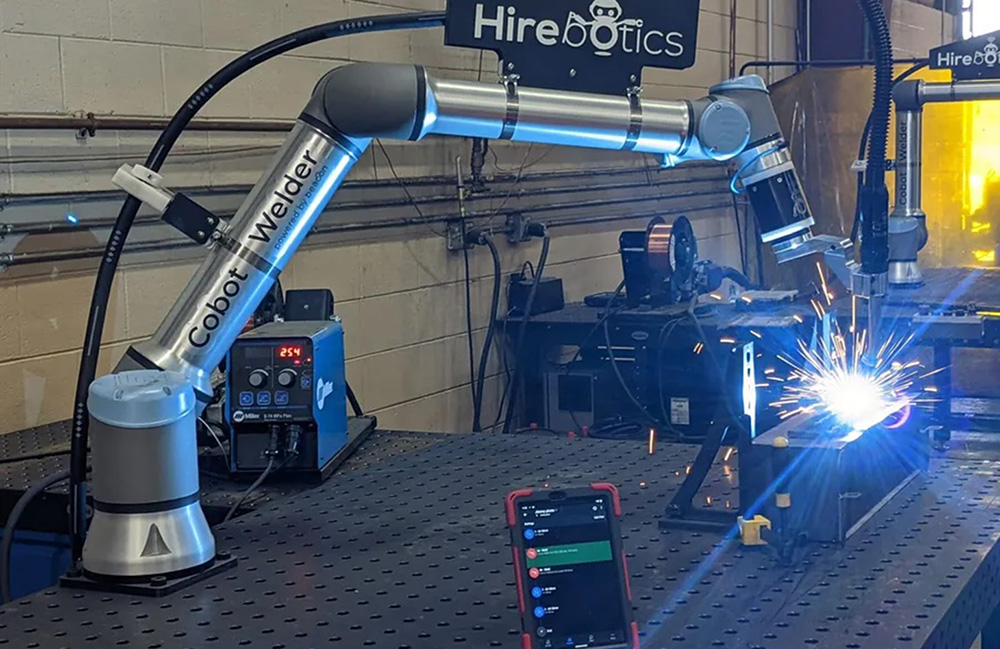
# Collaborative Robot Manufacturers Expand Reach with New Line Tracking and Linear Rail Technologies
**Collaborative robotics company Hirebotics has introduced two new capabilities for its cobot systems designed to help manufacturers handle larger workpieces and automate processes on moving production lines.** The innovations were revealed at a major industry trade show in Chicago and represent the company’s latest effort to make robotic automation more accessible to fabricators without specialized robotics teams.
## Addressing Two Core Limitations of Fixed-Envelope Robots
Every collaborative robot operates within a defined work envelope — the physical space its arm can reach. Manufacturers frequently encounter two challenges that exceed these boundaries: parts that are too large or awkwardly shaped to fit within the reach of a stationary robot, and parts that need to keep moving during processing.
Hirebotics, founded in Nashville in 2015, has addressed both limitations with its latest product updates. The company’s platform combines robotics, process equipment, and software into integrated systems that can be deployed by fabrication shops without dedicated robotics programmers.
## Line Tracking Enables Painting on Moving Conveyors
The first new capability allows Hirebotics’ Cobot Painter to follow parts moving along a conveyor belt and maintain a consistent painting path without requiring the production line to stop.
A sensor detects the arrival of each part, triggering the robot to begin its programmed painting operation automatically. As the conveyor continues to move, the cobot adjusts in real time, compensating for any changes in belt speed and keeping the spray path aligned with the part.
All calibration and configuration are handled through the company’s cloud-based, no-code platform, which is designed to simplify deployment. Key features of the line-tracking system include:
– **Conveyor mapping:** Operators teach the robot the direction and speed of the conveyor through the platform.
– **Automatic part detection:** Sensors identify when a new part enters the robot’s working area and initiate the painting sequence.
– **Real-time path compensation:** The robot continuously adjusts its movements to account for conveyor speed variations.
– **Seamless production integration:** The system works without pausing the assembly line or requiring parts to be removed and repositioned.
This approach is particularly relevant for finishing operations where stopping the conveyor or handling each part individually would create bottlenecks and increase cycle times.
## Modular Linear Rail Extends Cobot Reach for Large Components
The second innovation is a modular linear rail system that lets a collaborative robot travel along the length of a large workpiece. With a standard reach of 68.9 inches (175 cm), Hirebotics’ force- and power-limited robots can already handle a wide range of tasks. However, certain applications — such as welding a 12-foot steel frame, cutting a 20-foot structural assembly, or finishing large weldments — go well beyond that fixed envelope.
The new rail, available in 5-foot (1.5 m) modules or custom lengths, allows the cobot to glide along the workpiece and access different sections without the operator having to reposition the part. The rail is compatible with Hirebotics’ welding, plasma cutting, and painting systems.
### Industries That Stand to Benefit
The linear rail is especially suited for sectors that routinely work with oversized or difficult-to-handle components, including:
– Shipyards and marine fabrication facilities
– Structural and heavy fabrication shops
– Trailer and truck body manufacturing
– Agricultural and heavy construction equipment builders
– Tank and vessel production
The rail can also improve A/B workflow efficiency. For example, a cobot can complete a weld on one side of a part while an operator simultaneously loads the next section on the opposite side, then the robot travels automatically to continue the process.
## Manual Now, Automated Soon
The linear rail is currently available with manual positioning, meaning operators physically move the robot to the next station. Hirebotics noted that this removes the complexity of a traditional automated seventh axis while still extending the system’s working range.
The company’s roadmap includes position verification within its software platform, which will guide operators through rail movement changes. A fully automated version, where the system moves the cobot between positions without operator intervention, is expected by the end of 2026.
## A Unified Platform Approach
Hirebotics emphasized that these new features are built into the Beacon platform rather than requiring separate controllers or programming environments. As the company expands its automation capabilities across welding, cutting, and painting, the goal is to give manufacturers a single, consistent operating model — avoiding the need to build a dedicated robotics department or train staff on multiple software systems.
“The larger goal is to make automation applicable to more of the work manufacturers already do, without requiring them to build a robotics department around it,” said the company’s CEO.
—
## Frequently Asked Questions (FAQ)
**What is Hirebotics, and what does the company do?**
Hirebotics is a collaborative robotics company founded in Nashville in 2015. It offers turnkey cobot systems for welding, plasma cutting, and painting, powered by a cloud-based platform called Beacon that requires no dedicated programming expertise to operate.
**What is line tracking in the context of collaborative robots?**
Line tracking is a capability that allows a cobot to follow a part as it moves along a conveyor, maintaining its programmed processing path without requiring the production line to stop or the part to be removed for stationary processing.
**How does the new linear rail work?**
The linear rail is a modular track system available in 5-foot segments or custom lengths. It allows a Hirebotics cobot to travel along a large workpiece, reaching sections that fall outside the robot’s standard 68.9-inch working envelope without repositioning the part.
**Which industries benefit most from these new capabilities?**
Sectors such as shipbuilding, marine fabrication, structural steel, heavy equipment manufacturing, trailer and truck production, and tank and vessel construction — all of which frequently handle oversized or long components.
**Is the linear rail fully automated right now?**
No. The rail currently supports manual positioning. Fully automated movement between stations is planned for release by the end of 2026.
**Do these new features require separate software or controllers?**
No. Both line tracking and the linear rail operate within Hirebotics’ Beacon platform, which is designed as a single, unified interface for all applications.
**What is the Beacon platform?**
Beacon is Hirebotics’ cloud-based, no-code operating platform that integrates robotics, process equipment, and software. It is designed to allow fabricators to deploy and manage cobot systems without hiring robotics engineers or programmers.
—
## Conclusion
The introduction of line tracking and modular linear rail capabilities marks a significant step forward for collaborative robot manufacturers seeking to serve a broader range of industrial applications. By addressing the two most common constraints — parts that are too large and processes that require continuous movement — Hirebotics is expanding the practical boundaries of what a fixed-envelope cobot can accomplish. With a no-code platform and a clear roadmap toward full automation, these innovations make robotic automation more approachable for shops that lack specialized robotics teams, reinforcing a trend toward simpler, more flexible manufacturing automation.
Thank you for reading
