



# Free-Flying Space Robot Successfully Demonstrates Microgravity Operations Ahead of ISS Mission
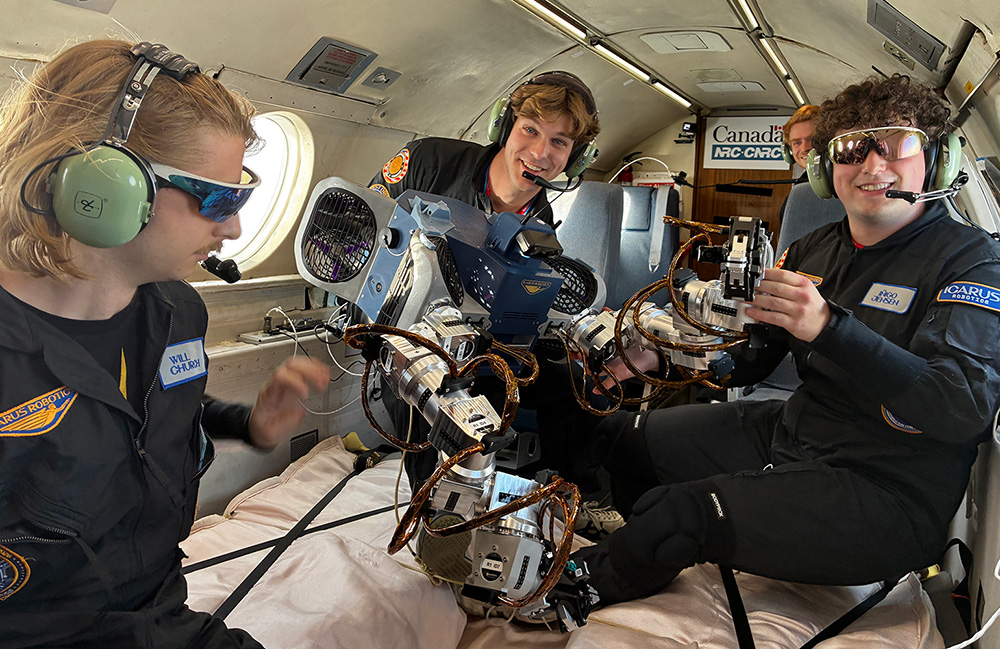
A robotics startup has successfully completed a series of microgravity flight tests for its autonomous cargo-handling robot, marking a critical milestone on the path to deployment aboard the International Space Station. The company’s free-flying platform, named JOY, completed 66 parabolas across four flights between September 9 and September 11, accumulating two total minutes of weightlessness.
## A Robot Designed for Orbital Logistics
JOY was engineered to navigate the pressurized interior of the space station and take over the repetitive cargo and logistics tasks that occupy a significant portion of astronauts’ schedules. Equipped with robotic arms featuring seven degrees of freedom and adaptive finger pinch grippers, the system is designed to manipulate objects and move through modules autonomously over time.
“We want to free up crew members so they can focus on the science and mission objectives that truly require human judgment,” said a company spokesperson involved in the program.
The startup, based in New York, secured $6.1 million in seed funding last year and has since refined JOY into a scalable, production-ready platform. Its next major step is handing over the flight-qualified hardware to NASA, which is expected to send the robot to the ISS in May 2027 as part of a mission called Joyride-1. The handover to the space agency is scheduled for January 25, 2027.
## Three Core Systems Put to the Test
The parabolic flight campaign allowed the engineering team to isolate and evaluate three major subsystems: manipulation, state estimation, and flight control. Roughly half of the test flights were dedicated to assessing the robotic arms and their ability to perform precise movements in a weightless environment.
“The arms were one of the biggest unknowns for us. Modeling their behavior in a simulator is extremely difficult, and we were pleasantly surprised by how well they performed,” said the company’s chief technology officer. “We ran multiple controllers, trajectories, and movement patterns, and the arms consistently returned to their intended positions.”
For state estimation, the team manually guided the robot during microgravity intervals to validate its internal sensors and positioning algorithms before running autonomous flight controllers. The state estimation performed better than expected, the team reported.
Flight control proved to be the most operationally demanding system to evaluate. Parabolic flights produce short windows of microgravity, and the aircraft’s banking and diving motions introduce gravitational variances that a robot bound for orbit would not encounter. Because JOY cannot yet be teleoperated in the same manner it will be on the space station, engineers pre-recorded trajectories and control set points on the ground and then replayed them during the weightless segments to benchmark performance.
“We had to be conservative with how long we ran the flight controller on each parabola,” the CTO explained. “Operators had to catch the robot, restrain it, and release it, all while dealing with G-force fluctuations.”
## Navigating a Shrinking Testing Landscape
An unexpected challenge arose when the team’s preferred U.S.-based parabolic flight provider suspended operations, forcing Icarus to seek testing facilities abroad. The campaign was ultimately conducted in Canada, where the National Research Council operates microgravity aircraft.
This is not an isolated issue. With fewer domestic providers available, American companies developing hardware for space are increasingly looking to international partners in Europe, Asia, and elsewhere. The bottleneck has led to longer timelines and added logistical complexity for startups trying to validate their hardware before orbital deployment.
## What Sets This Robot Apart
Engineering leaders emphasized that JOY is not simply another free-flying platform like those currently aboard the station. Unlike previous systems that rely on consumer-grade computing, JOY is powered by a high-performance NVIDIA Jetson Thor processor, providing significantly more computational headroom for advanced perception, planning, and manipulation tasks.
“This is arguably one of the most complex robots ever sent into a microgravity environment,” said the CTO. “We’re leveraging a decade of advancements in terrestrial robotics hardware and software, and we’ll be among the first to bring that capability to orbit.”
The company plans to study test data, apply software corrections, and continue fine-tuning operations in the months ahead before the formal handover to NASA.
—
## Frequently Asked Questions
**What is JOY?**
JOY is a free-flying robot developed by a New York-based robotics startup. It features robotic arms with seven degrees of freedom and finger pinch grippers, designed to handle cargo and logistics tasks inside the International Space Station.
**Why were parabolic flights necessary?**
Parabolic flights are currently the only way to produce real microgravity conditions without going to orbit. During each parabola, the aircraft follows a steep arc that creates roughly 20 seconds of weightlessness, allowing engineers to test how the robot behaves in a space-like environment.
**How many tests were conducted?**
The campaign involved four flights spanning three days, producing 66 total parabolas and two cumulative minutes of weightlessness.
**When will JOY launch to the ISS?**
JOY is scheduled to launch to the International Space Station in May 2027 as part of the Joyride-1 mission, managed in partnership with Voyager Technologies.
**What happens after the robot reaches the station?**
Initially, JOY will be teleoperated by ground teams. Over time, the company plans to develop and refine onboard autonomy systems using data collected in the orbital environment.
**How is JOY different from other robots on the ISS?**
JOY is built specifically for manipulation and physical task execution, powered by a high-performance NVIDIA Jetson Thor processor. Earlier free-flying platforms on the station have focused primarily on camera-based monitoring and communication tasks using less powerful computing hardware.
**Why was testing done in Canada instead of the United States?**
The only U.S.-based parabolic flight operator is currently not flying, so American companies seeking microgravity test time must work with international providers. This has created a bottleneck and longer timelines for space hardware validation across the industry.
—
## Conclusion
The successful microgravity demonstration of JOY represents a significant step forward in the development of autonomous robotic systems for orbital infrastructure. With its advanced manipulation capabilities and high-performance computing platform, the robot is positioned to take on the routine logistics work that currently consumes valuable crew time aboard the space station. As the company moves toward its January handover to NASA and the planned May 2027 launch, the results from this test campaign provide strong confidence that the system is ready for the demands of orbital operations. The broader challenge of limited domestic testing infrastructure also highlights the need for continued investment in microgravity test capabilities to support the growing number of companies building hardware for space.
Thank you for reading
