



# From Fast-Running Legs to Warehouse Workhorses: How Humanoid Robotics Company Agility Evolved Its Flagship Platform
Agility Robotics has spent over a decade refining one of the most recognizable humanoid robots in the industry. Starting from a university research lab at Oregon State University, the company has gone from building a fast-running bipedal prototype to deploying commercial humanoids in real factories and warehouses across North America. The journey from their first legged robot to the latest generation — now capable of working safely alongside people — tells a story of rapid iteration, real-world learning, and a clear shift in priorities.
## The Origins: A Robot Built for Speed
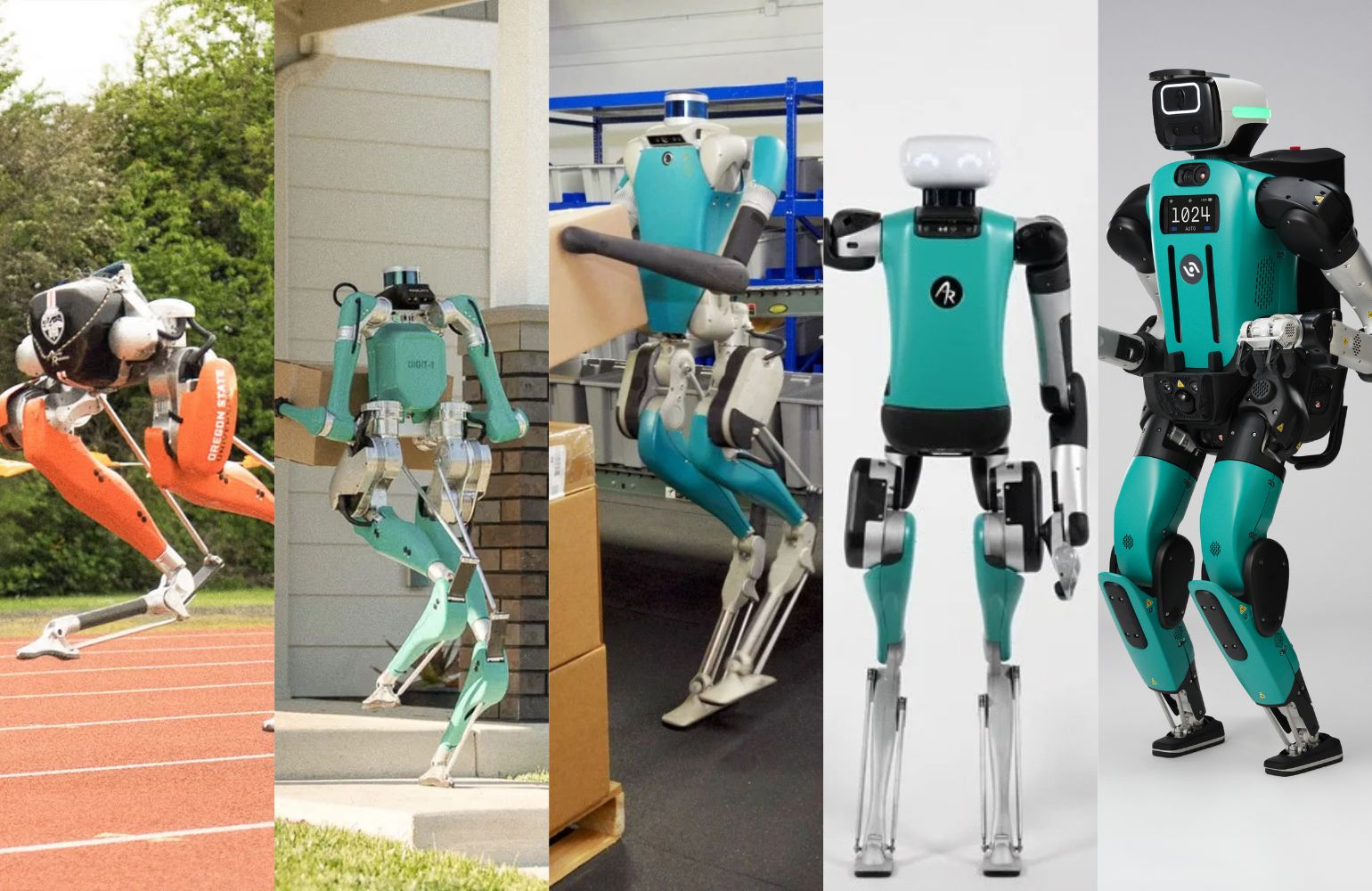
Every great humanoid project has to start somewhere, and for Agility, it began with Cassie. Developed in the Dynamic Robotics Lab at Oregon State University, Cassie was designed with one goal in mind: go as fast as possible on two legs. The robot debuted in 2016 with a striking set of ostrich-like legs, a design choice that Agility’s co-founder and Chief Robot Officer Jonathan Hurst described as a happy accident. The team was aiming for efficiency and speed, and nature provided the answer through the anatomy of large flightless birds.
The ostrich connection proved more than aesthetic. An ostrich can maintain speeds of 40 miles per hour over long distances, and that kind of endurance was exactly what the team was chasing. Cassie went on to set a Guinness World Record in 2022, completing a 100-meter sprint without falling in 24.73 seconds at Oregon State’s Whyte Track and Field Center. While Agility never built a second version of Cassie, the robot served a vital purpose: it was the research and development foundation for everything that followed.
## Birth of a Humanoid: Digit 1
In 2017, Agility took the bold step of transforming its legged research into a humanoid form factor. The first version of Digit made the company one of the earliest entrants into the humanoid robotics market, a space that has since become increasingly competitive. This initial Digit was built primarily for the research community, serving as a proof of concept for what a bipedal, human-shaped robot could actually do.
The first Digit proved that the ostrich-inspired leg design could be adapted into a machine capable of walking, climbing stairs, and carrying objects. While rudimentary compared to what would come later, it validated the core thesis: a human-shaped robot with two legs could navigate environments built for humans.
## Going Commercial with Digit 3
Agility took a major step toward commercialization when it released Digit 3 in 2019. For the first time, the company was ready to sell robots to real customers. The focus was on practical logistics applications, particularly the “last mile” delivery problem and warehouse operations.
The delivery use case was especially compelling. While many robotic delivery solutions at the time relied on wheels and could only reach a sidewalk or a building entrance, Digit’s legs gave it the ability to traverse stairs and actually arrive at a customer’s front door. Agility also explored using Digit in warehouses, where the robot could pick up and stack boxes weighing up to 40 pounds (approximately 18 kilograms).
That same year, Ford became Agility’s first paying customer, purchasing two robots directly off the production line. The automaker was interested in a specific scenario: loading Digit into self-driving delivery vans and having the robot carry packages from the vehicle to the customer’s doorstep. It was one of the earliest examples of a humanoid robot being integrated into a commercial supply chain, and it signaled that the market was ready for this kind of technology.
## Digit 4: Finding the Right Fit in Warehouses
Released in 2023, Digit 4 marked a significant maturation of Agility’s platform. It was the last robot in the series to carry the bird-like leg design, and it represented the end of the company’s proof-of-concept phase. With Digit 4, Agility was ready to show the world what its robot could really do in a working environment.
The robot was purpose-built for warehouse and distribution center tasks. It featured redesigned end effectors — the robotic “hands” at the end of its arms — specifically optimized for the kinds of objects commonly handled in e-commerce and shipping environments, such as plastic totes and bins. Digit 4 could reach, pull, pick up, and place a variety of items, making it genuinely useful on a warehouse floor.
Agility deployed Digit 4 across a growing roster of high-profile partners, including Toyota Motor Manufacturing Canada, GXO Logistics, Schaeffler, and Amazon. Each deployment generated valuable data and insights that would feed directly into the design of the next generation.
## Digit 5: A New Era of Safety and Collaboration
Digit 5 represents a fundamental shift in how Agility thinks about its robot. The company is no longer chasing raw speed. Instead, the focus is squarely on strength, endurance, and — most importantly — safety around people.
The most visible change is the legs. Gone are the ostrich-like appendages. Digit 5’s legs now look far more like a human’s, a deliberate design decision driven by the robot’s new operational context. In logistics and manufacturing facilities, the robot doesn’t need to sprint. It needs to lift heavy loads, work for extended shifts, and move fluidly through spaces shared with human workers.
Perhaps the most significant upgrade is in safety. Digit 5 can operate in the same space as people without needing to be cordoned off. As a human approaches, the robot continuously evaluates the risk in real time. It slows down, and if necessary, comes to a complete stop. There are no predefined safety zones or physical boundaries — the robot adapts dynamically to its surroundings. Agility views this as the first true step toward robots that don’t just work near people, but work alongside them as collaborators.
“This is the first step towards creating robots that can work with humans, not just near them,” Hurst explained. Looking further ahead, he painted a picture of a future where humanoid robots are commonplace in homes, and Digit 5’s role as the first commercially deployed and functionally safe humanoid becomes a historical milestone.
## Scaling Up: The Road Ahead
Agility’s ambitions extend well beyond the robot itself. The company has expanded from its origins at Oregon State to operating three offices across the United States, employing more than 400 people, and building a manufacturing facility capable of producing up to 10,000 robots per year. To fuel its next phase of growth, Agility plans to go public through a proposed SPAC merger with Churchill Capital Corp. XI, which would value the company at $2.5 billion.
The combination of a rapidly maturing product, a growing customer base, and serious financial backing suggests that humanoid robots are moving from experimental prototypes to essential tools in the logistics and manufacturing sectors — and potentially beyond.
—
## Frequently Asked Questions (FAQ)
**What is Agility Robotics?**
Agility Robotics is a humanoid robotics company that has been developing bipedal robots for over a decade. It grew out of the Dynamic Robotics Lab at Oregon State University and has offices across the United States with a factory capable of producing thousands of robots per year.
**What was Cassie?**
Cassie was Agility’s first robot, a bipedal machine designed for speed. It featured ostrich-like legs and debuted in 2016. Cassie set a Guinness World Record for the fastest 100 meters by a bipedal robot in 2022.
**How many versions of Digit has Agility built?**
Agility has created five versions of its Digit humanoid robot, from the original proof-of-concept model to the latest, Digit 5.
**What makes Digit 5 different from earlier versions?**
Digit 5 features human-like legs instead of the bird-like legs of earlier models, longer battery life, enhanced strength, and advanced safety capabilities that allow it to work in spaces shared with people. It evaluates risk in real time and adjusts its speed or stops entirely when someone comes close.
**Who has used Digit robots?**
Digit robots have been deployed or tested by major organizations including Ford, Toyota Motor Manufacturing Canada, GXO Logistics, Schaeffler, and Amazon.
**What is Agility’s long-term vision?**
Agility envisions a future where humanoid robots work alongside humans in homes, factories, and warehouses. Digit 5 is positioned as the foundation for that future, with the company prioritizing functional safety and real-world reliability.
—
## Conclusion
The story of Agility Robotics and its Digit platform is a case study in how robotic technology evolves from a research curiosity into a practical industrial tool. Each generation of Digit built on the lessons of its predecessors, gradually shifting the focus from speed and novelty to strength, endurance, and safety around people. With Digit 5, Agility has arrived at a turning point — the first commercially deployed humanoid robot capable of working alongside humans in real facilities — and it is well-positioned to scale that technology across industries. As the company gears up for public markets and expands its manufacturing capacity, the question is no longer whether humanoid robots can work in the real world, but how quickly they will become a fixture in it.
Thank you for reading
