



# InOrbit Unveils OpenRobOps: An Open-Source Foundation for Scaled Robot Fleet Management
**Mountain View, CA** — InOrbit.AI, a company specializing in enterprise robot orchestration software and spatial intelligence, has released OpenRobOps (ORO), an open-source platform designed to simplify the orchestration of mobile robot fleets at scale. The announcement marks a significant step toward lowering the barriers that prevent robotics organizations from deploying and managing diverse fleets efficiently.
## Breaking Free from the “Build Trap”
As autonomous mobile robots (AMRs) become more common in manufacturing, logistics, and other industries, equipment manufacturers face growing pressure to deliver fully functional fleet management capabilities. According to industry leaders, many OEMs fall into what has been called the “build trap” — spending years developing and maintaining proprietary back ends, databases, and user interfaces instead of dedicating resources to their core product innovations.
OpenRobOps is positioned as a production-grade, open-source operations layer that allows development teams to bypass years of foundational back-end work. The platform provides a ready-made foundation covering telemetry ingestion, real-time spatial tracking, configuration management, incident automation, and more.
## Key Capabilities
The platform includes several core features aimed at streamlining fleet operations:
– **High-throughput telemetry ingestion** engineered for bandwidth-constrained and unreliable network environments, minimizing overhead for hardware diagnostics and system vitals.
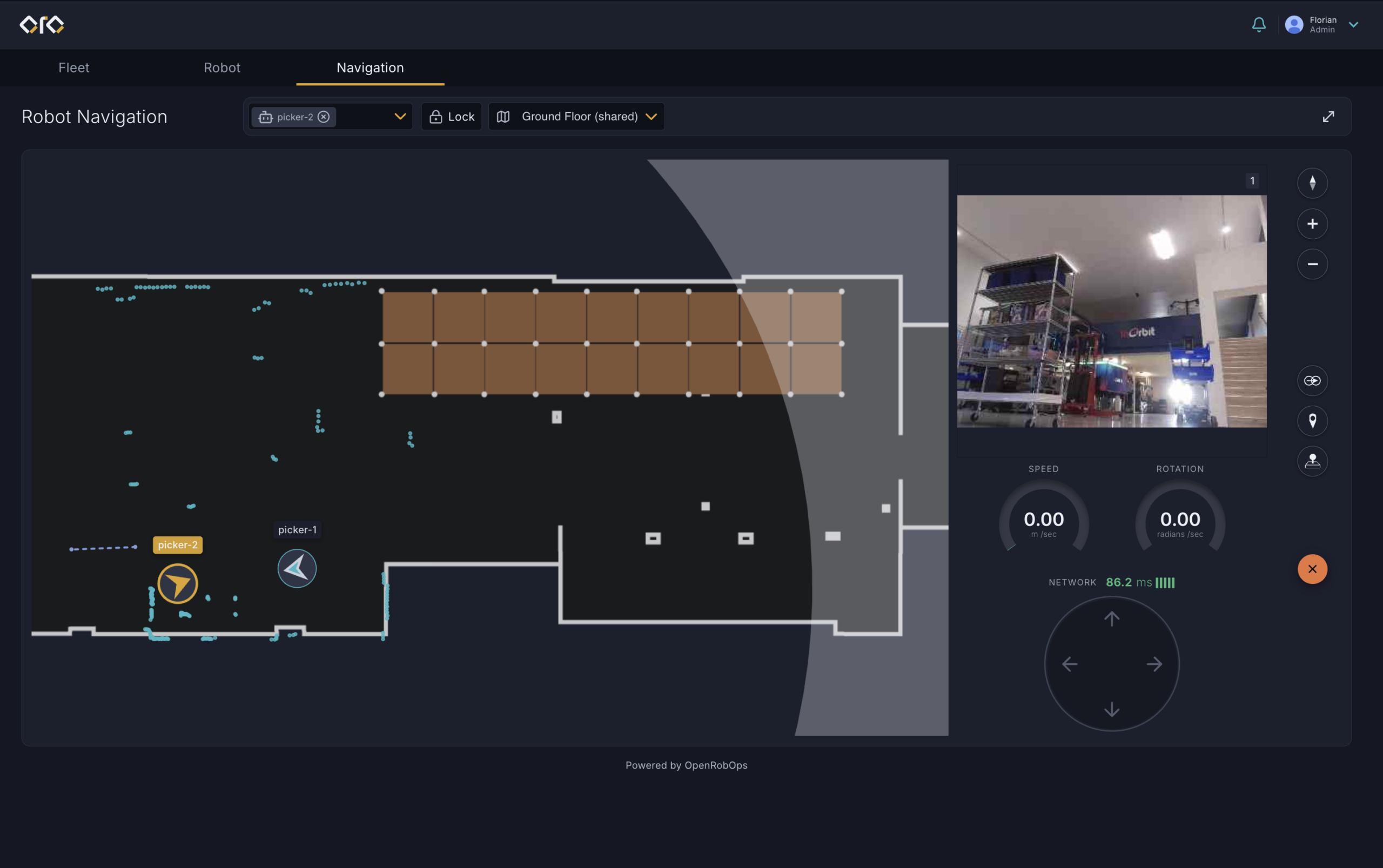
– **Real-time spatial tracking** supporting interactive mapping, live camera feeds, and teleoperation with a robot-locking mechanism for safe manual intervention.
– **Configuration as code (CaC)** enabling teams to manage telemetry sources, metrics, and alert rules directly within Git-based CI/CD pipelines.
– **Automated incident remediation** that continuously evaluates system health, autonomously recovers from anomalies, or escalates issues to human operators when needed.
– **Edge-to-cloud hybrid architecture** offering flexible deployment across fully on-premises setups, air-gapped edge environments, and secure connections to enterprise cloud infrastructure.
– **Native Open-RMF interoperability** with built-in adapters that connect physical and simulated fleets into multi-fleet traffic management systems.
## Aligning with ISO 21423
A distinguishing aspect of OpenRobOps is its role as the first reference implementation of ISO 21423, an emerging international standard for communication and data exchange between industrial mobile robots (IMRs) and fleet managers (IMRFMs). This standard is expected to play a critical role in ensuring interoperability across different robot manufacturers and fleet management platforms.
InOrbit’s involvement with the ISO working group dates back years, and the company’s founder has served as a representative for ANSI, the U.S. national standards body. The release of ORO translates that standards work into a practical, deployable tool that OEMs can use to ensure their systems comply with the new specification.
## A ROS-Level Contribution for Operations
Industry observers have drawn comparisons between the release of OpenRobOps and the introduction of the Robot Operating System (ROS), which transformed robotics development by providing shared, open primitives that eliminated the need to rewrite low-level code.
Steve Cousins, executive director of the Stanford Robotics Center and a board member at InOrbit.AI, was a central figure behind the original ROS project during his time leading Willow Garage. He noted that OpenRobOps aims to create a similar paradigm shift — this time focused on operations and fleet management rather than device drivers — while also introducing standards-based interoperability.
## Licensing and Accessibility
OpenRobOps is distributed under the Apache 2.0 license, making it freely available to academic researchers, robotics startups, and commercial enterprises alike. The open-source model permits adaptation, embedding, and deployment without licensing fees, and InOrbit has made the software’s source code and deployment documentation publicly accessible.
## Broader Implications
The platform is designed to work with robots of any form factor — whether wheeled, bipedal, or quadrupedal — and is intended to serve as a universal operations layer. End users can leverage the platform alongside other tools for spatial intelligence and fleet analytics, enabling a more cohesive approach to managing heterogeneous automation environments.
—
## Frequently Asked Questions (FAQ)
**What is OpenRobOps?**
OpenRobOps is an open-source software platform developed by InOrbit.AI that provides a complete foundation for robot operations and fleet management. It is designed to help development teams deploy and manage fleets of mobile robots without building foundational back-end systems from scratch.
**What problem does OpenRobOps solve?**
Many robotics OEMs spend excessive time and resources building and maintaining proprietary fleet management infrastructure — a challenge commonly referred to as the “build trap.” OpenRobOps provides a production-ready, open-source alternative that frees developers to focus on their core products.
**What is ISO 21423?**
ISO 21423 is an international standard being developed by the International Organization for Standardization that defines communication and data exchange protocols for industrial mobile robots and their fleet managers. OpenRobOps includes the first reference implementation of this standard.
**What types of robots does OpenRobOps support?**
The platform is designed to be form-factor agnostic and can orchestrate robots with wheels, legs, or any other locomotion method. It works with heterogeneous fleets composed of robots from different manufacturers.
**Under what license is OpenRobOps distributed?**
OpenRobOps is released under the Apache 2.0 open-source license, which allows free use, modification, and distribution for academic, startup, and commercial purposes without licensing fees.
**How does OpenRobOps compare to ROS?**
While ROS focuses on providing shared primitives for robotics development — such as device drivers and communication frameworks — OpenRobOps applies a similar open-source philosophy to the operations and fleet management layer, adding standards-based interoperability on top.
**Can OpenRobOps be deployed on-premises?**
Yes. OpenRobOps supports a fully on-premises deployment model, as well as air-gapped edge environments and hybrid configurations that bridge securely to enterprise cloud platforms.
—
## Conclusion
The release of OpenRobOps represents a meaningful milestone for the robotics industry. By offering a production-grade, open-source foundation for fleet operations — backed by a reference implementation of ISO 21423 — InOrbit.AI has provided a tool that can accelerate deployment timelines, reduce fragmentation, and foster greater interoperability across the robotics ecosystem. As more organizations adopt standards-based platforms like ORO, the path toward scalable, multi-vendor robot orchestration becomes increasingly tangible. For developers and OEMs alike, the ability to stand on a shared foundation rather than reinventing the wheel could prove transformative for the next wave of autonomous systems.
Thank you for reading
