



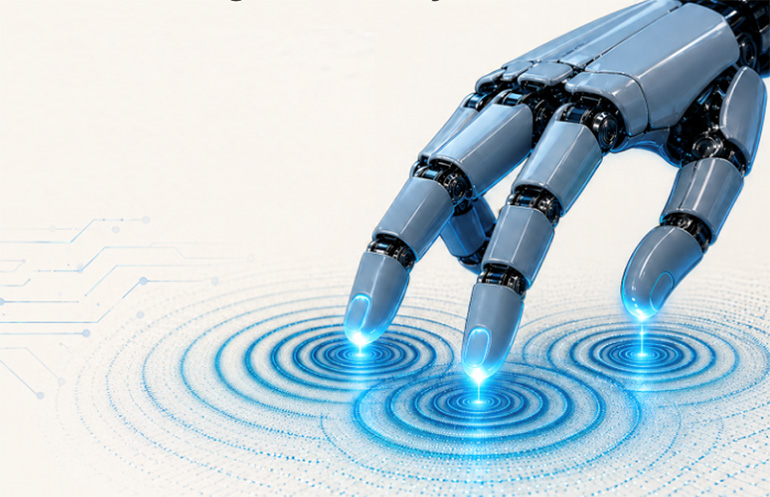
# How Sub-Surface Ultrasound Is Reshaping Robotic Tactile Sensing for Physical AI
Physical AI has made remarkable strides. Robots now see, plan paths, navigate complex environments, and execute sophisticated movements. But one capability remains the critical bottleneck for real-world manipulation: the sense of touch. For humanoid hands, dexterous grippers, logistics automation, service robots, and industrial systems, tactile sensing must reliably detect contact, map force distribution, sense shear and slip, and interpret how materials interact during manipulation. The question is no longer whether robots need touch — it is which tactile architecture can actually scale to commercial deployment.
Many current approaches to robotic touch rely on flexible electrical sensing layers bonded to or embedded near the contact surface. Capacitive, piezoresistive, piezoelectric, triboelectric, and impedance-based structures integrated into elastomers, flexible substrates, conductive networks, and multilayer films have all advanced the field. Yet for high-duty-cycle robotic fingers and grippers, these surface-coupled electronic skin technologies face a fundamental scaling problem: the sensing layer sits uncomfortably close to the harshest mechanical environment the robot encounters.
—
## The Hidden Cost of Surface-Mounted Sensing
A robotic fingertip presses, slides, rubs, and impacts objects thousands or millions of times over its operating lifetime. The outer surface must provide friction, compliance, sealing, abrasion resistance, and durability. When electronic sensing layers are placed on or near that surface, they become part of the wear environment they are supposed to measure.
Repeated compression can alter the electrical properties of conductive networks. Abrasion and contamination degrade the sensing film. Humidity and temperature variation introduce parasitic effects. Over time, elastomers age, adhesive layers degrade, and interlayer boundaries shift. These changes produce hysteresis, creep, baseline drift, and signal degradation — problems that are manageable in a laboratory prototype but become central to product viability in a commercial robotic hand operating over millions of contact cycles.
The real issue is not visible wear. It is lifetime signal integrity. A tactile system must remain accurate, repeatable, and calibrated from day one through months or years of continuous operation. Recent advances in thin-film force sensing show the industry is moving beyond simple single-effect sensors. Newer impedance-based approaches capture broader electrical responses by measuring combined resistive and capacitive behavior, reinforcing an important point: reliable robotic touch demands richer information than binary contact detection or a single force value.
Yet nearly all of these approaches still depend on a functional sensing layer sitting directly in the mechanical load path. The outer surface should be optimized for durability and mechanical performance while the sensing element remains protected from that environment. That separation is exactly what acoustic sensing makes possible.
—
## Why Ultrasound Changes the Architecture
Sub-surface ultrasound enables a fundamentally different tactile architecture. Rather than measuring electrical deformation at the contact surface, an ultrasound sensor interrogates the material stack from below. Acoustic waves propagate through the structure, reflect from internal boundaries, and shift in response to contact-induced deformation.
When an object presses into a compliant outer layer, the geometry of the material stack changes. Acoustic path length shifts. Echo timing is altered. Reflection amplitude and frequency content respond to the deformation. Under shear conditions, internal displacement and boundary conditions shift laterally. These acoustic changes can be analyzed to infer what is happening at the contact interface — without the sensing electronics ever being exposed to the surface environment.
This opens up multi-parameter sensing in the acoustic domain. Time-of-flight, reflection amplitude, attenuation, frequency response, phase, and acoustic impedance mismatch all carry information about contact, deformation, force distribution, shear, slip, and the nature of the material being touched. Ultrasound becomes a multi-parameter sensor architecture rather than a single-effect transducer, offering far richer data than any one electrical modality alone.
The practical implication is significant. The robot designer can select an outer surface material — elastomer, polymer, glass, metal, leather, fabric, or any engineered surface — while ultrasound reads contact through the entire stack. The outer material is freed to prioritize mechanical performance, and the sensing element is shielded from the environment that causes degradation in conventional designs.
—
## From Contact Detection to Material Classification
A useful robotic tactile system must deliver multiple layers of information simultaneously.
**Contact detection and localization** come from observing how the acoustic response changes when the surface is mechanically perturbed. Even subtle deformations shift echo patterns in measurable ways, enabling the system to identify when and where contact occurs.
**Force mapping** goes beyond a single aggregate value. Robots need to know whether a force is centered or off-axis, whether the contact patch is broad or concentrated, and whether the load is shifting over time. Ultrasound infers deformation through time-of-flight and echo changes, enabling localized force maps with fine spatial resolution. Demonstrations have shown tactile sensing achieving spatial resolution in the range of 500 micrometers through an elastomer layer, capable of resolving ridge and valley patterns in a contact profile. Force profiling with precision on the order of 1.25 millinewtons has been demonstrated under controlled conditions.
**Shear and slip detection** is critical for manipulation. In many tasks, tangential forces matter more than normal force. A robot may grip an object firmly enough in the normal direction, but if lateral slip begins, the grasp can fail before any vision system detects motion. Sub-surface ultrasound tracks lateral displacement within the material stack to infer shear-related behavior, with noise floors demonstrated in the range of approximately 5 millinewtons for shear-force inference.
**Material and contact classification** leverages the acoustic impedance of different substances. Every material reflects and transmits acoustic energy differently based on its density and sound velocity. Metal, glass, plastic, rubber, fabric, skin, foam, and soft biological tissues each produce distinct reflection signatures. By analyzing reflection amplitude, echo characteristics, attenuation, frequency response, and time-domain behavior, the system can classify not only the tactile response but also the nature of the surface being touched — opening the door to smarter, context-aware manipulation decisions.
—
## Scaling Through Platform Reuse
For tactile sensing to move beyond research prototypes into mass-produced robotic systems, it must become a manufacturable platform with repeatable electronics, standardized calibration, robust firmware, compact packaging, and straightforward integration.
The foundation for this kind of scaling already exists in adjacent industries. Automotive human-machine interaction applications demand reliability across temperature extremes, vibration tolerance, moisture resistance, manufacturability, and long-term repeatability. Compact AI devices demand small form factors, low power consumption, premium materials, sealed construction, and intuitive interaction. The production engineering expertise developed for these markets — including mixed-signal integrated circuit design, calibration methodologies, firmware development, and high-volume test — can be redirected toward tactile intelligence for physical AI.
A scalable tactile solution cannot depend on complex laboratory-grade assemblies or fragile sensor films requiring frequent replacement. It needs compact modules, integrated electronics, repeatable manufacturing processes, and edge processing capable of running local intelligence without constant cloud connectivity. The goal is a local tactile intelligence layer that can detect touch, estimate multi-axis force maps, infer shear and slip, classify contact state, recognize material response, and deliver actionable data to the robot controller in real time.
—
## Material Flexibility and Intellectual Property
One underappreciated advantage of ultrasound-based tactile sensing is its indifference to the outer surface material. In conventional capacitive touch systems, solid metal interfaces present a challenge because electric fields are shielded or distorted. Ultrasound bypasses this limitation entirely by relying on acoustic propagation rather than surface electric-field modulation.
This material flexibility extends across the robotics spectrum. A robotic fingertip designed for dexterous manipulation may use a soft elastomer for compliance and friction. An industrial gripper might require a rugged, chemically resistant polymer. Medical and service robots need surfaces that can withstand frequent cleaning and sterilization. Consumer and premium industrial products may incorporate metal, glass, leather, or woven fabrics for design and feel. A tactile platform that can read through all of these materials — rather than forcing designers into a single fragile sensing medium — gives engineers far more freedom.
As tactile sensing enters commercial deployment, intellectual property becomes a strategic asset. A robust portfolio of issued and pending patents covering ultrasound-based touch, force sensing, time-of-flight tactile measurement, calibration techniques, and system architectures — including designs for sensing beneath protective cover layers — establishes a defensible foundation for long-term development and industry adoption.
—
## FAQ: Sub-Surface Ultrasound for Robotic Tactile Sensing
**Q: What is sub-surface ultrasound tactile sensing?**
A: It is an approach where acoustic waves are sent through a material stack from below the contact surface. Changes in echo timing, amplitude, frequency content, and impedance mismatch are analyzed to detect contact, measure force, infer shear and slip, and classify the material being touched — all without exposing the sensing electronics to the surface environment.
**Q: How is this different from capacitive or piezoresistive touch sensors?**
A: Conventional electrical sensors measure deformation or changes in an electrical property at or near the contact surface. This makes them vulnerable to wear, contamination, humidity, and material aging. Ultrasound-based sensing reads mechanical changes through the material stack from a protected position beneath the surface, reducing exposure to the harshest conditions.
**Q: Why does sub-surface sensing matter for commercial robotics?**
A: Commercial robots operate over millions of cycles in real-world environments. Surface-mounted sensing layers degrade over time, leading to signal drift, calibration loss, and eventual failure. By moving the sensing element away from the contact surface, the system can maintain signal integrity over a much longer operational lifetime.
**Q: What kinds of information can ultrasound tactile sensing provide?**
A: Ultrasound can support contact detection and localization, multi-axis force mapping, shear and slip inference, material classification through acoustic impedance analysis, and deformation profiling — all from a single sensing platform.
**Q: Can ultrasound-based tactile sensing work through different surface materials?**
A: Yes. Because ultrasound relies on acoustic propagation rather than electrical field modulation, it can operate through elastomers, polymers, glass, metal, leather, fabric, and other engineered surfaces. This gives designers flexibility in choosing outer materials for durability, compliance, or aesthetics.
**Q: Is this technology ready for mass production?**
A: The underlying ultrasound platform has been produced at scale in other industries, with millions of units shipped. Adapting that platform for tactile intelligence involves custom integrated circuits, calibration routines, and robot-specific integration, but the manufacturing fundamentals are established.
**Q: What spatial resolution and force precision have been demonstrated?**
A: Demonstrations have achieved spatial resolution around 500 micrometers through elastomer layers and force profiling precision on the order of 1.25 millinewtons for compressive force, with shear-force inference noise floors around 5 millinewtons.
**Q: How does this fit into the broader Physical AI trend?**
A: Physical AI requires robots that can interact with the real world intelligently. Vision and motion are necessary but insufficient for dexterous manipulation. Reliable, durable, and scalable tactile sensing is the missing layer that enables robots to feel, adapt, and respond to physical contact in real time.
—
## Conclusion
The transition of Physical AI from digital reasoning to physical interaction hinges on solving the tactile sensing problem. Surface-coupled electronic skin technologies have pushed the field forward, but their dependence on a sensing layer in the mechanical wear path creates a durability and scaling ceiling that limits commercial deployment. Sub-surface ultrasound offers a path around this ceiling by relocating the sensing operation below the damage zone, decoupling mechanical surface design from sensing performance.
The approach delivers multi-parameter information — contact, force distribution, shear, slip, and material classification — from a single architecture that is inherently protected from abrasion, contamination, and environmental degradation. Combined with platform reuse from established high-volume manufacturing, material flexibility, and a growing intellectual property foundation, ultrasound-based tactile sensing is positioned to become a foundational technology for the next generation of intelligent robots.
As demand grows for robots that can manipulate objects with human-like dexterity and reliability, the tactile architecture chosen today will shape what is possible tomorrow. Sub-surface ultrasound represents not just an incremental improvement, but a fundamental rethink of how robots can feel the world — durably, precisely, and at scale.
Thank you for reading
