



# Agility Robotics Unveils Digit 5 Humanoid Robot With Redesigned Legs and Industrial Safety Architecture
Agility Robotics has introduced Digit 5, the fifth iteration of its humanoid robot platform, marking a significant leap forward in the company’s push to deploy walking, manipulating machines in real industrial environments. The announcement arrives as Agility moves closer to becoming a publicly traded company through a proposed SPAC merger with Churchill Capital Corp. XI, a transaction that values the robotics firm at $2.5 billion.
Digit 5 represents what the company describes as a ground-up rethinking of the humanoid form factor, driven by three years of real-world deployment data gathered from its previous generation on factory floors, warehouses, and distribution centers. Agility has reported receiving more than $300 million in multi-year orders and maintaining an expanding pipeline of customers spanning manufacturing, warehousing, and logistics.
## Engineering for Proximity Work
A central goal of the Digit 5 redesign was enabling the robot to operate safely in close proximity to human workers without the physical safety barriers — such as ropes, fences, or cages — that currently surround most industrial humanoid robots.
To achieve this, Agility engineered a comprehensive safety architecture that combines proprietary AI algorithms, multiple sensor modalities, and an independent safety controller. The system continuously monitors the environment in a full 360-degree radius, detecting nearby people and responding dynamically by slowing, stopping, or shifting into a stable seated position. There are no fixed exclusion zones; the robot adapts its behavior in real time based on the proximity and movement of people around it.
Visual and auditory cues help communicate Digit 5’s intent to people nearby, adding another layer of transparency to its autonomous decision-making process.
## Redesigned Legs and Propulsion
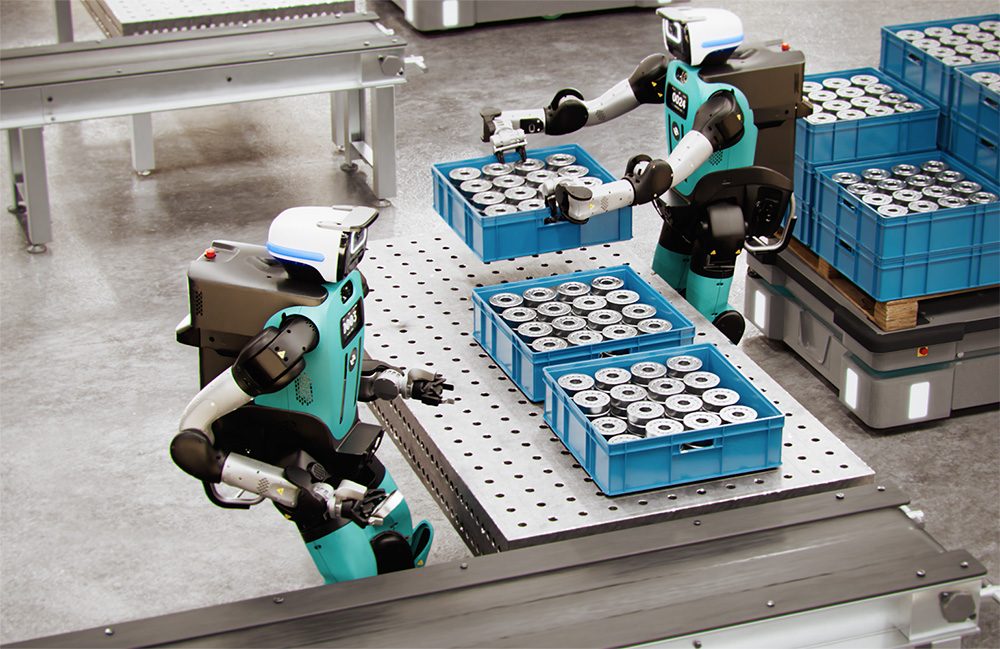
One of the most visually striking changes in Digit 5 is its leg configuration. Earlier versions featured a distinctive ostrich-like backward knee design optimized for speed and running. Digit 5 abandons that aesthetic in favor of a more conventional, human-like leg structure engineered for a different priority: repeatedly lifting heavy loads and navigating the full range of motion required by industrial tasks.
The legs are powered by proprietary cycloidal actuators capable of handling repeated lifts of up to 50 pounds (approximately 22.7 kilograms). This load capacity is intended to cover single-person lift tasks in facilities governed by OSHA regulations. The new leg geometry also allows Digit to kneel and sit down into a stable, statically balanced position, which is a core element of the robot’s safety strategy — when a person approaches, Digit can lower itself to the ground and power off its motors before any contact occurs.
Digit 5 stands 5 feet 11 inches (1.81 meters) tall and weighs 284 pounds (129 kilograms). Its maximum reach has been extended to 7.2 feet (2.2 meters), a substantial increase over the previous model’s 5.5-foot reach.
## Battery and Charging Breakthrough
Operational endurance has been a persistent challenge for mobile humanoid robots, and Agility addressed it directly with Digit 5’s upgraded battery system and a faster autonomous charging mechanism. The robot can now operate for 90 minutes on a single charge and reach a full charge in just nine minutes, yielding a 10:1 run-to-charge ratio. By comparison, the prior generation offered a 2:1 ratio. This improvement means Digit 5 can remain active for more than 20 hours within a standard 24-hour operational window.
## Manipulation and End-Effector Strategy
Digit 5 expands the manipulation capabilities of the platform beyond the tote-based material handling that dominated earlier deployments. The robot is designed to cover a facility’s full workflow, including depalletizing incoming goods, machine tending, kitting and sequencing, quality inspection of items in transit, and palletizing finished products for shipment.
Agility has equipped Digit 5 with a swappable gripper system that uses ISO-standard mounting flanges, allowing operators to exchange end-effectors depending on the task at hand. The company currently relies on a two-fingered parallel-jaw gripper, drawing inspiration from competitions like Cybathlon, where prosthetic devices are tested in real-world manipulation challenges. Agility noted that the most dexterous artificial manipulators in recent Cybathlon competitions have been simple parallel-jaw designs rather than complex multi-fingered hands.
The company said it is open to adopting third-party end-effectors if a superior option becomes available, and it is investing heavily in developing its own gripper solutions in-house as well.
## Regulatory Expansion and Global Market Access
Digit 5 marks Agility’s first push into commercial deployment outside of North America. The company plans to launch in the European Union and the United Kingdom, and Digit 5 is expected to carry a CE mark along with additional regulatory certifications required for market access across the EU, Great Britain, and Northern Ireland.
Early access to Digit 5 is scheduled for the first half of 2027, with general availability for manufacturing, warehouse, and distribution operators targeted by the end of 2027.
## Financial and Commercial Context
According to recent filings with the U.S. Securities and Exchange Commission, Agility Robotics generated $1.8 million in net sales during 2025. Despite the modest revenue figure at this stage, the company’s order backlog and customer pipeline reflect strong industrial interest in deploying humanoid robots at scale.
Digit 5 remains integrated with Agility’s cloud-based fleet management platform, which provides centralized deployment, monitoring, and management capabilities for operators running multiple units across their facilities.
—
## Frequently Asked Questions (FAQ)
**Q: What makes Digit 5 different from previous versions of Agility’s humanoid robot?**
A: Digit 5 features redesigned human-like legs powered by cycloidal actuators, upgraded batteries with a 90-minute runtime and nine-minute charge time, a more comprehensive safety architecture for proximity work, a taller and heavier frame with greater reach, swappable end-effectors, and expanded manipulation capabilities for full facility workflows.
**Q: Can Digit 5 work alongside human workers without safety barriers?**
A: Yes. Digit 5 is engineered with a multi-layered safety system — including AI-based people detection across a 360-degree radius, dynamic speed and stop responses, visual and auditory intent cues, and an independent safety controller — that allows it to operate near people without ropes, fences, or cages.
**Q: What kind of tasks is Digit 5 designed to perform?**
A: Digit 5 can handle depalletizing, machine tending, kitting and sequencing, quality inspection, and palletizing, in addition to tote-based material handling. Its swappable gripper system allows tool changes for different job requirements.
**Q: When will Digit 5 be available for purchase?**
A: Early access begins in the first half of 2027, with general commercial availability for manufacturing, warehouse, and distribution operators by the end of 2027.
**Q: Is Digit 5 being deployed outside North America?**
A: Yes. Agility plans to launch Digit 5 commercially in the European Union and the United Kingdom, with the robot expected to carry CE marking and additional regulatory certifications for those markets.
**Q: What is Agility Robotics’ current revenue and valuation?**
A: Agility reported $1.8 million in net sales in 2025. Through its proposed SPAC merger with Churchill Capital Corp. XI, the company is valued at $2.5 billion.
**Q: How does Digit 5’s battery and charging compare to the previous model?**
A: Digit 5 offers a 90-minute runtime and a nine-minute full charge, delivering a 10:1 run-to-charge ratio compared to the previous generation’s 2:1 ratio. This enables over 20 hours of operation in a 24-hour day.
—
## Conclusion
Digit 5 represents a pivotal moment for Agility Robotics and for the broader humanoid robotics industry. By shifting from experimental demonstrations to an engineering approach grounded in three years of live customer deployments, Agility has addressed many of the practical bottlenecks — safety certification, charging logistics, payload capacity, and regulatory compliance — that have historically held humanoid robots back from widespread industrial adoption.
The company’s commitment to working near people rather than in isolated zones signals a confidence in its safety architecture that could set a new standard for the field. Combined with aggressive expansion into European markets and a growing backlog of over $300 million in orders, Digit 5 positions Agility at the forefront of the race to bring humanoid robots out of the lab and into the factory floor at scale.
Thank you for reading
