



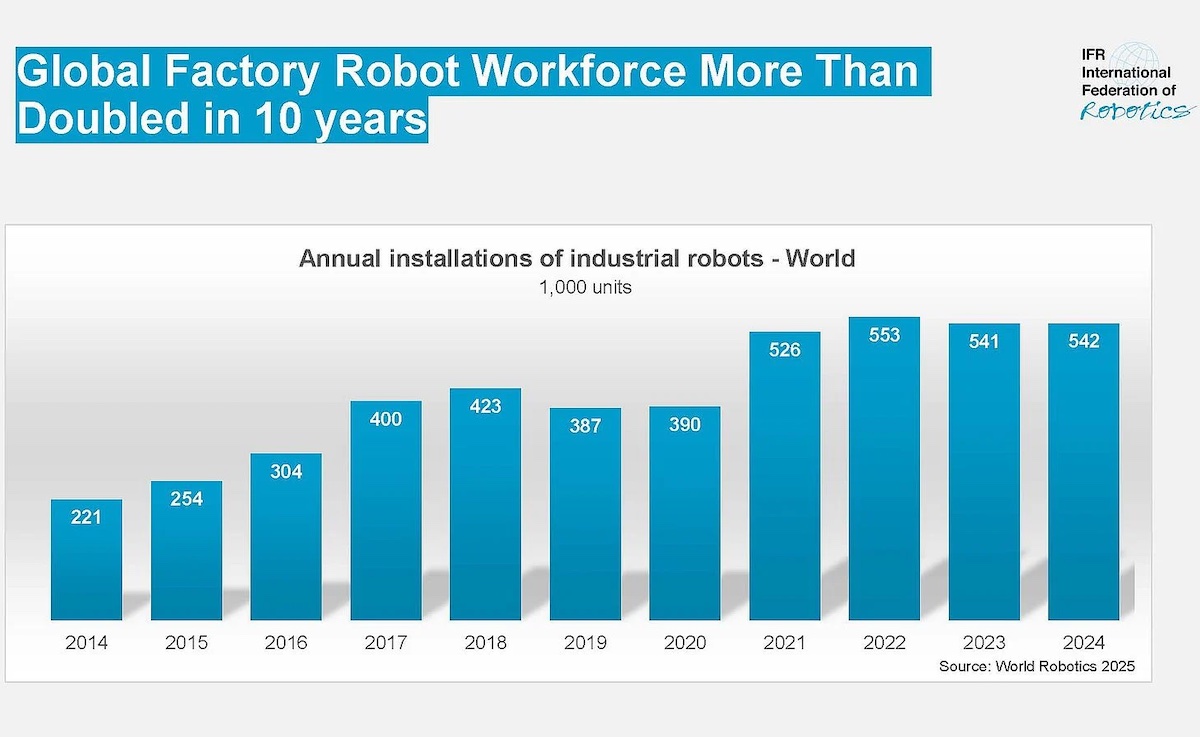
Industrial robot uptake keeps climbing, reports the IFR.
The contemporary robotics landscape is split into two primary sectors: industrial and consumer. Both segments have experienced consistent growth in robotic unit sales, as noted by the International Federation of Robotics (IFR).
In 2024, 229,000 industrial robotic units were purchased globally. A striking 70% of these sales originated from only five nations: Japan, China, the U.S., Germany, and South Korea. These governments actively promote robotics through national strategies, though the U.S. depends largely on private-sector investment rather than state funding.
We’ll explore the core economic drivers behind robotic adoption and how they’re reshaping economies. Globally, more than 343 firms build industrial robots, while over 347 firms specialize in integrating these systems into manufacturing. Additionally, over 860 companies design professional service robots, and 204 focus on personal-use service robots.
A Framework for Categorizing Robot Types
Four key thematic clusters emerge:
- Fundamental robotics technologies
- Medical robotics
- Core robotics technologies
- Emerging innovation frontiers
The latter includes energy harvesting from surroundings, self-repairing mechanisms, multimodal interfaces, gesture recognition and synthesis, and swarm intelligence for adaptive production units.
Service robots are segmented into professional and personal categories. Professional service robots represented 11.5% of the total, with 24,207 units sold last year. Military and specialized robots made up 45% of that figure (11,000 units). Meanwhile, 4.7 million personal service robots were sold—a jump that pushed total revenue up by 28%, reaching $2.2 billion.
The IFR forecasts robust expansion across all robotics segments. It anticipates industrial robot sales hitting 400,000 units, professional service robots reaching 152,375 units valued at $19.6 billion, and personal service robots soaring to 35 million units worth $12.2 billion.
Myria Research estimates that the combined market for robotics and intelligent operating systems—encompassing both hardware and software—could surpass $380 billion by 2030, up from its current valuation of $63 billion.
As robotic integration deepens over the next decade, organizations may establish dedicated executive roles to oversee automation efforts, or robotics could become embedded in broader industrial and commercial ecosystems. Furthermore, hybrid workforces—where humans, AI, and robots collaborate closely—are likely to emerge.
 Propose a session for the 2026 RoboBusiness conference
Robotics Sector Confronts Growth Barriers
Post-pandemic, industrial robot sales dipped due to slower e-commerce expansion, automakers scaling back electrification plans, and disruptions in global trade. Key challenges hindering robotics development include:
- Inadequate educational frameworks
- Shortage of skilled robotics professionals
- Obsolete training curricula
- Absence of proprietary tech solutions
- Limited grasp of the global robotics landscape
- Poor understanding of market demand for robotic products
Additional concerns involve the constrained domestic VC market, logistical hurdles in importing/exporting tech components, opaque research funding processes, and bureaucratic inefficiencies. Interestingly, the dip in service robot sales partly reflects improved data reporting by more companies.
Foreign manufacturers boosted industrial robot sales to 41,100 units—including output from international plants in China, the world’s largest industrial robot market.
Japan recorded nearly 29,300 unit sales, suggesting a peak. While Japan remains a top market by annual volume, its sales have trended downward since their 2005 high of 44,000 units.
Pursuing Sustained Industrial Growth
Despite headwinds, industry associations and analysts agree that global automation adoption will keep rising. For example, annual industrial robot shipments have grown by roughly 50% on average.
The automotive and electronics sectors have been the biggest engines of this growth, with automotive accounting for about 43% of all robot sales. Investments in modern production capacity in emerging markets and factory upgrades in auto-producing nations rose 34% to 48,400 units.
Sales across non-automotive industrial sectors jumped 21% in 2025, with a long-term average growth rate of 17% from 2010–2025. Over that span, automotive robot sales grew 27%, while electronics saw an 11% increase.
Beyond traditional sectors, robotics vendors report a growing customer base—though most still place small orders, except when deploying entire fleets of autonomous mobile robots (AMRs) in warehouses.
Last year, the IFR and A3 (Association for Advancing Automation) identified military, automotive, and electronics as the most promising industrial robotics niches.
This signals a strategic pivot toward defense applications over civilian uses. Respondents also highlighted healthcare, autonomous vehicles, and security/safety tasks as top opportunities in service robotics.
Sales Figures Don’t Tell the Full Story
Note that these figures exclude software, peripherals, and engineering services. Including them would triple the true market size.
As a result, the worldwide industrial robotics market is estimated to be worth roughly $32 billion in 2025. Numerous nations are showing a growing readiness to embrace industrial robots. To fairly compare countries with varying sizes of manufacturing sectors, the IFR applies robotic density as a standard measure.
This measure counts the number of general-purpose industrial robots present for every 10,000 employees across the automotive, manufacturing, and advanced automation sectors. An approximation of the industrial robots actively used within these fields makes it possible to evaluate their current level of automation maturity.
In contrast, sectors like healthcare and hospitality continue to have very few robots in operation. Meanwhile, nations with robust electronics manufacturing tend to record higher technical adoption rates. Since a majority of Western countries lack domestic electronics production, there are increasing efforts to bring these operations back home.
The surge in electronics demand due to artificial intelligence has significantly boosted Taiwan’s robot density in recent times. This achievement positions Taiwan in fifth place according to IFR data, reporting 138 robots for every 10,000 workers.
Emerging markets like India, which currently maintain lower robot densities, represent substantial opportunities for expansion as global supply chains undergo redistribution. Increased investment in robotic solutions could ease current economic pressures by boosting efficiency and adaptability.
 About the author
 About the author
Elena Krosheva works as a freelance journalist, marketing analyst, and SEO specialist. She completed her studies at the Faculty of Journalism, Institute of Modern Knowledge in Minsk, Belarus, graduating with honors in 2007.
Her reporting focuses on digital transformation, information technology, the modern economy, and transhumanism. With a background in technical education prior to her journalism degree, she has a strong passion for computers and cyberpunk culture.
