



At a Glance
- A mystery bettor wagered $1 million on Spain to defeat Cape Verde in their Group H opener on June 15, 2026.
- Spain and Cape Verde played to a 0-0 draw, wiping out the entire million-dollar stake.
- Polymarket user “Fishalive” took the opposing side at nearly 9¢ per share, pocketing a $4.3 million profit.
Offer a moment of silence.
Picture this: an anonymous bettor drops a million bucks on Spain to win a World Cup match against a country making its tournament debut on the world stage. The Polymarket odds for a draw sat at just 6.6 cents. On paper, this seemed like textbook logic. Reality, however, had a very different script.
🚨BREAKING: Just moments ago, someone placed a $1M wager on Spain TO BEAT Cape Verde today
Successful payout totals $1,085,943.48 via Polymarket pic.twitter.com/7ODo3dJ7Pl
— Polymarket Sports (@PolymarketSport) June 15, 2026
Spain, the current European champions riding a 30-game unbeaten streak, squared off against Cape Verde—a tiny island nation ranked 67th in FIFA’s global standings, playing at a World Cup for the very first time. The match concluded scoreless at Atlanta’s Mercedes-Benz Stadium.
The person who bet seven figures on the powerhouse went home empty-handed.
That shot at a $1,085,943.48 payday disappeared over 90 minutes against a squad that Polymarket’s own pre-match odds gave less than a 1% chance of lifting the entire World Cup trophy.
The GK, the saves, the folklore
Cape Verde’s 40-year-old shot-stopper Josimar Évora, affectionately called “Vozinha”—who may well have been the standout story of the tournament’s opening week—recorded eight saves on the day. He denied a Ferran Torres strike into the far corner, tipped a Mikel Oyarzabal attempt over the bar, and watched as Torres rattled the crossbar from what ESPN labeled Spain’s clearest chance of the entire match. Lamine Yamal, widely regarded as Spain’s brightest talent, was completely unable to assert any control over the game.
The outcome was so shocking it instantly drew parallels to the most legendary upsets in World Cup lore. Cape Verde had topped their CAF qualifying group with seven wins, two draws, and just one loss—skipping the inter-confederation playoffs altogether—but nothing in that run hinted at an ability to shut down a Spain team that had recently dismantled England, France, and Germany.
Within minutes of the final whistle, X was overrun with memes and looping GIFs. Every punchline about the “safest wager in sports” got a fresh makeover. The stat showing Spain’s 27 shots compared to Cape Verde’s paltry six became the perfect visual punchline for watching a “guarantee” unravel spectacularly.
“Fishalive” nailed it
On the opposite end of this wager was a Polymarket user known as Fishalive. Per the trader’s Polymarket profile, the account signed up in June 2026 and had only made two total predictions—purchased “No” on Spain winning at an average cost of 9¢ per share. That bet essentially said Spain had roughly a 9% probability of winning. Meanwhile, the market was giving Spain a 92% chance.
The trader picked up just over 4.7 million shares at that rate. When the final whistle blew on a 0-0 draw, those “No” shares paid out at 100¢ apiece. The position’s value reached $4,738,433.49. The day’s profit came to $4,310,481.12—a return exceeding 1,000%.
🚨BREAKING: Someone named “fishalive” put $400k on Spain NOT to win vs Cabo Verde at 9% odds…
This trade just cashed out $4,702,769.23 on Polymarket pic.twitter.com/Kvp6RsoQJO
— Polymarket Sports (@PolymarketSport) June 15, 2026
This is prediction markets at their best: A trader factors in a scenario the majority dismisses, places a sizable bet, and cashes in when it comes true. The lingering question is always whether it was skill or luck.
Heavy losses on near-certainties
The $1 million Spain wager is eye-catching, but it’s far from the first time Polymarket has delivered a warning about betting at extreme odds. Traders who purchase “Yes” at 90¢ or higher are making a bold probability call—they’re claiming the real likelihood is even greater than 90%. When the outcome says otherwise, the damage goes beyond just money.
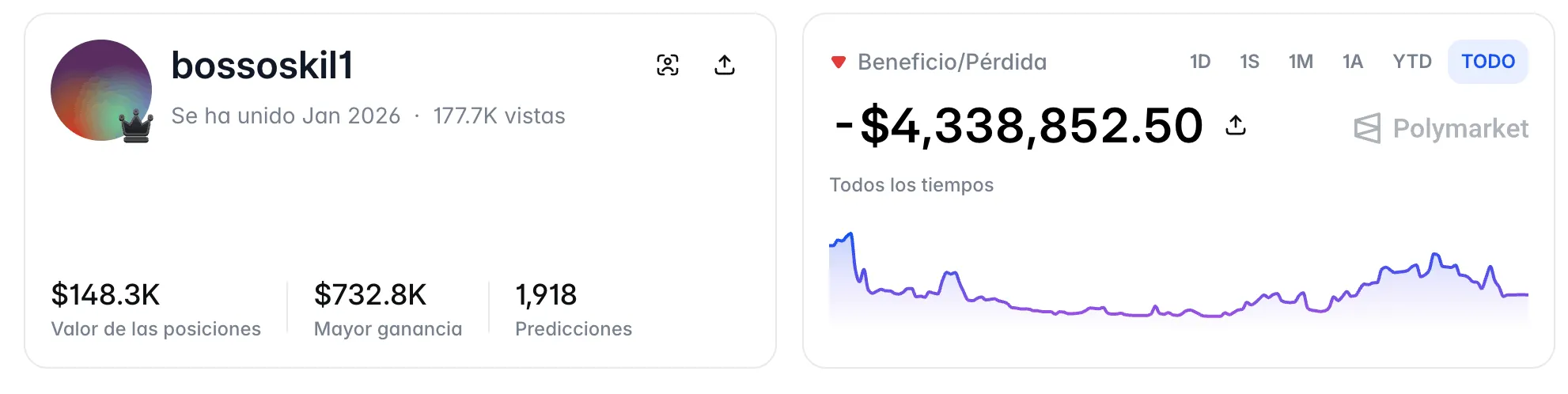
A user called “beachboy4” dropped more than $2 million on Polymarket over 35 days, with a single $1.58 million bet on Liverpool to beat Leeds United on January 1, 2026 being the largest loss. Another trader, bossoskil1, blew through $2.36 million in just eight days across 53 U.S. sports markets without any hedging or stop-loss approach.
Today that account shows a net loss of $4.3 million.
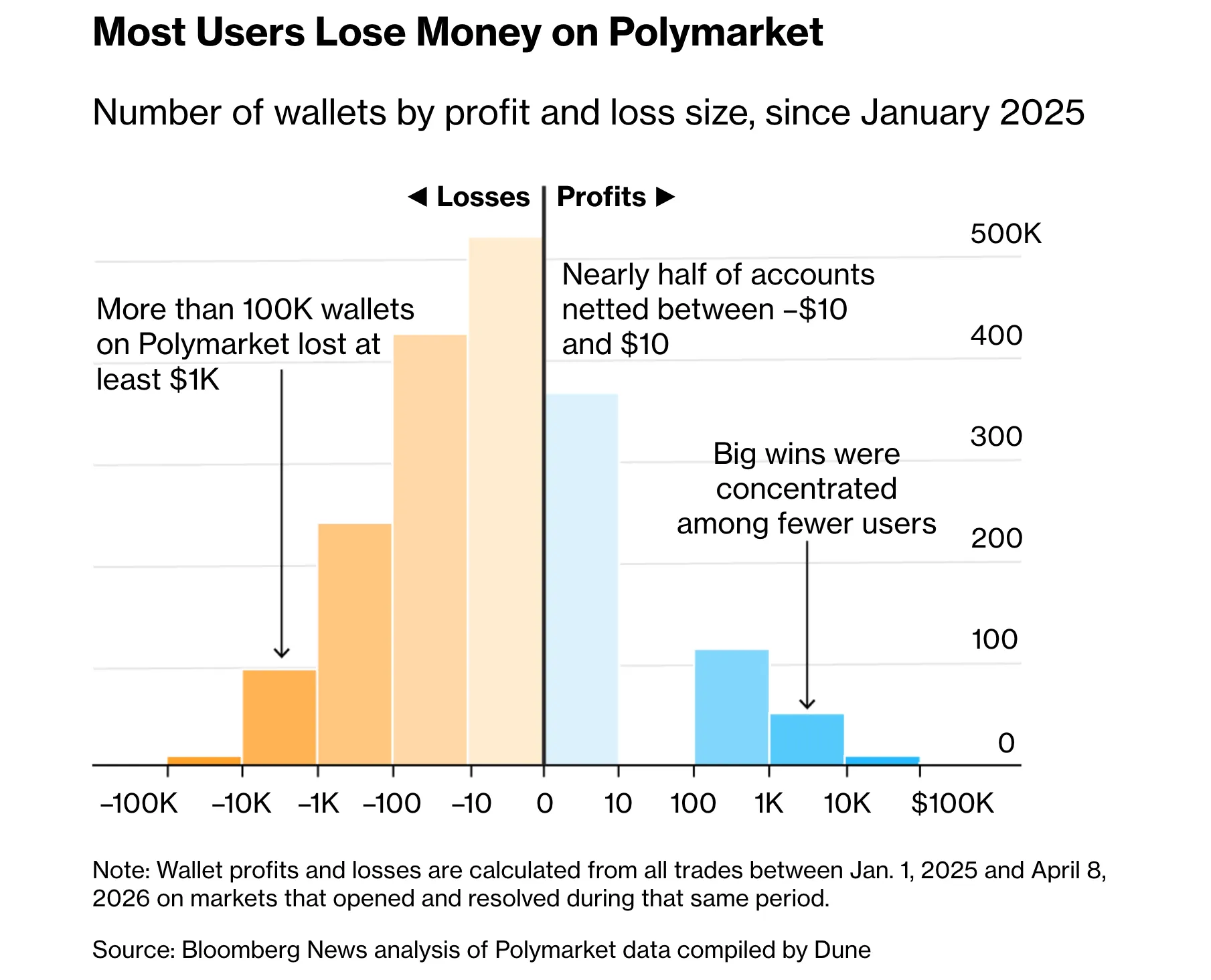
A Bloomberg report released in April 2026 revealed that since January 2025, over 100,000 Polymarket accounts had suffered losses of at least $1,000—almost twice the number of wallets that saw similar profits.
A scholarly study conducted by researchers at the University of Toronto, examining 2.4 million users, showed that 68.8% had lost money since 2022. It also found that those losing money tended to trade at extreme price points—either below 10¢ or above 90¢.
That’s precisely the approach taken by the anonymous bettor from Spain today.
At the same time, across both Kalshi and Polymarket, the 2026 World Cup winner market has surpassed $2.34 billion in total trading volume. Several states, including Tennessee, have already issued cease-and-desist orders to both platforms regarding sports prediction markets. Regulators are keeping a close eye on the situation. Traders continue to place bets regardless. Most participants in the Spain-Cape Verde market are likely nursing losses, and somewhere online, “Fishalive” is enjoying a very profitable Monday.
Cape Verde’s next match is against Uruguay on June 21.
Daily Debrief Newsletter
Kick off each morning with the biggest stories happening right now, along with exclusive features, a podcast, videos, and much more.
