




Bitcoin (BTC) kicks off the third week of June on a positive note, buoyed by a potential US-Iran peace agreement that’s lifting risk assets.
Key takeaways:
- Bitcoin’s price is eyeing $66,000 as US stock futures rally and oil prices drop to their lowest since early March.
- Market participants view $69,000 as a probable near-term target for BTC.
- The Federal Reserve’s upcoming interest-rate decision is drawing intense scrutiny under new Chair Kevin Warsh.
- Large Bitcoin holders have shifted from selling to accumulating, establishing a “strong support level” around $60,000.
- Persistent weak demand casts doubt on a sustained bull-market recovery.
Oil falls below $80 as Iran peace talks gain momentum
The US-Iran conflict is back in the spotlight this week as a peace agreement seems more achievable than before.
Weekend developments initially pointed to a Sunday deadline for finalizing a ceasefire, which was later moved to Friday.
Several sources then verified that the US and Iran would sign a deal for a 60-day ceasefire, along with additional measures, in Switzerland on Friday.
In a post on Truth Social, US President Donald Trump confirmed the agreement would involve reopening the Strait of Hormuz — a vital global oil shipping lane.
“Once the Strait is opened upon signing the Deal on Friday, for mine removal purposes, oil will flow freely again for the Region and the World!” he wrote.
Source: Truth Social
US stock futures jumped in response, with risk assets advancing broadly — including Bitcoin and other cryptocurrencies.
Oil, however, dropped sharply, with WTI crude falling below $80 per barrel for the first time since mid-April.
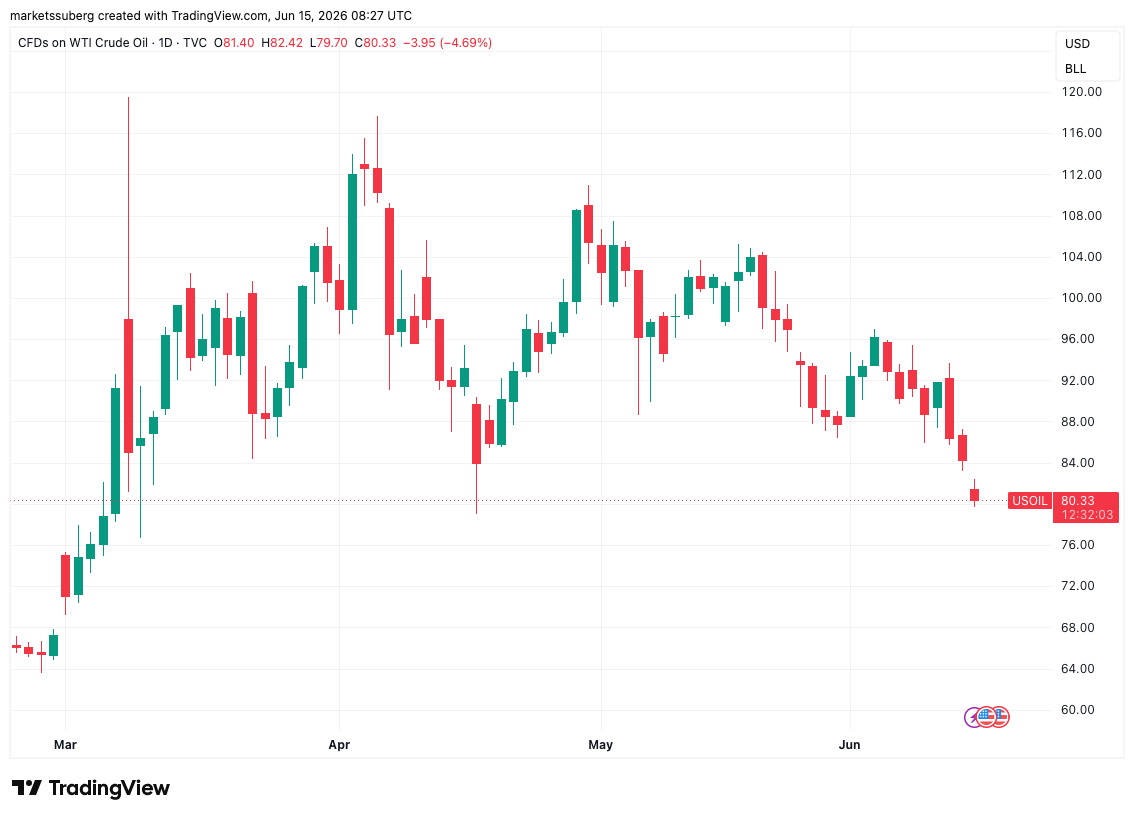
CFDs on US WTI crude oil one-day chart. Source: Cointelegraph/TradingView
In response, portfolio manager Danny Dayan called the deal the “biggest and worst TACO ever,” referencing the Trump administration’s pattern of escalating and then backing down from geopolitical and economic confrontations.
“Overheating, rising core inflation, and a higher neutral rate will be the key macro factors going forward,” he told X followers, anticipating a shift away from oil as a primary market driver.
Throughout the conflict, rising oil prices have weighed on Bitcoin, even as equities continue to hit new record highs.
BTC/USD has now returned to the same level where it started on Feb. 28.
Bitcoin traders anticipate a short squeeze toward $69,000
Reports of a US-Iran peace deal helped push BTC prices to two-week highs heading into Sunday’s weekly candle close.
TradingView data showed local peaks of $65,988 as the new week opened.
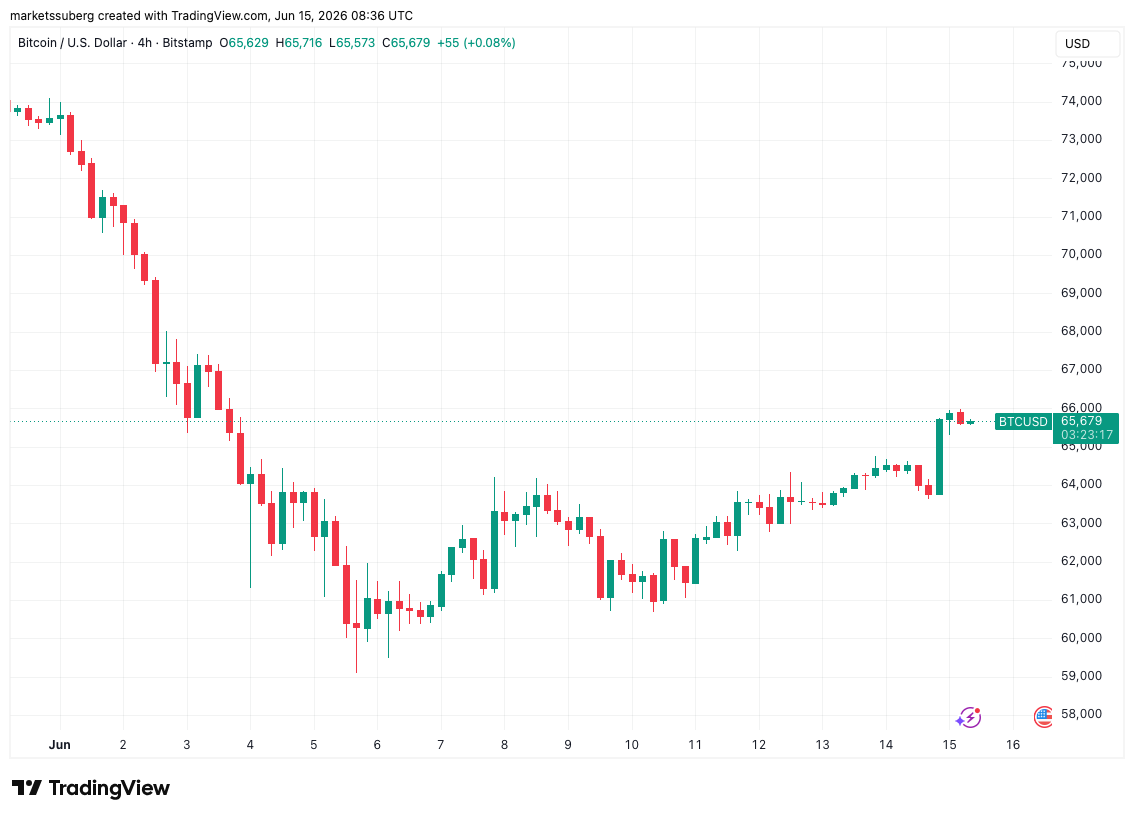
BTC/USD four-hour chart. Source: Cointelegraph/TradingView
With both $60,000 and Bitcoin’s 200-week simple moving average (SMA) at $62,000 holding firm as support, traders grew more optimistic in the near term.
“Closed near the highs with almost no upper wick, suggesting further upside this week,” trader SuperBro noted in his latest X analysis.
SuperBro identified the 200-week exponential moving average (EMA) as a likely target for a short squeeze.
“There’s a large cluster of leveraged short positions up to the 200 EMA near $69K. A move to that level seems probable,” he added.
“Q2 ends in just two weeks. Let’s see if buyers can maintain the momentum.”
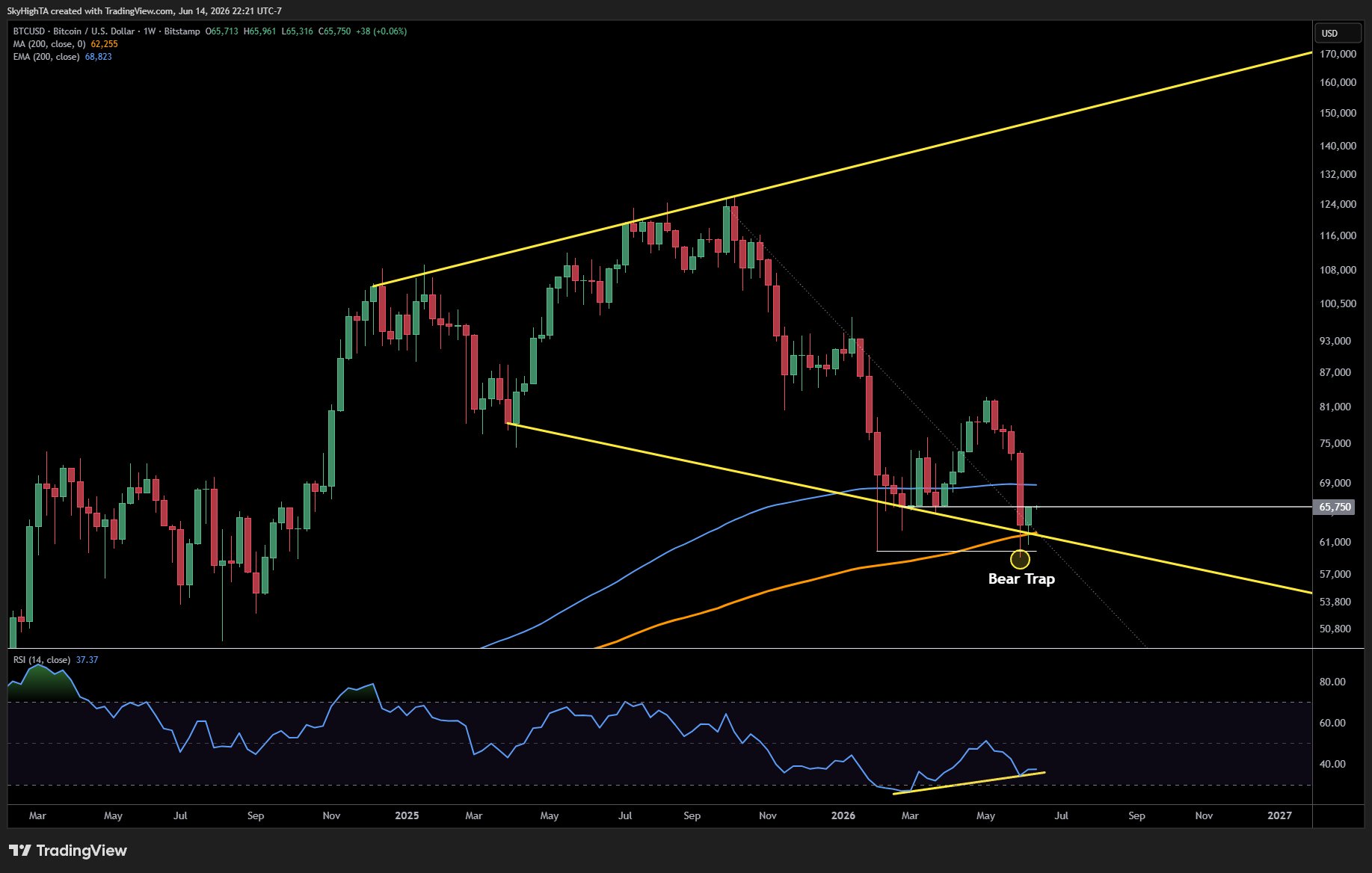
BTC/USD one-week chart. Source: SuperBro/X
Trader CrypNuevo also targeted the area just below $70,000 for the week ahead.
“Still expecting a recovery toward the mid-range $69k,” he wrote in his X analysis.
CrypNuevo cautioned that BTC/USD could still revisit recent lows as part of sideways trading.
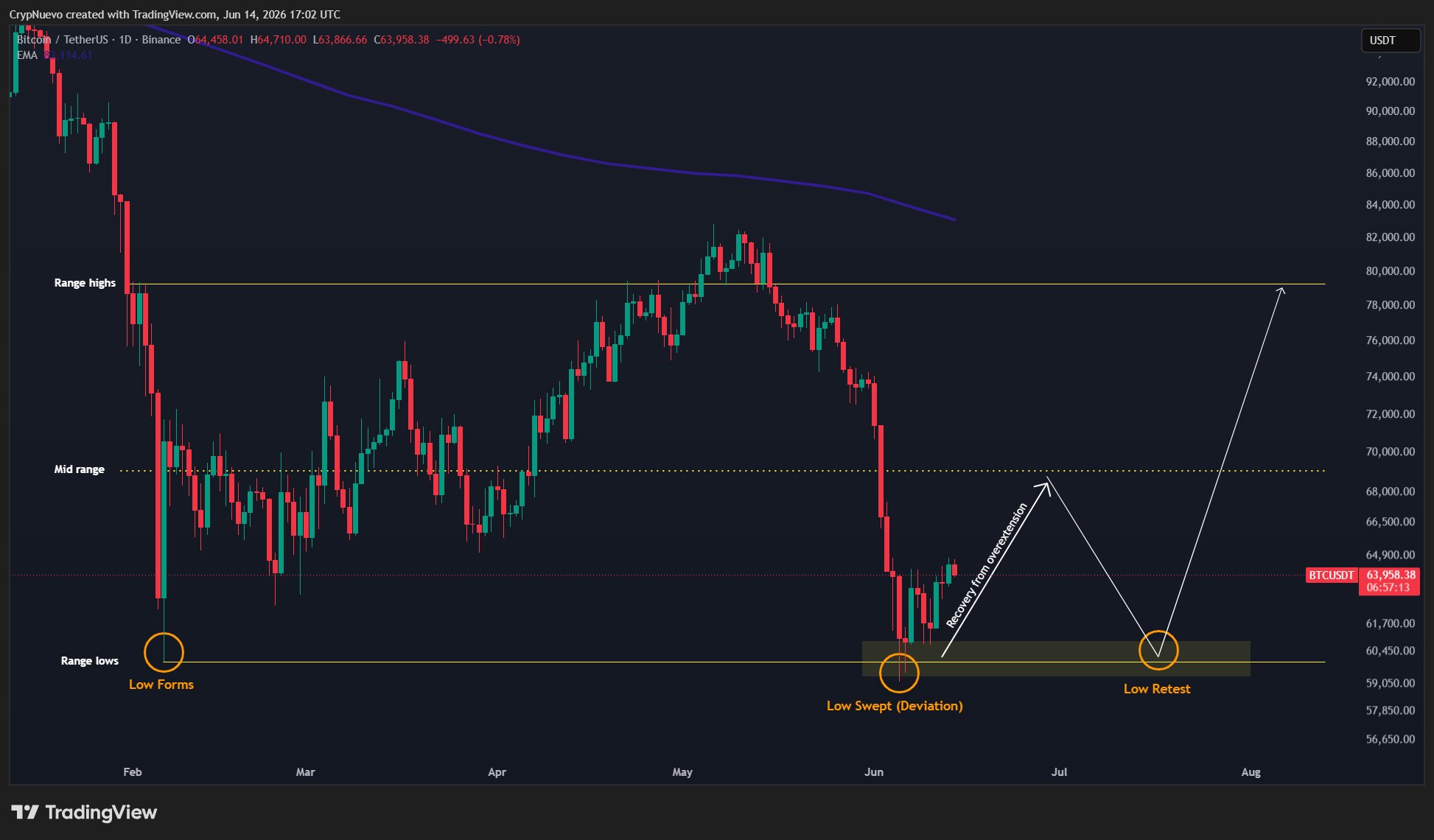
BTC/USDT one-day chart. Source: CrypNuevo/X
Trader and analyst Rekt Capital shared a similar view, emphasizing that price bounces typically weaken as bear markets mature, along with critical support — in this case the $60,000 level.
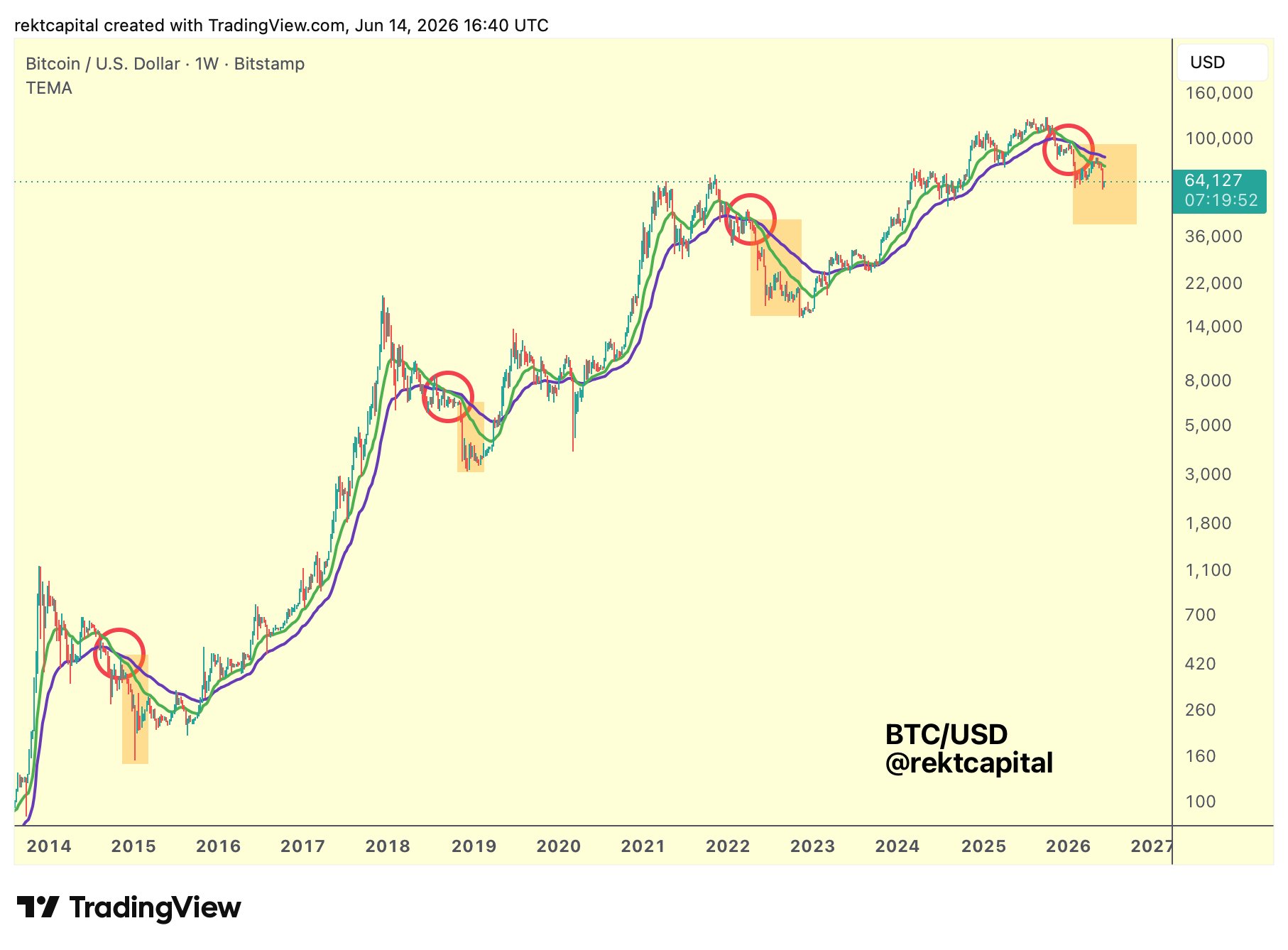
BTC/USD one-week chart. Source: Rekt Capital/X
New Fed chair faces pressure over rate cuts
Amid significant geopolitical uncertainty, market attention remains firmly fixed on the US Federal Reserve.
On Wednesday, the Fed’s new chair, Kevin Warsh, will preside over his first meeting on interest-rate policy.
Given the inflationary pressures stemming from the Iran conflict, markets see almost no chance of Warsh cutting rates — yet Trump has repeatedly demanded exactly that.
In an April interview, Trump told mainstream media he “would” be disappointed if Warsh failed to deliver a rate cut at his first opportunity.
“All eyes are on the Fed this week,” trading resource The Kobeissi Letter noted in its latest X analysis.
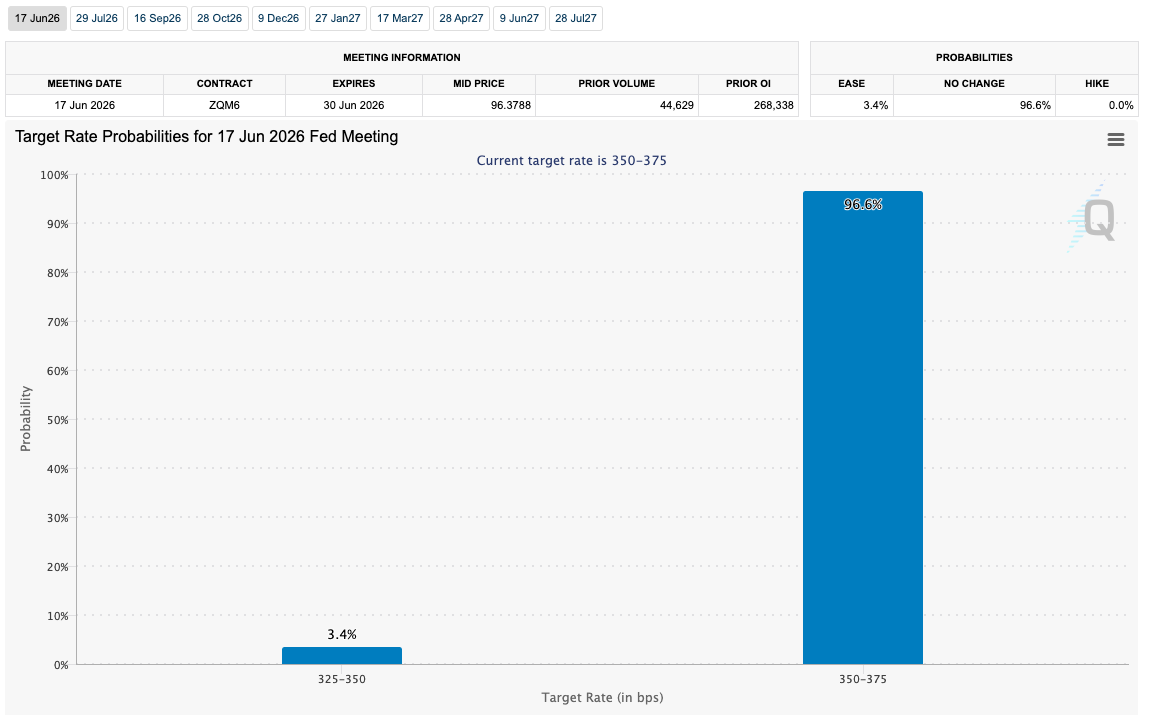
Fed target rate probabilities for Wednesday FOMC meeting (screenshot). Source: CME Group
The latest CME Group FedWatch Tool data shows just a 3.4% probability of a modest 0.25% rate cut.
Commentators widely expect rates to remain unchanged.
In Sunday analysis, Dayan described Warsh as “caught in a no-win situation.”
“If he takes a hawkish stance, he’ll be breaking promises made to Trump,” he wrote.
“OnOn the flip side, if he points to the recent drop in oil prices as justification for a wait-and-see approach, I believe he’s actually increasing the chances of a sudden, emergency rate hike later this year—driven by an overheating economy.
U.S. markets will operate on a shortened four-day schedule this week, with Wall Street shuttered on Friday in observance of the Juneteenth holiday.
Whales establish a “rock-solid floor”
In encouraging news for Bitcoin supporters, fresh analysis signals a major shift in behavior among large-scale investors in recent days.
According to onchain analytics firm CryptoQuant, Bitcoin whales have resumed buying.
By examining exchange deposits from whale wallets, CryptoQuant’s data reveals that coin days destroyed (CDD)—a metric tracking how long funds remained idle before being moved—have dropped sharply.
“Inflow CDD crashed from 2.16 million to nearly zero (33,000), indicating that long-term whale selling has fully halted,” wrote contributor Woo Minkyu in a Monday Quicktake blog post.
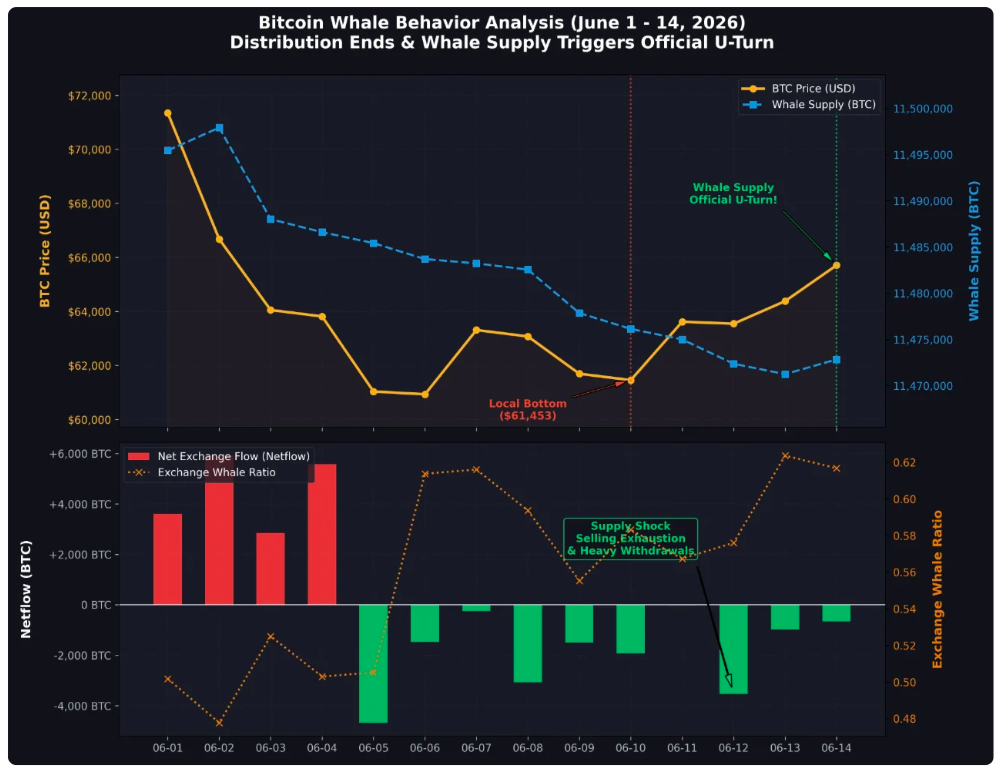
Bitcoin whale activity (screenshot). Source: CryptoQuant
Woo characterized the whales’ actions as an “aggressive bottom-buying spree” near $61,000, where they absorbed “all” the coins offloaded in panic by smaller or less committed investors.
“The transfer of wealth from weak hands to strong hands is now complete,” he concluded.
“Whales have cemented the $60,000–$61,500 zone as an unshakable floor. With exchange reserves drained, Bitcoin’s path of least resistance now points decisively upward.”
Earlier, Cointelegraph reported that three critical conditions for a BTC price recovery were nearly met. At the time, analysis noted that whales on platforms like Hyperliquid and Bitfinex were already positioning for a rebound.
Bitcoin’s apparent demand remains negative
Despite bullish whale activity, CryptoQuant urges caution regarding a full-scale market recovery, citing persistent onchain signals.
Related: Bitcoin miner ‘capitulation’ unfolds as trader predicts late-2026 bear-market bottom
Contributor XWIN Japan highlights that apparent demand—a key indicator—remains in negative territory, a pattern historically linked to bear markets.
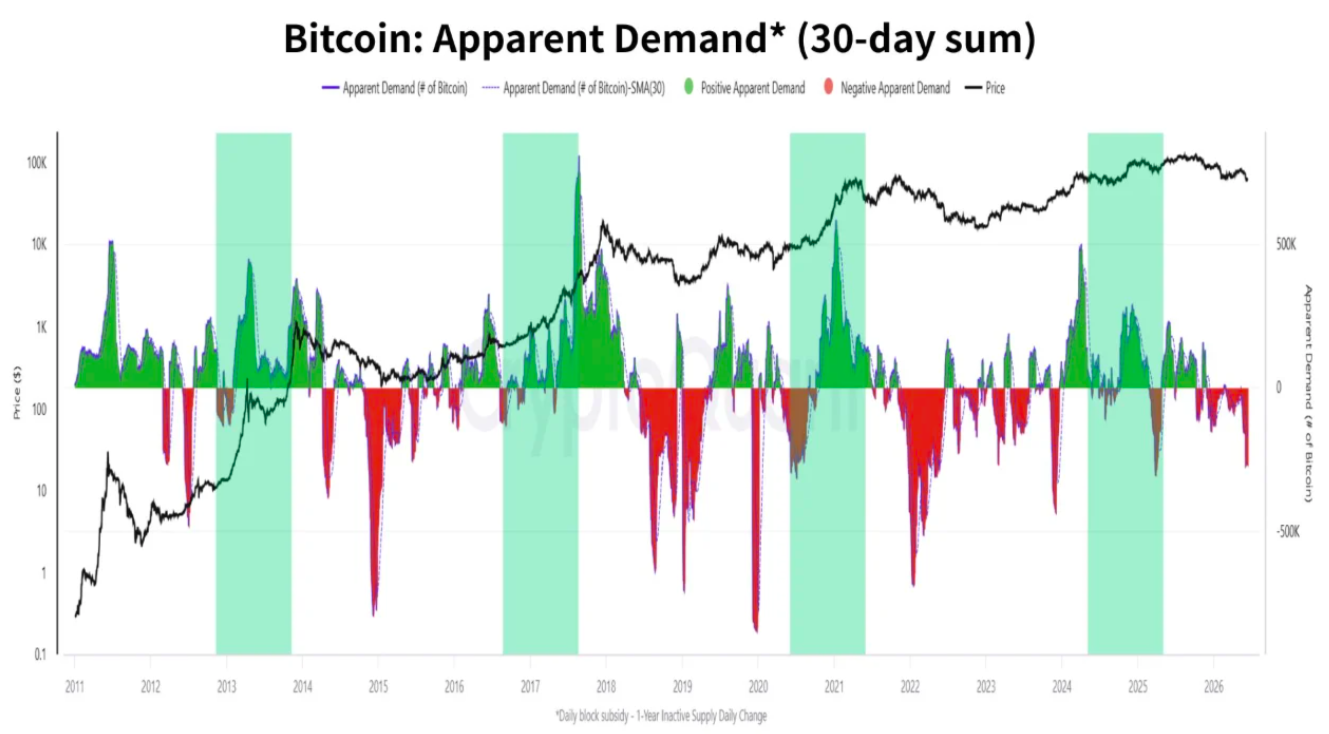
Bitcoin apparent demand (screenshot). Source: CryptoQuant
Apparent demand measures the gap between newly issued Bitcoin (from mining) and the portion of supply that hasn’t moved in over a year.
“If the reduction in dormant supply outpaces new production, demand is rising—and vice versa,” explains CryptoQuant’s head of research, Julio Moreno.
Given the current negative readings, XWIN argues this reflects broad disinterest in holding BTC and could even override traditional four-year cycle patterns in shaping future price trends.
“This implies Bitcoin’s decline isn’t just following a cyclical script. Rather, organic demand growth has stalled,” the firm noted over the weekend.
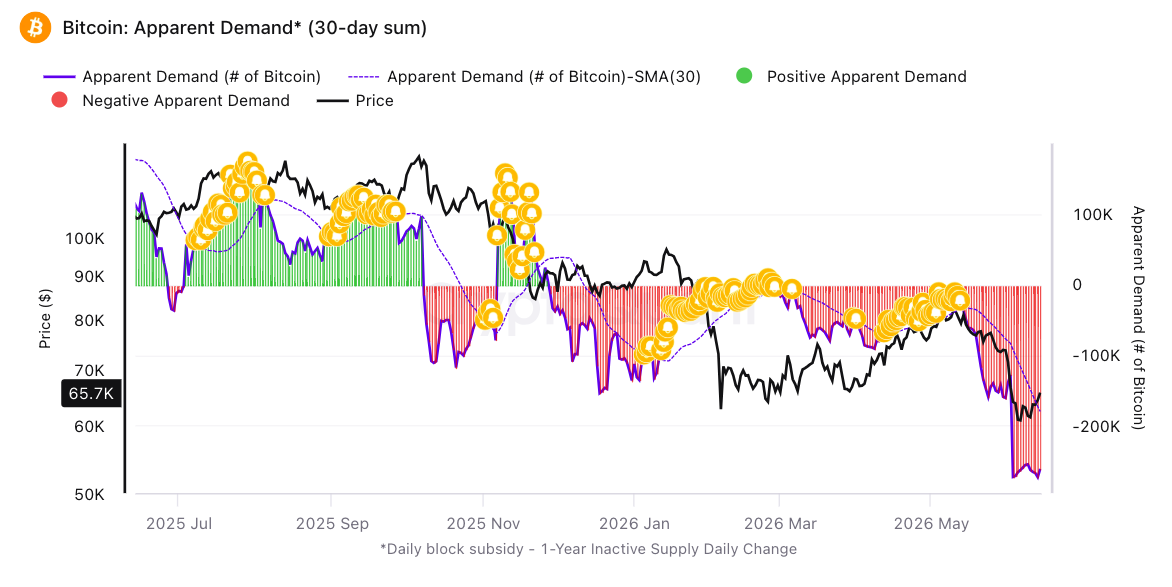
Bitcoin apparent demand (screenshot). Source: CryptoQuant
XWIN also flagged shrinking open interest in Bitcoin futures markets, while reiterating the possibility of a final “capitulation” event still ahead.
